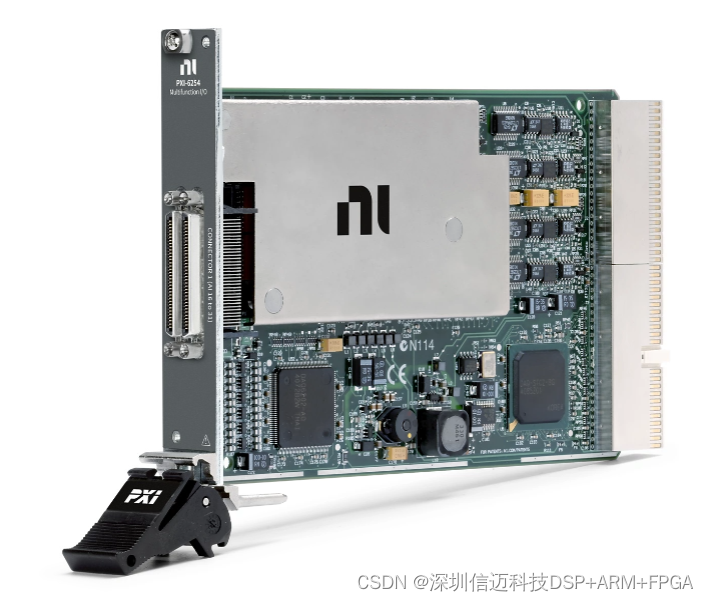
[NI Domestic Alternative] PXI-6254, 32 AI (16-bit, 1 MS/s), 48 DIO, PXI Multifunction I/O Module
The PXI-6254 is a workhorse PXI multifunction data acquisition module from National Instruments, widely deployed in automated test systems across industries ranging from semiconductor validation to aerospace manufacturing. As domestic Chinese alternatives to NI hardware continue to mature, the PXI-6254's feature set serves as an important benchmark — understanding what the original card does, and why those specifications matter, helps engineers evaluate equivalent domestic solutions with confidence.
What the PXI-6254 Delivers
At its core, the PXI-6254 is a multifunction I/O module built around four measurement pillars:
- 32 analog inputs (AI) at 16-bit resolution and up to 1 MS/s aggregate sample rate
- 48 digital I/O (DIO) lines, correlated with the analog subsystem for synchronized acquisition
- Two 32-bit counter/timer channels for frequency measurement, pulse generation, encoder decoding, and event counting
- Analog and digital triggering, enabling precise start-of-acquisition control from external signals
The 16-bit ADC resolution provides a theoretical dynamic range of roughly 96 dB — sufficient for most industrial sensor measurements, vibration analysis, and electrical characterization work. At 1 MS/s aggregate throughput across all channels, the board can sustain approximately 31.25 kS/s per channel when all 32 inputs are scanned in round-robin, or run fewer channels at proportionally higher per-channel rates.
Signal Conditioning Integration
Raw analog signals from thermocouples, strain gauges, accelerometers, or high-voltage test points require conditioning before they reach the ADC. The PXI-6254 supports two NI conditioning ecosystems:
- SCC (Signal Conditioning Components): compact, modular signal conditioning blocks that mount directly on an SC-2345 or SC-2350 carrier and attach to the DAQ device. Each SCC module targets a specific sensor type (thermocouple, RTD, IEPE accelerometer, 4–20 mA current loop, etc.).
- SCXI (Signal Conditioning eXtensions for Instrumentation): a rack-based multiplexing and conditioning platform capable of scaling a single DAQ card to hundreds of channels. SCXI modules handle amplification, filtering, isolation, and multiplexing upstream of the PXI-6254's analog inputs.
Both approaches allow the same PXI-6254 to serve fundamentally different applications — a bare board for voltage and TTL measurements in one rack, or a fully conditioned multi-thermocouple acquisition front-end in another — without changing the core DAQ hardware.
NI-DAQmx Driver Architecture
The PXI-6254 ships with NI-DAQmx, NI's unified driver that abstracts hardware-level register programming behind a task-based API. Key characteristics relevant to system integrators:
- Task-based model: AI, AO, DI, DO, and counter operations are configured as named tasks with channel collections, timing engines, and trigger specifications. This makes multi-device synchronization straightforward.
- Buffered and on-demand modes: single-point reads for slow control loops; hardware-timed buffered acquisition for continuous waveform capture.
- Trigger routing via RTSI/PXI backplane: the PXI-6254 can export or import its sample clock and trigger signals across the PXI star trigger and trigger bus lines, enabling tight multi-card synchronization without external cabling.
- Configuration utilities: NI MAX (Measurement & Automation Explorer) provides a GUI for device enumeration, channel calibration, self-test, and I/O panel verification — reducing bring-up time for new installations.
Application Fit
The PXI-6254 targets the cost-sensitive tier of automated test — a deliberate design point reflected in its 1 MS/s rate (versus the 1.25 MS/s or higher on premium NI cards) and shared-resource counter architecture. Typical deployment scenarios include:
- Laboratory automation: automated stimulus-response measurements on electronic assemblies, battery characterization, or component parametric testing.
- Design verification: capturing transient waveforms during power-on sequences, measuring settling time, or logging environmental sensor data during thermal cycling.
- Manufacturing test: high-mix, lower-volume production test fixtures where channel count and reliability matter more than extreme bandwidth.
- Research: general-purpose data logging in university or R&D labs where NI-DAQmx's broad language support (Python via
nidaqmx, LabVIEW, C, .NET) reduces integration effort.
Domestic Alternative Considerations
For Chinese system integrators seeking domestic alternatives to the PXI-6254 — driven by supply chain resilience, procurement policy, or cost targets — the specification checklist to match is clear:
| Parameter | PXI-6254 Baseline |
|---|---|
| Analog input channels | 32 single-ended / 16 differential |
| ADC resolution | 16-bit |
| Aggregate sample rate | 1 MS/s |
| Digital I/O | 48 lines, correlated |
| Counters/timers | 2 × 32-bit |
| Triggering | Analog + digital |
| Bus interface | PXI (PCI-based) |
| Driver ecosystem | NI-DAQmx compatible or equivalent API |
Domestic PXI DAQ vendors should be evaluated not only against raw specs but also against driver maturity, LabVIEW or Python SDK availability, and PXI chassis interoperability — areas where early domestic alternatives historically lagged but have improved significantly as the domestic instrumentation ecosystem has expanded.