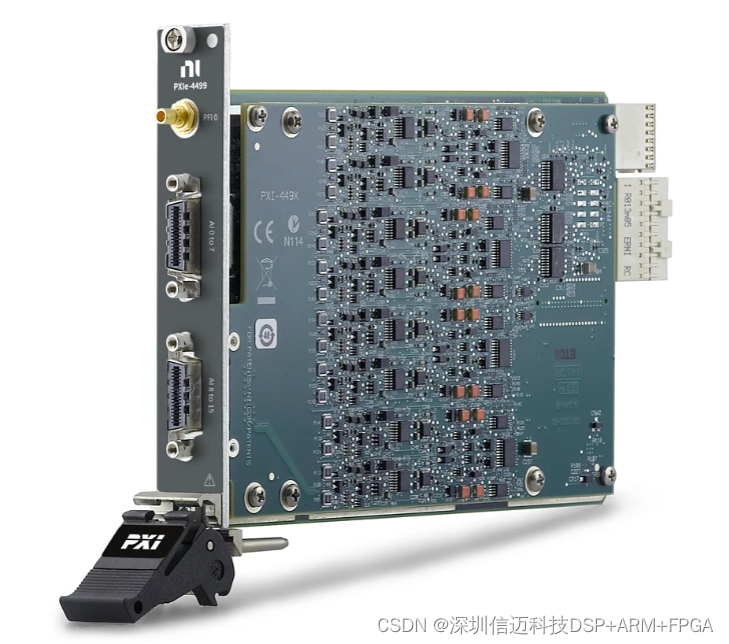
【NI Domestic Alternative】PXIe‑4499, 204.8 kS/s, 114 dB, Four Gain Ranges, AC/DC Coupling, 16-Input PXI Sound and Vibration Module
The PXIe-4499 is a high-channel-count PXI sound and vibration acquisition module from National Instruments, long regarded as a reference-class instrument for demanding acoustic and structural dynamics work. As Chinese industrial and defense sectors accelerate their push toward domestic alternatives to NI hardware, understanding exactly what the PXIe-4499 offers — and what any credible replacement must match — is an essential first step for engineering teams evaluating substitutes.
What the PXIe-4499 Is and Who Uses It
The PXIe-4499 slots into a PXI Express chassis and provides 16 simultaneously sampled analog input channels, each with 24-bit resolution and a maximum sample rate of 204.8 kS/s per channel. The 114 dB dynamic range figure is a key headline: it reflects the signal-to-noise and distortion performance achievable with the on-board delta-sigma ADC architecture, which makes the module competitive with laboratory-grade measurement amplifiers when configured correctly.
The module is purpose-built for environments where you need to capture fast-moving acoustic or vibrational phenomena across many sensors at once — wind tunnel testing, rotating machinery diagnostics, automotive pass-by noise certification, or large-aperture microphone array beamforming all depend on that combination of channel count, simultaneity, and dynamic range.
IEPE Signal Conditioning
One of the most practically important features of the PXIe-4499 is its integrated IEPE (Integrated Electronics Piezo-Electric) constant-current signal conditioning. IEPE sensors — including the overwhelming majority of industrial accelerometers and ICP-type microphones — require a bias current (typically 2–20 mA) supplied over the same coaxial cable that carries the signal back to the DAQ system. Without on-board IEPE conditioning, users must insert external signal conditioners between every sensor and the acquisition front-end, adding cost, cabling complexity, and potential noise pickup.
Having IEPE conditioning built into all 16 channels means the PXIe-4499 can connect directly to standard accelerometers and prepolarized condenser microphones, which is exactly the sensor ecosystem used in NVH (noise, vibration, and harshness) rigs and modal analysis setups.
AC/DC Coupling and Gain Ranges
The module supports both AC and DC coupling per channel. AC coupling blocks the DC bias component from sensors and is the default mode for vibration and acoustic work, preventing the large DC offset that IEPE biasing introduces from consuming ADC headroom. DC coupling is needed when measuring slowly varying signals or when absolute DC levels carry physical meaning — for example, strain-gauge-based load monitoring or very-low-frequency structural deflection.
The PXIe-4499 provides multiple software-selectable input gain ranges (the Chinese source notes four gain ranges in the title and six in the body — reflecting that the module can be configured across a span of sensitivity settings). This flexibility lets engineers match the front-end gain to the expected signal amplitude, preserving the full 24-bit dynamic range rather than wasting bits on headroom the signal never uses. Gain switching is handled entirely in software, so automated test sequences can adjust sensitivity between acquisitions without manual intervention.
Anti-Aliasing Filters
A 204.8 kS/s sample rate covers audio and low ultrasonic frequencies, but it creates an aliasing boundary at 102.4 kHz. The PXIe-4499 handles this with built-in anti-aliasing filters that automatically track the configured sample rate. When you reduce the sample rate — for example, to 51.2 kS/s for a measurement that only requires audio-band content — the filter cutoff adjusts accordingly, maintaining adequate attenuation at the new Nyquist frequency. This automatic tracking removes a common source of configuration error in multi-rate test sequences and eliminates the need for external switched-capacitor or analog filter banks.
TEDS Support
The module includes TEDS (Transducer Electronic Data Sheet) support. TEDS is an IEEE 1451.4 standard that stores sensor calibration data — sensitivity, serial number, calibration date — in a small memory chip embedded in the sensor connector. When a TEDS-compatible sensor is plugged in, the acquisition system can read this data automatically and apply the correct scaling without requiring the operator to look up and enter calibration coefficients manually. For test environments cycling through many sensors, TEDS dramatically reduces setup errors and audit trail complexity.
Simultaneous Sampling Across All Channels
All 16 channels sample simultaneously, with no channel-to-channel phase skew introduced by multiplexing. This is non-negotiable for applications that depend on cross-spectral analysis — beamforming, transfer function measurement, operational modal analysis, and acoustic holography all require that the phase relationship between channels is preserved. A multiplexed front-end introduces a fixed inter-channel delay that, even if corrected in software, degrades coherence at higher frequencies.
Typical Application Areas
NVH Analysis: Automotive and powertrain manufacturers use modules like the PXIe-4499 to characterize interior cabin noise, measure component vibration signatures, and meet regulatory pass-by noise requirements. The combination of high channel count and wide dynamic range lets a single chassis capture everything from structural resonances at tens of hertz to high-frequency bearing defect signatures approaching 100 kHz.
Large Microphone Arrays: Aeroacoustic research and architectural acoustics applications deploy dozens to hundreds of microphones simultaneously. Multiple PXIe-4499 modules in a synchronized chassis can scale to these channel counts while maintaining the phase coherence required for delay-and-sum or high-resolution beamforming algorithms.
Dynamic Structural Testing: Modal testing, ground vibration testing of aerospace structures, and seismic qualification of equipment all involve exciting a structure and simultaneously measuring the response at many points. The 24-bit resolution and simultaneous sampling make the PXIe-4499 well suited to capturing both the drive signal and the response channels without losing the low-amplitude structural modes buried beneath the noise floor.
Evaluating Domestic Alternatives
For engineering teams required to replace NI PXIe-4499 hardware with domestically sourced alternatives, the critical checklist should include: 24-bit ADC resolution per channel; simultaneous sampling architecture (not multiplexed); per-channel IEPE constant-current excitation; software-controllable gain and coupling; automatically adjusting anti-aliasing filters; a maximum sample rate at or above 204.8 kS/s; dynamic range at or near 114 dB; PXI Express electrical and mechanical compliance; and driver compatibility with common test software environments. Any module that compromises on simultaneity or dynamic range will produce results that are not directly comparable to data collected with the original NI hardware, which matters significantly when test specifications or certification standards were written with NI equipment as the reference.