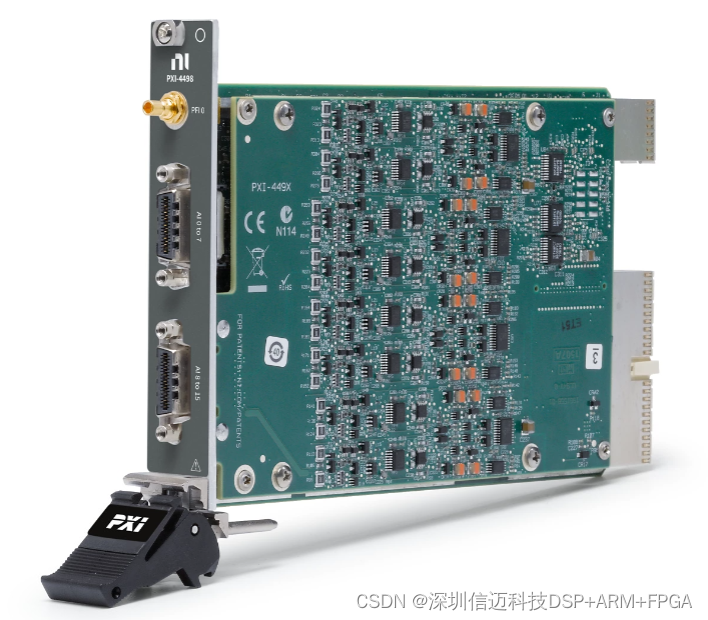
[NI Domestic Alternative] PXI-4498, 204.8 kS/s, 114 dB, 4 Gain Options, 0.5 Hz AC Coupling, 16-Input PXI Sound and Vibration Module
The PXI-4498 is a 16-input PXI sound and vibration module from National Instruments, purpose-built for high-channel-count acoustic and structural dynamics measurements. This post covers the module's key specifications, signal conditioning architecture, and the industrial test scenarios where it delivers value — along with guidance for engineers evaluating domestic Chinese alternatives for NI PXI hardware.
Why High-Channel-Count Sound and Vibration Acquisition Is Hard
Capturing sound and vibration data across many channels simultaneously imposes requirements that general-purpose data acquisition hardware struggles to meet. Sensors like ICP/IEPE accelerometers and condenser microphones produce low-level signals that demand high dynamic range, very low noise floors, and phase-coherent sampling across every channel. A single-sample skew between channels corrupts coherence functions and cross-spectral density estimates — the foundation of noise source identification and modal analysis. The PXI-4498 addresses these constraints with a tightly integrated architecture.
Core Specifications at a Glance
| Parameter | Value |
|---|---|
| Input channels | 16 (simultaneous) |
| Sample rate | Up to 204.8 kS/s per channel |
| Resolution | 24-bit |
| Dynamic range | 114 dB |
| AC coupling cutoff | 0.5 Hz |
| Input gain options | 4 software-selectable steps (up to 30 dB) |
| Signal conditioning | IEPE constant-current excitation |
| Smart sensor support | TEDS (IEEE 1451.4) |
The 204.8 kS/s maximum sample rate provides usable bandwidth to roughly 80 kHz after the anti-aliasing filter rolls off, which covers the full audible spectrum and extends into the ultrasonic range relevant for some structural resonance and bearing fault applications.
24-Bit Resolution and the 114 dB Dynamic Range
Dynamic range in a data acquisition system is determined by the ADC resolution, input noise, and the analog front-end design. With 24-bit converters, the theoretical maximum SNR is approximately 144 dB; achieving 114 dB in practice reflects a carefully designed analog chain that minimizes thermal noise, power supply coupling, and crosstalk between the 16 channels. For NVH work, 114 dB of dynamic range means a single acquisition can capture both the loud fundamental tones of an engine and the faint structure-borne harmonics that indicate early bearing wear — without range switching or separate measurement passes.
The 0.5 Hz AC coupling cutoff is particularly significant. Standard AC-coupled inputs typically cut off at 1–10 Hz, which rolls off the very low-frequency content relevant to whole-body vibration standards (ISO 2631) and low-speed rotating machinery. The 0.5 Hz corner preserves these components while still blocking DC offsets that would otherwise consume ADC headroom.
IEPE Signal Conditioning
The IEPE (Integrated Electronics Piezo-Electric) standard — also marketed as ICP by PCB Piezotronics — powers the internal electronics of piezoelectric sensors over the same two-wire coaxial cable that carries the signal. The PXI-4498 provides the constant-current excitation (typically 2–20 mA at 18–28 V compliance) required to bias these sensors. This eliminates the need for separate signal conditioners or charge amplifiers in front of the digitizer, which simplifies cabling and reduces noise pickup in industrial environments.
Accelerometers and microphones with IEPE outputs cover the vast majority of sensors used in automotive NVH, aerospace structural testing, and industrial machinery monitoring, making the built-in conditioning practically universal for these applications.
Software-Selectable Gain and Anti-Aliasing Filters
Four gain settings with a maximum of 30 dB of software-selectable boost let engineers optimize the input range for each sensor type and measurement level without hardware reconfiguration. A calibrated accelerometer producing 100 mV/g measuring a 0.01 g structural resonance will benefit from gain boost; the same channel measuring a 50 g shock event will run at unity gain. The ability to set gain per channel in software is essential when a mixed sensor array is connected to a single module.
The built-in anti-aliasing filters adapt automatically to the configured sample rate. This is an important detail: a fixed-frequency anti-aliasing filter designed for 204.8 kS/s operation would be nearly transparent at lower sample rates, allowing aliasing artifacts to fold into the passband. By scaling the filter corner with the sample rate, the PXI-4498 maintains valid Nyquist compliance regardless of which sample rate the application selects.
TEDS Smart Sensor Support
TEDS (Transducer Electronic Data Sheet, IEEE 1451.4) embeds calibration and identification data in a small memory chip inside the sensor connector. When a TEDS-compliant sensor is connected, the acquisition system reads sensitivity, calibration date, serial number, and measurement range automatically. In a 16-channel system with multiple sensor types, manual entry of calibration coefficients is error-prone and time-consuming; TEDS eliminates that risk and provides a complete calibration audit trail traceable back to each individual transducer.
Typical Applications
NVH Analysis (Noise, Vibration, and Harshness): Automotive and powertrain testing relies on NVH analysis to characterize how structure-borne and airborne noise propagates through a vehicle. The combination of high channel count, simultaneous sampling, and 114 dB dynamic range makes the PXI-4498 a natural fit for multi-point transfer path analysis (TPA) and operational modal analysis (OMA) on running engines, transmissions, and chassis.
Large Microphone Arrays: Acoustic beamforming and near-field acoustic holography require dozens of microphones sampled simultaneously with sub-sample phase accuracy. The PXI-4498's synchronous 16-channel architecture, combined with PXI trigger and clock lines for multi-module synchronization, supports arrays that scale into the hundreds of channels by daisy-chaining modules on a common 10 MHz reference.
Dynamic Structural Testing: Modal surveys on aerospace structures, civil engineering components, and precision machinery use impact hammers and shakers to excite resonances while accelerometers record the response. Phase accuracy between the force input channel and the response channels is critical for extracting accurate frequency response functions (FRFs); simultaneous sampling eliminates the phase uncertainty introduced by multiplexed architectures.
Domestic Alternative Considerations
For engineering teams in China seeking PXI-4498-equivalent hardware, the key specifications to match are simultaneous sampling across all 16 channels, 24-bit resolution with genuine 114 dB dynamic range (not just ADC bit depth), IEPE constant-current conditioning, TEDS support, and a software-adjustable anti-aliasing filter. Several domestic DAQ vendors now offer PXI sound and vibration modules targeting these NI product lines; verifying the actual noise floor and channel-to-channel phase skew through independent bench measurement — rather than relying solely on datasheet claims — is the recommended qualification step before committing these modules to production test systems.