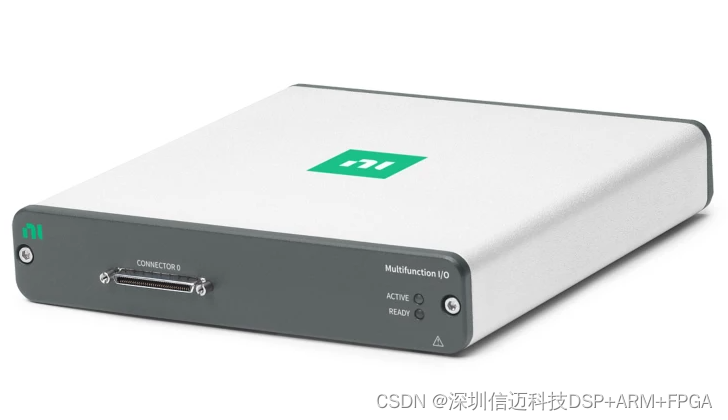
【NI Domestic Alternative】USB-6366, 8-Channel AI (16-bit, 2 MS/s), 2-Channel AO (3.33 MS/s), 24-Channel DIO, USB Multifunction I/O Device
A Drop-In Domestic Alternative to the NI USB-6366 Multifunction DAQ Device
For test engineers and system integrators who have built workflows around National Instruments' USB-6366, sourcing a domestic Chinese alternative has historically meant compromising on either performance or software compatibility. The USB-6366 occupies a well-defined niche: simultaneous-sampling, high-throughput analog acquisition with enough digital and counter resources to handle real control loops and automated test sequences in a single USB-connected module. This post walks through the key technical capabilities of the USB-6366 architecture and explains what to look for when evaluating a domestic substitute.
What Makes the USB-6366 Distinctive
Not all DAQ devices sample their analog input channels simultaneously. Many lower-cost designs use a single ADC with a multiplexer, sequencing through channels one at a time. The USB-6366 uses simultaneous sampling, meaning every analog input channel is digitized at exactly the same instant. This matters whenever you are correlating signals across channels — vibration analysis, phase-difference measurement, multi-axis torque/force monitoring, or any application where a few microseconds of skew between channels would introduce measurement error.
The headline specifications set the performance envelope:
- 8 analog input channels, 16-bit resolution, up to 2 MS/s aggregate (simultaneous across all channels, not per-channel multiplexed)
- 2 analog output channels at up to 3.33 MS/s, suitable for waveform generation, stimulus/response testing, and closed-loop control
- 24 digital I/O lines, programmable as input or output, supporting both static and clocked (hardware-timed) transfers
- Four 32-bit counter/timers with flexible routing for PWM generation, quadrature encoder decoding, frequency measurement, period measurement, and edge counting
The 16-bit ADC resolution gives a theoretical dynamic range of roughly 96 dB, which translates to roughly 0.0015% full-scale resolution — sufficient for most precision industrial measurements without requiring external signal conditioning.
The NI-STC3 Timing Core
The onboard NI-STC3 (System Timing Controller, generation 3) is the architectural element that separates the USB-6366 from simpler USB DAQ modules. NI-STC3 implements:
- Independent analog and digital timing engines. The analog acquisition clock and the digital I/O clock are derived from separate, independently configurable counters. This allows, for example, running a 1 MS/s analog acquisition sweep while simultaneously clocking a digital pattern at a different rate, without either task influencing the other's timing.
- Retriggerable measurement tasks. A hardware trigger can restart a finite acquisition or generation task without CPU intervention. This is essential in automated test equipment (ATE) setups where the device under test asserts a trigger line for each unit, and the host PC must not introduce latency between units.
- Hardware synchronization between tasks. Analog input, analog output, counter, and digital tasks can share a common sample clock or start trigger, maintaining deterministic phase relationships without relying on software scheduling.
For engineers migrating from simpler streaming DAQ setups, this level of timing flexibility can initially seem over-specified. In practice it pays off when requirements evolve: a data-logging application that later needs synchronized stimulus generation, or a control loop that requires hardware-timed digital outputs locked to the analog acquisition frame, can be accommodated within the same hardware without redesign.
Analog Output at 3.33 MS/s
The two analog output channels at 3.33 MS/s are fast enough to reconstruct signals well into the audio and ultrasonic range. Common uses include:
- Functional test stimulus — driving a known waveform into a circuit under test while simultaneously capturing the response on the analog inputs
- Arbitrary waveform generation — uploading a waveform buffer from the host and replaying it on a hardware clock, independent of host CPU scheduling jitter
- Closed-loop control — reading a sensor on an AI channel and computing a correction value to write to an AO channel, with the loop rate bounded by hardware timing rather than OS scheduler latency
Because AO and AI share the NI-STC3 timing fabric, the output waveform can be phase-locked to the input acquisition frame, which is a requirement for lock-in amplifier emulation and synchronous detection schemes.
Counter/Timer Applications
The four 32-bit counter/timers connect to the device's internal routing matrix, allowing their inputs and outputs to be mapped to any of the digital I/O lines. Supported measurement modes include:
- PWM generation with configurable frequency and duty cycle
- Quadrature encoder decoding (X1, X2, X4 encoding) for position feedback from incremental encoders
- Frequency and period measurement using either a direct-count or a reciprocal method, the latter giving better resolution at low frequencies
- Edge counting and buffered event counting, where each edge increments a 32-bit register that can be read on demand or sampled into a buffer on a clock
This counter flexibility means the USB-6366 can replace several single-function instruments in a test rack — a PWM source, an encoder interface card, and a frequency counter — within a single device.
Software Ecosystem: NI-DAQmx
The USB-6366 ships with the NI-DAQmx driver, which provides a hardware-abstraction API available in C/C++, Python (nidaqmx package), LabVIEW, LabWindows/CVI, and .NET. The DAQmx programming model is task-based: you create a task, add channels, configure timing and triggering, and then start/read/write/stop. This abstraction insulates application code from hardware register details and makes it straightforward to swap one NI device for another without rewriting measurement logic.
The included NI MAX (Measurement & Automation Explorer) configuration utility allows channel calibration, self-test, and I/O verification without writing any code — useful during incoming inspection and system integration.
Evaluating a Domestic Alternative
When assessing a domestic (Chinese-manufactured) substitute for the USB-6366, the NI-DAQmx software layer is often the hardest requirement to satisfy. Hardware specifications can be matched or exceeded, but application code written against the DAQmx API expects specific behavior:
- Simultaneous sampling architecture — a multiplexed design cannot emulate true simultaneity in software
- Hardware-timed tasks — the substitute must support sample-clock and trigger routing at the hardware level, not polled in firmware
- DAQmx API compatibility — either a native DAQmx-compatible driver or a shim layer that maps DAQmx calls to the device's own API
- Calibration traceability — 16-bit accuracy requires factory calibration with NIST-traceable references and a mechanism to store calibration coefficients on the device
Domestic alternatives in this class typically come from manufacturers such as Sienovo and others who have developed USB multifunction DAQ modules targeting the NI replacement market. Key questions to ask a vendor: what is the simultaneous sampling architecture (dedicated ADC per channel vs. sample-and-hold with shared ADC), what is the input voltage noise floor (in µV RMS or nV/√Hz), and does the driver expose hardware trigger and sample-clock routing to the application layer.
Typical Application Domains
The USB-6366's combination of fast simultaneous AI, high-rate AO, flexible DIO, and hardware counters makes it well-suited for:
- Vibration and acoustic analysis — multi-channel simultaneous acquisition preserves phase relationships between sensors
- Power electronics test — synchronized current and voltage acquisition for efficiency and harmonic analysis
- Automated functional test (ATE) — stimulus/response with hardware triggering for high-throughput production testing
- Motion control research — encoder feedback via counters combined with AO-driven motor commands
- Industrial data logging — robust USB connectivity with hardware-buffered acquisition that tolerates host CPU load spikes
The USB form factor and bus-powered operation (no external power supply required for most configurations) lower the barrier to deployment in field test systems and portable rigs where rack space and AC outlets are limited.