[NI Domestic Alternative] PXIe‑4492, 204.8 kS/s, 113 dB, Two Gain Ranges, 0.5 Hz AC/DC Coupling, 8-Input PXI Sound and Vibration Module
A Domestic PXI Alternative for High-Fidelity Sound and Vibration Measurement
For test engineers running noise, vibration, and harshness (NVH) programs or large-scale acoustic measurement campaigns, the NI PXIe-4492 has long been a go-to reference for high-dynamic-range data acquisition inside a PXI chassis. This post introduces a domestically produced alternative module that matches the PXIe-4492's headline specifications — 204.8 kS/s sample rate, 113 dB dynamic range, 24-bit resolution, and 8 simultaneous IEPE-conditioned inputs — and explains what those figures mean in practice and where this class of hardware fits in a real measurement chain.
What the PXIe Platform Offers for Acoustics and Vibration
PXI (PCI eXtensions for Instrumentation) is a rugged, modular instrument platform built on the PCI/PCIe bus standard. A PXIe chassis provides a shared 10 MHz reference clock and trigger backplane that lets multiple modules synchronize acquisitions to sub-nanosecond precision without external cabling. For multi-channel vibration testing — think modal analysis on a turbine casing with 64 accelerometers — that synchronized trigger fabric is essential: phase relationships between channels must be preserved, or the modal extraction math falls apart.
The PXIe-4492 form factor slots into any PXIe-compatible chassis and draws its power and timing from the chassis backplane, keeping the cabling to the sensor array clean.
Key Specifications and Why They Matter
24-bit resolution and 113 dB dynamic range. A 24-bit ADC provides a theoretical noise floor around 144 dB below full scale. Real-world dynamic range of 113 dB accounts for front-end noise, anti-aliasing filter insertion loss, and thermal noise in the analog conditioning chain. For acoustic work, 113 dB of usable range means the module can simultaneously capture a barely audible 20 dB SPL background hiss and a 130+ dB near-field engine noise event in the same acquisition window without saturation or bit-crushing the quiet signal. This is critical in NVH work where you need to characterize both the dominant tonal components and the broadband noise floor in a single pass.
204.8 kS/s per channel, simultaneous sampling. Audio-band vibration analysis typically demands coverage to at least 80 kHz to capture high-frequency structural modes and ultrasonic emissions. At 204.8 kS/s, the Nyquist limit sits at 102.4 kHz, which comfortably covers that range. Crucially, simultaneous sampling means all 8 channels are digitized at the exact same instant — there is no multiplexed skew between channels. This preserves phase coherence across the sensor array, which matters enormously when computing transfer functions or cross-power spectra between an excitation force and a structural response point.
Two gain ranges. The module exposes two primary hardware gain ranges (the Chinese source notes six software-selectable input gain ranges), allowing the input span to be matched to the sensor's output level. A ±10 V range suits high-output piezoelectric accelerometers wired directly; a lower-gain range maximizes resolution for low-amplitude microphone signals. Selecting the wrong gain range wastes bits: a ±10 V ADC digitizing a 10 mV signal uses only the bottom 0.1% of its range, effectively throwing away 10 bits of resolution.
0.5 Hz AC/DC coupling. The 0.5 Hz lower cutoff in AC-coupled mode is low enough to capture infrasound and very-low-frequency structural resonances (bridge deck sway, large rotating machinery imbalance) while still blocking DC offsets that would otherwise clip the ADC. DC coupling mode passes the full signal down to 0 Hz, which is needed when digitizing quasi-static signals from strain gauges or DC-output accelerometers.
IEPE Signal Conditioning
IEPE (Integrated Electronics Piezo-Electric) is the generic name for the constant-current excitation standard that ICP®, DeltaTron, and similar sensor families rely on. An IEPE sensor integrates a FET-input buffer amplifier inside the sensor housing, powered by a 2–20 mA constant current supplied through the coaxial signal cable. The module's built-in IEPE conditioning sources this current (typically 4 mA) per channel, removing the need for an external signal conditioner or in-line coupler box. In a large microphone array, eliminating eight external coupler boxes per module meaningfully reduces rack space, cable count, and failure points.
The constant-current source also acts as a bias supply for prepolarized (externally polarized) condenser microphone capsules, which is one reason this module class appears in large array beamforming setups.
Built-in Anti-Aliasing Filters
Hard-to-notice aliasing artifacts are a persistent source of measurement errors in digitized vibration data. The module's anti-aliasing filters track the programmed sample rate automatically: lower the sample rate and the filter's cutoff frequency steps down proportionally, maintaining a consistent ratio between the passband edge and the Nyquist frequency. This behavior prevents the common mistake of setting a low sample rate for a slow sweep while forgetting to tighten the anti-aliasing filter, which would allow high-frequency content to fold back into the passband as apparent low-frequency energy.
TEDS Smart Sensor Support
TEDS (Transducer Electronic Data Sheet, IEEE 1451.4) stores calibration and identification data in a small memory chip embedded in the sensor connector. When a TEDS-enabled sensor is plugged in, the module reads back the sensor's sensitivity, serial number, calibration date, and measurement range automatically. In a 64-channel modal test rig where accelerometers are frequently swapped, TEDS eliminates manual sensitivity entry and the test-corrupting mistakes that come with it — a miskeyed sensitivity of 10.2 mV/g vs. 102 mV/g produces a 20 dB error invisible to the acquisition software unless TEDS catches it at connection time.
Typical Application Scenarios
NVH analysis. Automotive and powertrain NVH programs use this class of hardware to acquire simultaneous sound pressure (microphones) and structural acceleration (accelerometers) data across a vehicle or drivetrain. The high dynamic range handles the full operating envelope from idle to wide-open-throttle in a single configuration.
Large microphone arrays. Acoustic beamforming and near-field acoustic holography require phase-coherent data from dense arrays of microphones — sometimes 64 to 256 channels spread across a surface or volume. Simultaneous sampling with a shared PXI backplane trigger allows multiple modules to be phase-locked across the full array.
Dynamic structural testing (modal analysis). Experimental modal analysis measures a structure's natural frequencies, damping ratios, and mode shapes by measuring the ratio of structural response to a known excitation (impact hammer or electrodynamic shaker). The 113 dB dynamic range accommodates the wide variation in response amplitude near resonance vs. anti-resonance, and the simultaneous sampling preserves the phase of each response channel relative to the reference force signal.
Domestic Alternative Positioning
As supply-chain diversification becomes a priority in industrial and defense test programs, domestically produced PXI DAQ modules with equivalent specifications to established NI hardware reduce single-source dependency without requiring changes to the PXI chassis infrastructure, cabling, or measurement workflows. A module with the same pinout, sample rate, resolution, and IEPE conditioning parameters as the PXIe-4492 can slot into existing test stands with driver-level adaptation rather than a full system redesign.
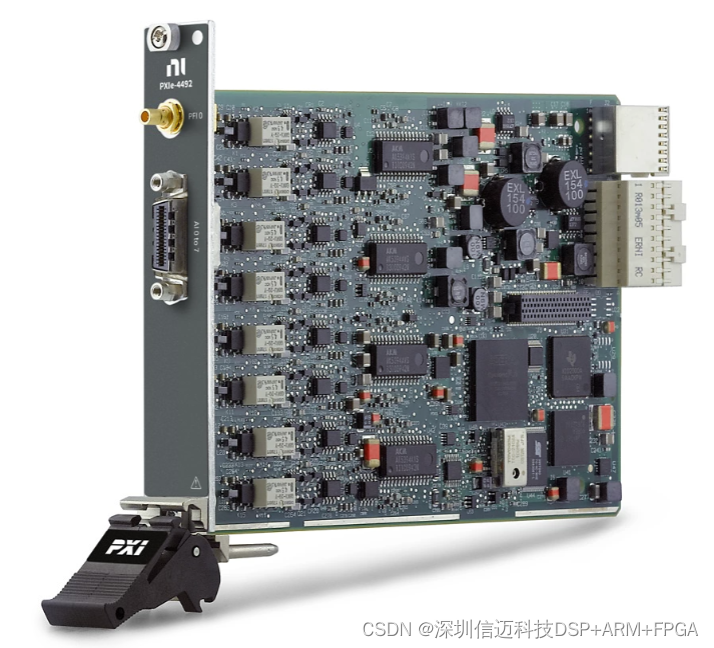
For teams evaluating alternatives to NI's sound and vibration lineup, the combination of 24-bit resolution, 113 dB dynamic range, simultaneous 8-channel IEPE acquisition at 204.8 kS/s, automatic anti-aliasing, and TEDS support covers the vast majority of industrial acoustic and structural test requirements without compromise on measurement quality.