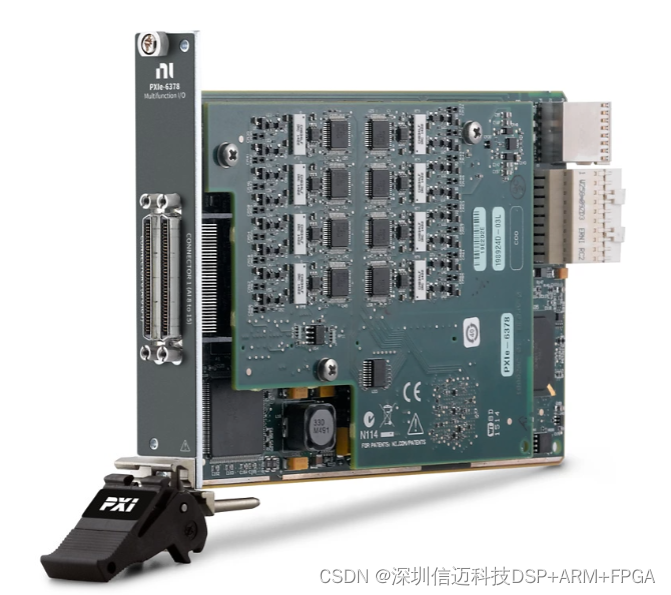
[NI Domestic Alternative] PXIe‑6378, 16-Channel AI (16-bit, 3.5 MS/s/ch), 4-Channel AO, 48-Channel DIO, PXI Multifunction I/O Module
The domestic Chinese market has seen strong growth in high-performance data acquisition alternatives to National Instruments hardware, driven by supply-chain resilience requirements and cost pressures in industries ranging from telecommunications to defense. One notable entry in this space is a PXIe multifunction I/O module that mirrors the specification of the NI PXIe-6378 — offering engineers a drop-in compatible path without sacrificing measurement fidelity.
Module Overview and Core Specifications
The module is a synchronously sampled multifunction DAQ device built around the PXIe (PCI Express-based PXI Express) form factor, which is the high-bandwidth evolution of the original Compact PCI-based PXI standard. PXIe slots provide dedicated point-to-point PCIe lanes to each instrument slot, eliminating the shared-bus bandwidth contention that limits parallel high-speed acquisition in legacy PXI chassis.
Key electrical specifications at a glance:
| Parameter | Value |
|---|---|
| Analog input channels | 16 (simultaneous/synchronous sampling) |
| AI resolution | 16-bit |
| AI sample rate | 3.5 MS/s per channel |
| Analog output channels | 4 |
| Digital I/O lines | 48 |
| Counters/timers | 4 × 32-bit |
| Triggering | Analog and digital |
The 3.5 MS/s per-channel rate with all 16 channels active simultaneously places this device firmly in the intermediate-frequency (IF) digitization tier — fast enough to capture the baseband and IF stages of most modern communication and radar systems without undersampling artifacts, yet within the power and cost envelope of a single PXIe slot.
Synchronous Sampling Architecture
A critical distinction for multi-channel precision measurement is whether channels are sampled simultaneously or multiplexed through a single ADC. Multiplexed architectures introduce a channel-to-channel phase skew proportional to the inter-channel sampling interval, which corrupts phase-sensitive measurements such as impedance analysis, beamforming delay calculations, and coherent signal averaging.
This module uses synchronous (simultaneous) sampling across all 16 analog input channels, meaning each channel has a dedicated sample-and-hold circuit that captures all inputs at exactly the same instant. For applications like ultrasonic phased-array inspection or ISDN line testing where inter-channel timing relationships carry physical meaning, this architecture is non-negotiable.
NI-STC3 Timing and Synchronization Engine
Onboard NI-STC3 (System Timing Controller 3) technology manages timing and synchronization functions. The STC3 provides two independent timing engines — one for analog I/O and one for digital I/O — which allows analog acquisition and digital pattern generation or capture to run concurrently on independent clocks without competing for timing resources.
The independent engines enable use cases such as simultaneously streaming digitized IF signals on the analog channels while capturing a synchronization or framing signal on the digital lines, with each subsystem clocked and triggered separately. The STC3 also supports retriggerable measurement tasks, where a single armed acquisition restarts automatically on each trigger edge rather than requiring the host to re-arm after every burst. This matters in production test environments where stimulating a device-under-test and capturing its response must repeat hundreds or thousands of times per second with minimal host CPU involvement.
Target Applications
IF Digitization and Communications Manufacturing Test At 3.5 MS/s with 16-bit dynamic range, the module can digitize IF signals in the hundreds-of-kilohertz to low-megahertz range for ISDN (144 kbps basic rate, 2.048 Mbps primary rate), ADSL (up to ~2.2 MHz downstream bandwidth), and POTS (300 Hz – 3.4 kHz voice band) manufacturing conformance testing. Production lines for DSL modems and ISDN terminal adapters have traditionally relied on NI PXI platforms; this domestic alternative allows test engineers to replicate those rigs with identical DAQmx API calls.
Transient Recording High-speed simultaneous sampling on 16 channels is well-suited to capturing single-shot or infrequently repeating events — power transients, electrostatic discharge waveforms, or mechanical shock signals — where the event cannot be repeated to allow sequential per-channel capture. Retriggerable task support means the system can arm, capture, disarm, and re-arm in tight loops without host intervention.
Ultrasonic and Sonar Testing Ultrasonic non-destructive testing (NDT) and sonar echo processing require coherent multi-channel capture with precisely known inter-channel phase relationships. The synchronous sampling architecture and the STC3's ability to synchronize acquisition with an external transmit pulse make this module suitable for both pulse-echo and phased-array ultrasonic inspection systems.
High-Energy Physics Detector readout chains in particle physics experiments often require many simultaneous analog channels with high dynamic range, triggered by an external coincidence signal. The 48-channel DIO bank can interface with TTL-level trigger logic from front-end electronics, while the four 32-bit hardware counters can serve as scalers for rate monitoring without consuming analog input resources.
Driver Compatibility and Configuration
The module ships with NI-DAQmx driver compatibility and a configuration utility that follows the standard NI DAQmx API surface. For organizations already invested in NI-DAQmx-based test programs — whether written in LabVIEW, C/C++, Python (nidaqmx package), or MATLAB — this compatibility layer means existing code requires no modification to run against the domestic hardware. Test executives, calibration procedures, and fixture driver libraries remain unchanged, which significantly reduces the validation cost of transitioning to domestic hardware.
Summary
For engineers evaluating domestic NI alternatives in PXI-based test systems, this PXIe multifunction I/O module offers the complete combination of high-channel-count simultaneous 16-bit sampling at 3.5 MS/s, flexible digital I/O, hardware counters, and NI-DAQmx API compatibility. Its onboard STC3 timing engine with independent analog and digital engines and retriggerable task support makes it a technically credible replacement for NI's PXIe-6378 across IF digitization, communications production test, ultrasonic NDT, and physics data acquisition workloads.