RK3588S-based UAV Flight Control Board, Supporting Wireless Video Transmission, Gimbals, and More
The RK3588S-based UAV flight control board offers the following core technical advantages in terms of wireless video transmission and gimbal support:
I. Hardware Performance Support
- Eight-core Processor Architecture Equipped with 4x Cortex-A76 cores (up to 2.4GHz) + 4x Cortex-A55 cores (up to 1.8GHz), providing real-time flight control computing power to meet multi-task collaborative processing requirements.
- 6TOPS NPU Computing Power Integrates a dedicated AI acceleration module, supporting frameworks like TensorFlow/PyTorch, capable of directly running gimbal vision algorithms such as object recognition and tracking.
- 8K Video Encoding and Decoding Capability Supports H.265 hardware encoding, enabling low-power processing of high-definition video streams, laying the foundation for the video transmission system.
II. Key Technologies for Wireless Video Transmission
- Ultra-low Latency Transmission Encoding and decoding latency as low as 15ms, with end-to-end transmission latency controlled within 30-60ms, meeting real-time control requirements.
- Strong Resistance to Bandwidth Limitations Supports stable transmission of 1080P@60fps video streams over narrow-band channels from 500Kbps to 2Mbps, adapting to long-distance communication scenarios.
- Multi-channel Video Fusion Capable of simultaneously processing multiple video sources such as SDI/MIPI, ensuring smooth video through bandwidth adaptive technology.
III. Deep Adaptation for Gimbal Systems
- Dual-sensor Gimbal Support Connects visible light and infrared sensors via MIPI CSI interface, enabling multi-spectral data fusion processing.
- Intelligent Recognition and Tracking Integrates object detection (e.g., YOLO series) and ByteTrack multi-object tracking algorithms, supporting the locking of specific targets such as ships/vehicles.
- Jitter Compensation Technology Built-in image stabilization algorithm, effectively suppressing the impact of flight jitter on gimbal footage.
IV. Expandability and Reliability
- Rich Interface Design
- 3x PCIe 3.0/2.0: For expanding 4G/5G video transmission modules
- Multiple MIPI CSI: Supports gimbal camera cascading
- USB3.1/SATA3: For external storage devices.
- Military-grade Stability Passed -40℃~85℃ industrial temperature range testing, with a 10-layer PCB design ensuring reliability in complex electromagnetic environments.
- Lightweight Integration Core board dimensions are only 45×50mm (1.1mm thick), suitable for space-constrained UAV platforms.
Application Case: A military UAV equipped with an RK3588S mainboard achieved automatic tracking of targets 15km away in border and coastal defense areas via a dual-sensor gimbal, with video transmission latency ≤35ms and a cumulative flight time exceeding 2 hours.
Current technical bottlenecks mainly lie in optimizing object recognition models for complex high-altitude scenarios and improving the efficiency of OSD information overlay. Relevant manufacturers are continuously improving through sample enhancement and algorithm acceleration.
The Rockchip RK3588S main chip is a general-purpose SoC, primarily used in PCs, edge computing devices, personal mobile internet devices, and other digital multimedia applications. The RK3588S integrates quad-core Cortex-A76 and quad-core Cortex-A55, along with a dedicated NEON coprocessor, supporting 8K video encoding and decoding.
Detailed Parameters
CPU
·Eight-core 64-bit big.LITTLE architecture, 4*Cortex-A76 + 4*Cortex-A55
GPU
·ARM Mali-G610 MC4
·OpenGL ES 1.1/2.0/3.1/3.2
·Embedded high-performance 2D image acceleration module
Display
·Multi-display, supports HDMI2.0/MIPI/LVDS/EDP
Multimedia
·Supports H.265/H.264/AV1/VP9/AVS2 video decoding, up to 8K60FPS
·Supports H.264/H.265 video encoding, up to 8K30FPS
NPU
·6TOPS computing power
·Supports int4/int8/int16/FP16/BF16/TF32
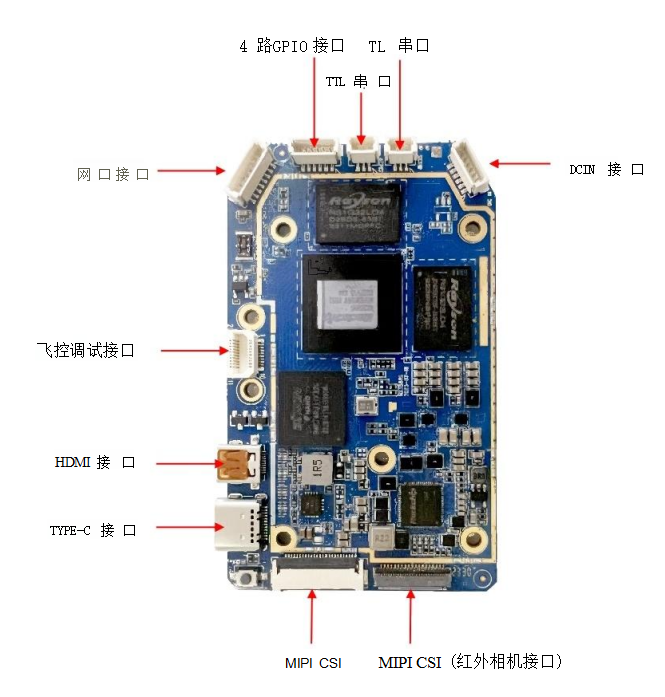
The core board based on the Rockchip RK3588S high-performance processor possesses powerful computing capabilities, 2D/3D graphics processing, and full HD video encoding/decoding capabilities. It supports interfaces such as HDMI, MIPI CSI, GPIO, and TTL.
The mainboard utilizes 1.25/2.0mm pitch wire-to-board connectors in multiple locations. The compact design not only enriches the interfaces but also significantly saves space. The power supply uses a 9-15VDC wide voltage input, offering low power consumption, which is both energy-efficient and safe.