NXP+FPGA-Based Rail Transit 3U Chassis Structure Remote Input/Output Module (RIOM)
NXP + FPGA-Based Rail Transit 6U Chassis Remote Input/Output Module (RIOM)
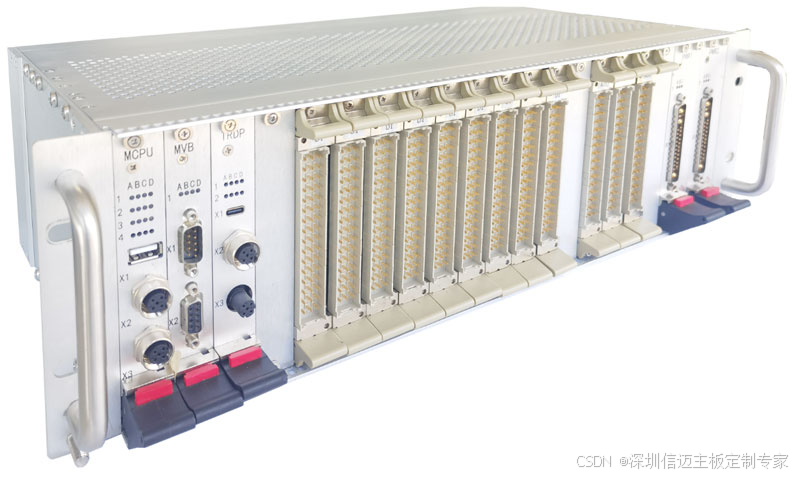
Modern rail transit systems — metros, light rail, and mainline trains — demand reliable, low-latency data acquisition and actuation distributed across the entire consist. Wiring every sensor and actuator directly back to a central Vehicle Control Unit (VCU) is neither practical nor cost-effective: cable runs grow heavy, harness complexity multiplies fault points, and maintenance becomes a significant operational burden. The Remote Input/Output Module (RIOM) solves this by placing intelligent I/O concentration at the point of need, close to sensors and actuators, and communicating with the VCU over a fieldbus network. This article covers an NXP + FPGA-based RIOM designed for 6U chassis integration in rail transit rolling stock, detailing its architecture, interface options, configurable I/O modules, and key technical parameters.
What Is a RIOM and Why Does It Matter?
A RIOM acts as a distributed I/O node on a train's control network. Rather than running individual signal cables the full length of a consist, the RIOM aggregates signals locally — door sensors, brake feedback, HVAC status, lighting control — and exposes them to the rest of the train's control system via a high-integrity fieldbus. This topology reduces total cable weight and length substantially, which matters in rail applications where every kilogram affects traction energy consumption and where cable routing in confined under-floor spaces is a significant integration challenge.
The NXP + FPGA pairing is a natural architectural choice for this class of equipment. An NXP application processor (typically from the i.MX or QorIQ families) handles protocol stacks, configuration management, and higher-level logic, while an FPGA provides deterministic, cycle-accurate handling of real-time I/O — capturing fast digital transitions, generating precisely timed output pulses, and implementing custom glue logic for legacy signal types. This split avoids the latency jitter that a purely software-driven I/O approach would introduce.
Configurable I/O Module Architecture
One of the defining features of this RIOM platform is its modular, field-configurable I/O architecture. The chassis supports up to 14 I/O modules, allowing system integrators to tailor each unit to the specific signal mix required by that position in the consist. Supported module types include:
- DI (Digital Input) — for discrete on/off signals such as door-closed feedback, pressure switches, and limit switches.
- DIO (Digital Input/Output) — bidirectional digital channels where the same physical pin can be configured as input or output under software control.
- MDO (Medium-power Digital Output) — for driving relays, solenoids, or indicator lamps at currents above what a standard logic-level output can source.
- RDO (Relay Digital Output) — galvanically isolated relay contacts for hard-wired interlock circuits where electrical isolation between control and load circuits is mandatory.
- AIO (Analog Input/Output) — for 4–20 mA current loops, 0–10 V voltage signals, or sensor interfaces such as thermocouples and RTDs used in HVAC and traction cooling systems.
- PTI (Pulse Train Input) — for frequency or quadrature encoder signals, commonly used for speed measurement from tachogenerators or wheel-speed sensors.
This mix of module types within a single 6U chassis allows a single RIOM unit to serve as the complete I/O front-end for a car section, rather than requiring multiple purpose-built devices.
Interface Options and Network Topology
The RIOM supports two variants distinguished primarily by their primary fieldbus interface, reflecting the two dominant train communication standards in service today:
MVB RIOM
Supports three interfaces: MVB / CAN / Serial Link
MVB (Multifunction Vehicle Bus, IEC 61375-1) is the traditional train-level process data bus used widely in European and Asian rail fleets. The MVB variant of the RIOM integrates as a slave device on the MVB network, presenting its I/O channels as process data variables that the VCU can read and write at fixed cycle times. CAN and serial link interfaces provide secondary connectivity for subsystems that use those buses — for example, pantograph control units or third-party diagnostic equipment.
TRDP RIOM
Supports two interfaces: TRDP / CAN
TRDP (Train Real-time Data Protocol, IEC 61375-2-3) is the Ethernet-based successor to MVB, operating over Ethernet Consist Network (ECN) infrastructure. A TRDP RIOM connects to the onboard Ethernet switch and participates in the consist's IP-based control network, enabling higher bandwidth and easier integration with modern diagnostics and condition monitoring platforms. CAN remains available for local subsystem communication.
Both variants can coexist in a multi-car consist, allowing mixed fleets or staged migration from legacy MVB installations to modern TRDP/ECN architectures.
Technical Specifications
| Parameter | Value |
|---|---|
| Dimensions (W × H × D) | 427 mm × 132 mm × 230 mm |
| Weight | 8 kg |
| Input Voltage | 110 V DC |
| Operating Temperature | –25 °C to +70 °C |
| Max I/O Modules | 14 |
| Networking | TRDP / MVB / CAN / ECN |
The 110 V DC input voltage aligns with the standard auxiliary power bus used in many rail vehicles worldwide, eliminating the need for an additional DC/DC converter in the installation. The operating temperature range of –25 °C to +70 °C covers the demanding thermal environments encountered in under-floor equipment bays, from cold-soak conditions during winter storage to heated compartments in tropical operation.
The 6U chassis form factor (approximately 132 mm in height) is standard for 19-inch rack installations, making it compatible with both dedicated rack enclosures and modular equipment cabinets common in modern rolling stock.
Edge Computing and Diagnostics Potential
Because the NXP processor on this platform has meaningful compute headroom beyond what basic I/O aggregation demands, the RIOM is well-positioned as an edge computing node. Signal pre-processing — filtering, engineering-unit conversion, threshold detection, and basic anomaly flagging — can be offloaded from the central VCU to the RIOM itself. In a large consist with many RIOM nodes, distributing this work reduces VCU load and latency, and enables local protective actions (such as isolating a faulty output channel) without requiring a round-trip through the network.
The combination of TRDP/ECN connectivity and onboard processing also makes the platform compatible with modern Condition-Based Maintenance (CBM) architectures, where telemetry from I/O channels is continuously forwarded to a cloud or trackside analytics platform for fleet-wide health monitoring.
Summary
The NXP + FPGA-based 6U RIOM described here addresses the core challenge of distributed I/O in rail transit: concentrating diverse signal types locally, communicating reliably over industry-standard fieldbuses, and doing so within the rugged environmental and power constraints of rolling stock. Its support for up to 14 configurable I/O modules across DI, DIO, MDO, RDO, AIO, and PTI types, combined with dual-standard fieldbus support (MVB and TRDP), makes it applicable across both legacy and next-generation train control architectures. For engineers specifying or integrating consist control systems, this platform represents a flexible, standards-compliant building block that can reduce wiring costs while improving system modularity and maintainability.