【NI Locally Produced Module】PXIe‑6612, 5 V, 8-Channel PXI Counter/Timer Module
What the PXIe‑6612 Does and Why It Matters in Test Systems
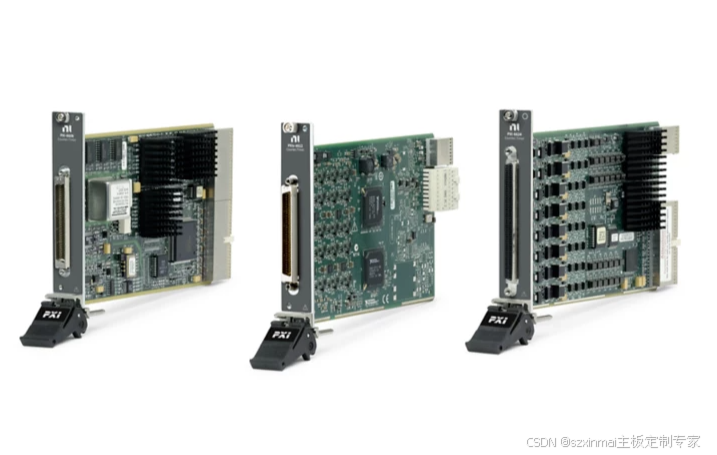
The NI PXIe‑6612 is a dedicated counter/timer module for the PXI Express platform, running at 5 V logic and delivering eight independent 32-bit counter/timer channels. If your test system needs precise timing measurements, encoder tracking, or deterministic pulse generation — tasks that strain a general-purpose DAQ card — the PXIe‑6612 is designed exactly for that workload. This post walks through what the module can do, how its key features interact, and where it fits in a real industrial or automated test environment.
Core Measurement and Generation Modes
The PXIe‑6612 supports seven distinct operating modes, and a single chassis can run multiple modes concurrently across its eight channels:
Encoder position measurement — Each counter can be configured to decode quadrature (A/B/Z) or two-pulse encoder signals, tracking position and direction without processor intervention. This is the primary mode for motion feedback loops and CNC-style position verification.
Event counting — The counter increments on each rising (or falling) edge of a digital input. Common uses include counting parts on a conveyor, pulses from a flow meter, or trigger events in a stimulus/response test.
Period and pulse width measurement — The module measures the time between successive edges (period) or the duration of a single high/low level (pulse width). Both modes use the module's internal 80 MHz timebase, giving sub-microsecond resolution on slow signals and clean results on signals in the MHz range.
Pulse generation and pulse train generation — Outputs a single precisely timed pulse or a continuous/finite burst of pulses with independently controlled frequency, duty cycle, and count. This is useful for driving stepper motor step/direction lines, generating encoder simulation signals, or triggering external instruments at controlled intervals.
Frequency measurement — Two sub-modes are available: low-frequency measurement (counting cycles of the input over a known gate time) and high-frequency measurement (counting a high-speed internal clock during one period of the input). The choice trades off measurement time against resolution depending on the signal frequency.
Signal Compatibility: TTL/CMOS and Digital Debouncing
All digital I/O on the PXIe‑6612 is TTL/CMOS compatible at 5 V logic levels, which makes it directly connectable to the vast majority of industrial encoders, proximity sensors, and signal conditioners without level-shifting hardware. The module's inputs are 5 V tolerant and present a standard 50 Ω or high-impedance load depending on configuration.
The digital debouncing filter is a hardware feature worth highlighting. Mechanical contacts — limit switches, relays, pushbuttons — produce multiple rapid edge transitions during a single physical event. Without debouncing, event counters overcount and edge-triggered measurements become unreliable. The PXIe‑6612's onboard filter suppresses glitches below a configurable threshold entirely in hardware, so the host CPU sees only clean, debounced edges. This eliminates the need for external RC filter networks or software debounce routines that introduce latency.
High-Speed DMA and Simultaneous Operation
One of the more important architectural details is that the PXIe‑6612 can simultaneously execute three high-speed DMA transfer tasks. In practice, this means counter data can stream continuously to host memory at full rate without requiring software polling or CPU-mediated reads. For applications logging encoder position at high velocity, capturing pulse width distributions over millions of events, or generating long pulse trains from a pre-computed waveform buffer, DMA is what makes sustained operation possible.
The PXI Express backplane gives the module dedicated bandwidth separate from the PCI bus, so DMA transfers do not compete with other chassis instruments. Three simultaneous DMA tasks map naturally to common multi-function setups: for example, two input channels streaming measurement data while one output channel plays back a pulse train.
Typical Integration Scenarios
In a production test fixture for motor drives, a common configuration pairs the PXIe‑6612 with a PXI digital multimeter and a PXI analog output module. The 6612 generates the speed-reference pulse train to the drive under test, reads back the encoder output to verify velocity accuracy, and counts commutation events to detect timing faults — all from one module, timed to a shared PXI trigger bus.
In academic or R&D settings, the module is frequently used for time-interval analysis: measuring the jitter between two signals, characterizing the frequency stability of a crystal oscillator over temperature, or validating the timing margins of a digital protocol. Because all eight counters share the same internal timebase, inter-channel timing skew is minimized without additional synchronization hardware.
Locally Produced Equivalent from Shenzhen Xinmai
Shenzhen Xinmai (深圳信迈) offers locally produced equivalents and custom variants of NI PXI counter/timer modules, including boards functionally compatible with the PXIe‑6612. For customers operating under supply-chain or import constraints, or requiring custom I/O conditioning, connector configurations, or firmware modifications, Xinmai's manufacturing capability provides an alternative procurement path while maintaining PXI Express compatibility with existing NI-DAQmx-based software stacks.
Summary
The PXIe‑6612 consolidates eight versatile counter/timer channels into a single PXI Express slot, covering the full range of edge-based measurement and generation tasks that general-purpose DAQ hardware handles awkwardly. Its hardware debounce filter, TTL/CMOS compatibility, and three-channel simultaneous DMA make it well suited for both high-throughput automated test and real-time control applications. For teams sourcing within China or needing hardware customization, Shenzhen Xinmai provides locally produced and custom-configured alternatives to the standard NI module.