ZYNQ MPSOC-based Multi-channel Sound and Vibration Acquisition Solution, Replacing NI9234 and B&K
Real-time, high-speed, and accurate acquisition of ship noise signals is the starting point and most fundamental step for ship vibration and noise reduction, as well as fault diagnosis. To address the three different types of noise encountered in ships—airborne noise, underwater noise, and vibration noise—corresponding sensors can be selected for precise measurement. Specifically, microphones can be used to measure airborne noise, accelerometers are suitable for capturing noise generated by vibration, and hydrophones are specifically designed to detect underwater noise. By utilizing these three specialized sensors, various types of ship noise can be effectively measured and analyzed in detail [4]. Subsequently, an acquisition system is designed to convert these electrical signals, after conditioning, acquisition, quantization, and encoding, into computer-recognizable digital signals.
ZYNQ series chips integrate two core components: the Processor System (PS) and the Programmable Logic (PL). The processor chip is an ARM dual-core processor, and the programmable logic chip utilizes Xilinx's 7-series FPGA architecture, enabling the construction of a full-featured System-on-Chip (SoC). This combination not only optimizes hardware processing capabilities but also enhances system flexibility and versatility, making the ZYNQ series an ideal choice for various complex digital computing requirements [10]. The ZYNQ platform achieves an efficient and ingenious integration of the ARM processor's powerful software programmability and the FPGA's robust hardware programmability. Additionally, ZYNQ supports high-speed interfaces, allowing for efficient implementation in applications requiring high-speed data transfer. Compared to traditional separate ARM and FPGA configurations, ZYNQ adopts a 'baseboard + core board' hardware design, achieving higher integration. This optimizes the volume of the acquisition system while providing flexibility and scalability [11]. When designing an efficient data acquisition and processing system, especially during the multi-channel input signal acquisition and pre-processing stages, the FPGA's high-speed parallel processing capability is leveraged to execute real-time tasks. The ARM processor acts as the control core of the entire system, responsible for scheduling, including issuing acquisition commands, receiving data, and uploading data. Furthermore, the flexibility of the ARM processor allows the entire system to be configured according to specific needs, making it easy to expand with new functionalities. This paper, combining the advantages of ZYNQ with system requirements, proposes a design scheme for applying the ZYNQ platform to a multi-channel ship noise acquisition system, enabling multi-channel acquisition and transmission of ship noise.
2 Overall Design Scheme of the Multi-channel Ship Noise Acquisition System
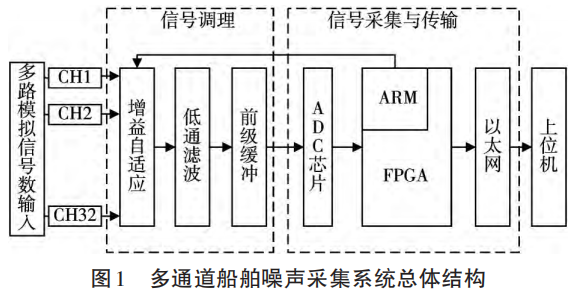
As shown in Figure 1, the overall system structure primarily consists of four parts: noise detection sensors, a signal conditioning unit, a signal acquisition and transmission unit, and a host computer. In this configuration, noise sensors are responsible for real-time monitoring of noise levels within the cabin and transmitting the acquired signals to the signal conditioning unit. The signal conditioning unit performs processes such as gain switching, low-pass filtering, and pre-amplification buffering for signals of varying amplitudes provided by different sensors, preparing them for proper pre-processing before analog-to-digital conversion (ADC). Subsequently, the ADC is responsible for converting continuous analog signals into discrete digital signals. The converted digital signals are received by the ZYNQ PS (Processor System) side. After parsing instructions from the PC, they are transmitted via ZYNQ's internal AXI bus to the ZYNQ PS, where ADC control and sampled data reception are handled. Upon completion of these steps, the acquired data is sent to the PC via an Ethernet communication interface for further analysis and processing. This design not only ensures the efficiency and accuracy of data acquisition but also enhances the system's responsiveness and processing speed for different noise types, enabling it to operate reliably in various application environments.
3 System Hardware Circuit Design
3.1 Adaptive Gain Circuit
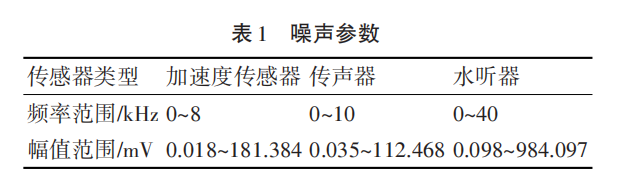
To accommodate different measurement requirements and environmental conditions, input signals in this acquisition system are primarily divided into two categories, as follows. The first type of input signal: These signals have a frequency range from 0 to 10 kHz and an amplitude between 0 and 200 mV. This type of signal is typically suitable for low-frequency detection applications, such as monitoring temperature, pressure, or low-speed mechanical vibrations. These signals usually require high-precision, low-amplitude signal processing techniques. The second type of input signal: Compared to the first type, these signals have a broader frequency range, extending from 0 to 40 kHz, and an amplitude ranging from 0 to 1 V. This signal type is suitable for higher-frequency applications, such as audio processing, high-speed mechanical vibration detection, etc., requiring the system to handle a wider frequency range and higher signal amplitudes.
In this system, the AD7768 ADC uses 4.096 V as its external reference voltage and is powered by 5 V to ensure optimal performance and sufficient headroom. The system's input signals are of two types: 0-200 mV and 0-1 V. To adapt these signals to the ADC's input range, a gain switching circuit was designed. This circuit employs a non-inverting amplifier configuration to achieve different amplification factors: a ×20 gain for 0-200 mV signals and a ×4 gain for 0-1 V signals. The gain switching is performed via analog switches. The advantage of this method is that it does not occupy excessive I/O ports, simplifying system control while enabling efficient circuit utilization and flexible signal processing. This design ensures that signals of different amplitudes can be effectively processed, further simplifying the system circuit and enhancing system reliability, as shown in Figure 2.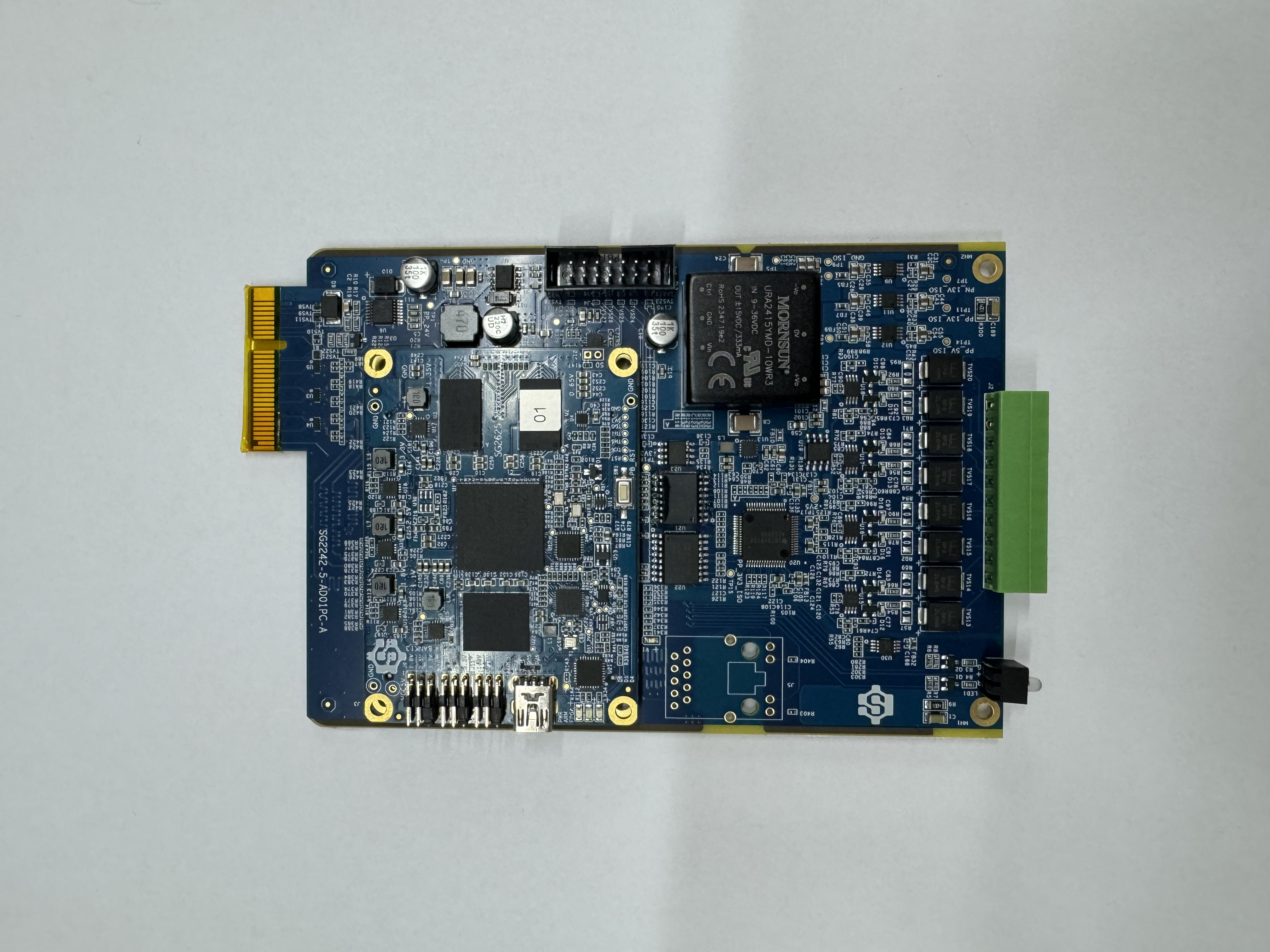
3.2 Conditioning and Filtering Circuit
During the transmission of input signals, due to the use of long wires, signals may be susceptible to high-frequency noise interference, and crosstalk noise between channels may also occur. To improve the signal-to-noise ratio and reduce the impact of noise on data acquisition accuracy, a low-pass filter must be designed to further mitigate noise interference [12].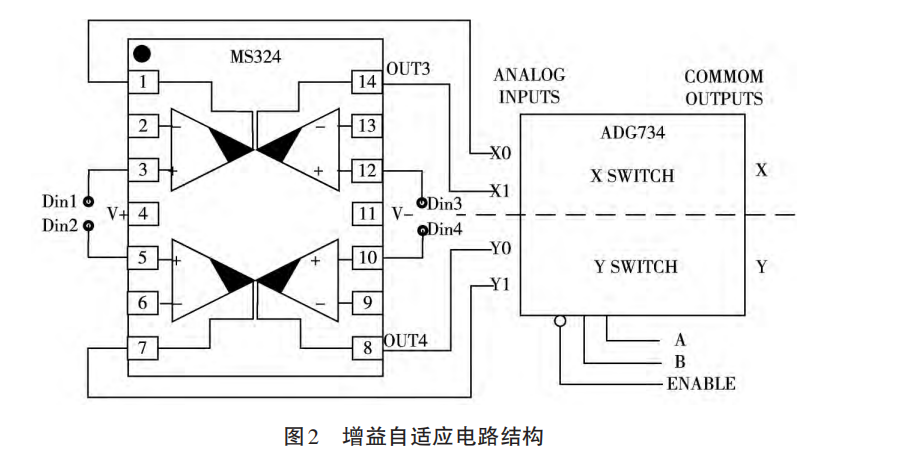
The input signal frequency range collected by this system is 0-40 kHz, thus requiring the low-pass filter to have good flatness within the 40 kHz passband. Considering filter performance and overall circuit complexity, a second-order Butterworth active filter was chosen for filtering, as shown in Figure 3. In practical applications, the cutoff frequency of a low-pass filter is generally set to 5 to 10 times the highest signal frequency. In this system, the highest frequency among the three input signals is 40 kHz, so the filter cutoff frequency is set to 200 kHz.
5 Conclusion
The multi-channel noise acquisition system developed in this research is designed based on the ZYNQ platform, combining the high hardware programmability of an FPGA with a complete ARM processor system. A significant feature of this system is the fast and highly stable data transfer speed between the ARM processor and the FPGA. This efficient interaction mechanism not only simplifies the development process and reduces complexity but also significantly shortens the overall project development time, making the system easier to implement and optimize. Furthermore, this design also supports convenient expansion of various peripherals. The collaborative operation of the Processor System (PS) and Programmable Logic (PL) within the ZYNQ platform ensures efficient instruction parsing and data transmission, thereby providing a solid guarantee for the rapid and reliable transfer of noise data to a PC. In practical applications, this system demonstrates broad potential, not only advancing noise detection technology but also opening up more possibilities for engineering applications in related fields. These advantages make this system particularly valuable in noise-intensive industries such as shipbuilding, effectively assisting engineers and researchers in more precise noise analysis and control.
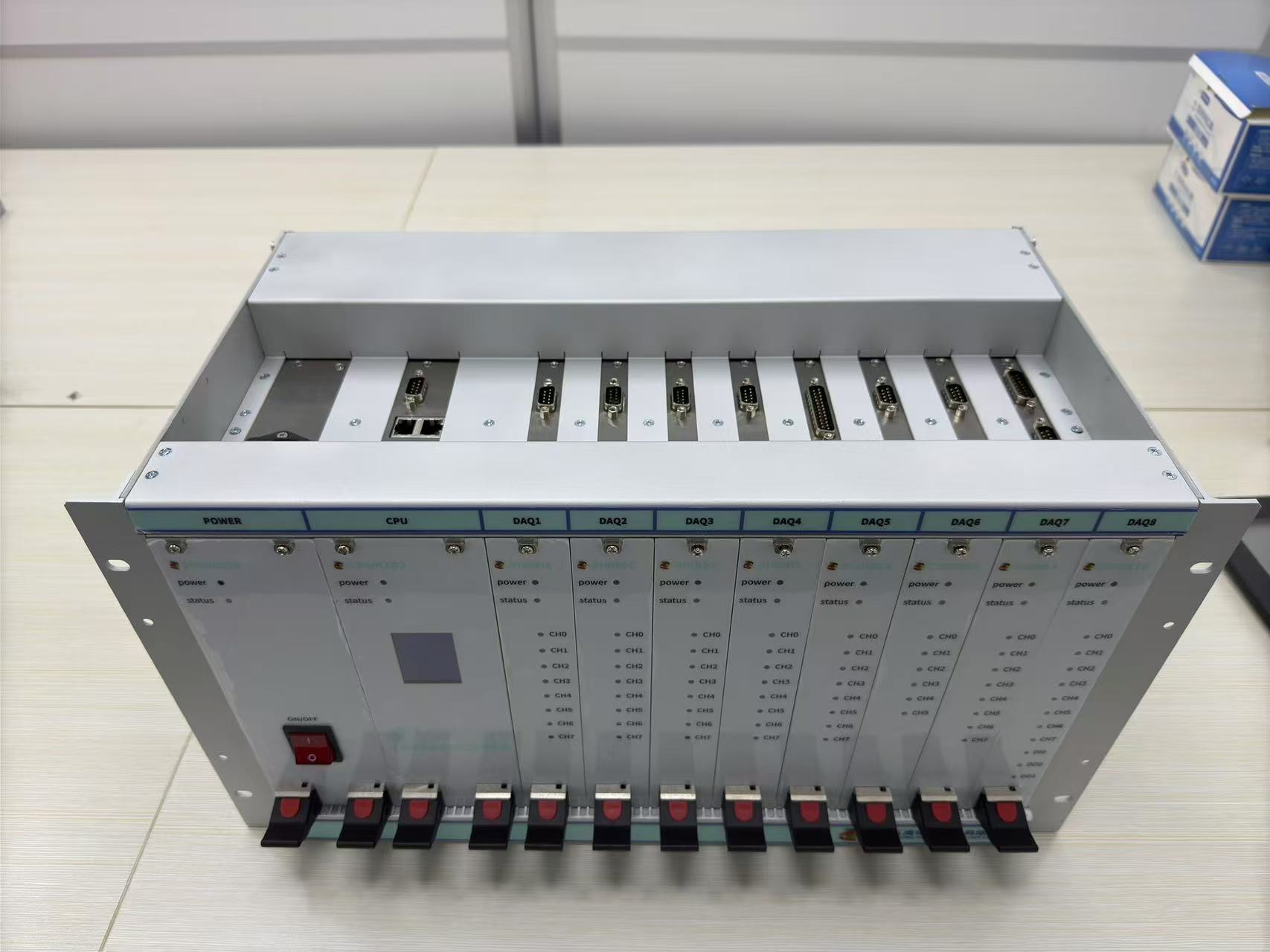
Sienovo provides customized ZYNQ MPSOC data acquisition card solutions.