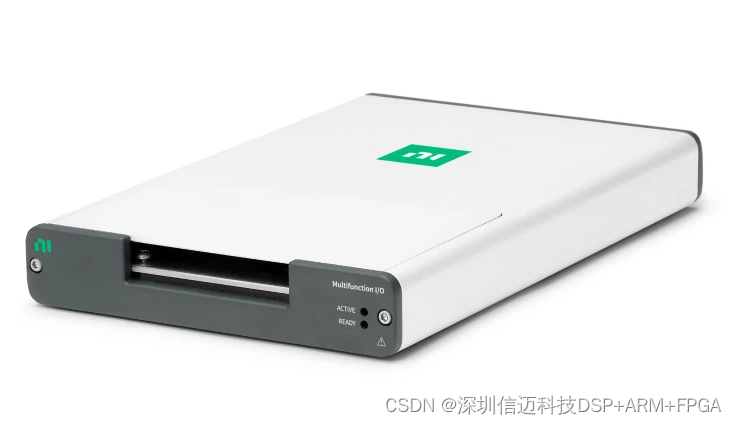
【NI Alternative】USB‑6363, 32-Channel AI (16-Bit, 2 MS/s), 4-Channel AO (2.86 MS/s), 48-Channel DIO, USB Multifunction I/O Device
Overview
The USB‑6363 is a high-performance USB multifunction data acquisition (DAQ) device from National Instruments, offering 32 channels of analog input at 16-bit resolution and up to 2 MS/s aggregate throughput, 4 channels of analog output at 2.86 MS/s, and 48 channels of digital I/O — all in a single bus-powered USB form factor. For engineers evaluating NI alternatives or building new DAQ systems, understanding exactly what the USB‑6363 delivers helps clarify the benchmark any replacement must meet.
Analog Input Subsystem
The 32 analog input channels are multiplexed into a single 16-bit successive-approximation ADC. The 2 MS/s figure is the aggregate sample rate across all active channels, so a single-channel acquisition runs at the full 2 MS/s while a 16-channel scan runs at roughly 125 kS/s per channel. Input ranges are software-selectable, and the analog front end supports both single-ended and differential configurations — reducing the effective channel count to 16 differential pairs when noise rejection is a priority in industrial environments.
The onboard NI‑STC3 (System Timing Controller 3) ASIC handles sample timing independently of the USB host, which means the acquisition clock is not subject to USB interrupt latency. Hardware-timed tasks are triggered and paced entirely on the device, with data streamed to the host in bulk transfers. This architecture is critical for applications that require deterministic, gap-free sampling even under a loaded host OS.
Analog Output Subsystem
Four analog output channels share a separate timing engine capable of 2.86 MS/s aggregate update rate. The AO subsystem can operate simultaneously with the AI subsystem without clock sharing, allowing independent waveform generation and digitization tasks to run in parallel. This is particularly useful in stimulus-response test automation, where a known signal must be injected while the response is being captured.
Analog outputs support hardware-timed waveform regeneration from an onboard FIFO, which reduces USB bandwidth pressure and allows smooth waveform output even during host-side processing spikes.
Digital I/O and Counter/Timers
The 48 digital I/O lines are organized into three 16-bit ports. Lines are individually programmable as input or output and support both static and hardware-timed clocked operations, enabling pattern generation and handshaking with external logic at rates well beyond what software-timed toggling can achieve.
Four 32-bit counter/timer channels extend the device's reach into motion and frequency domains. Common counter applications include:
- Quadrature encoder decoding — position tracking for motors and linear stages
- PWM generation — duty-cycle control for actuators, heaters, and fan controllers
- Frequency and period measurement — tachometry and event rate monitoring
- Event counting — pulse accumulation from proximity sensors, encoders, or particle detectors
Each counter operates independently and can be retriggered, meaning a new measurement task starts automatically on the next trigger edge without host intervention — a feature enabled by the NI‑STC3's retriggerable measurement task support.
NI‑STC3 Timing Architecture
The NI‑STC3 is the silicon core that separates professional-grade DAQ hardware from lower-cost alternatives. It provides independent clocking for the analog input, analog output, and digital I/O subsystems, so a high-speed AI acquisition does not starve AO updates or DIO handshaking. The chip also handles multi-device synchronization via the PFI (Programmable Function Interface) lines, allowing multiple USB‑6363 units — or mixed NI DAQ devices — to share a common start trigger and sample clock for channel-expanded synchronized systems.
Retriggerable measurement tasks are a particularly useful STC3 feature in production test: once armed, the hardware re-arms itself after each trigger without a round-trip to the software, enabling high-throughput pulse-by-pulse measurements at rates that would otherwise be limited by USB round-trip latency.
NI‑DAQmx Driver and Configuration
The USB‑6363 ships with the NI‑DAQmx driver, which abstracts the hardware into a consistent API across languages (C, C++, Python via nidaqmx package, LabVIEW, .NET). NI MAX (Measurement & Automation Explorer) provides a GUI for channel configuration, self-test, and calibration without writing a single line of code — useful for incoming inspection and field verification.
The DAQmx task model (configure → start → read/write → stop → clear) maps well onto both one-shot and continuous streaming workflows, and the same task configuration works unchanged whether the device is a USB‑6363 or a PCIe‑6363, making it straightforward to migrate a USB prototype to a PCIe production fixture.
Typical Application Areas
| Application | Key Features Used |
|---|---|
| Automated test equipment (ATE) | Multi-channel AI + AO, retriggerable tasks |
| Motor control validation | Encoder counter, PWM output, AI current sense |
| Data logging | 32-ch AI, hardware timing, USB portability |
| HIL simulation | Synchronized AI/AO, DIO handshaking |
| Vibration and acoustics | High-rate AI, independent timing engine |
Positioning as an NI Alternative Benchmark
When evaluating any NI alternative DAQ solution, the USB‑6363 specification set — 16-bit AI, 2 MS/s, independent AO timing, 32-bit counters, and a mature driver ecosystem — represents a well-established mid-range target. Alternatives must address not just raw sample rates but also timing architecture (hardware-clocked vs. software-polled), driver stability under real OS scheduling, and multi-device synchronization capability before they can be considered drop-in replacements for measurement-critical workflows.