飞腾S2500全国产主板为VPX 6U尺寸标准板卡在船舶、交通等的应用
S2500 Tengyun Processor Motherboard for VPX 6U Applications in Marine and Transportation
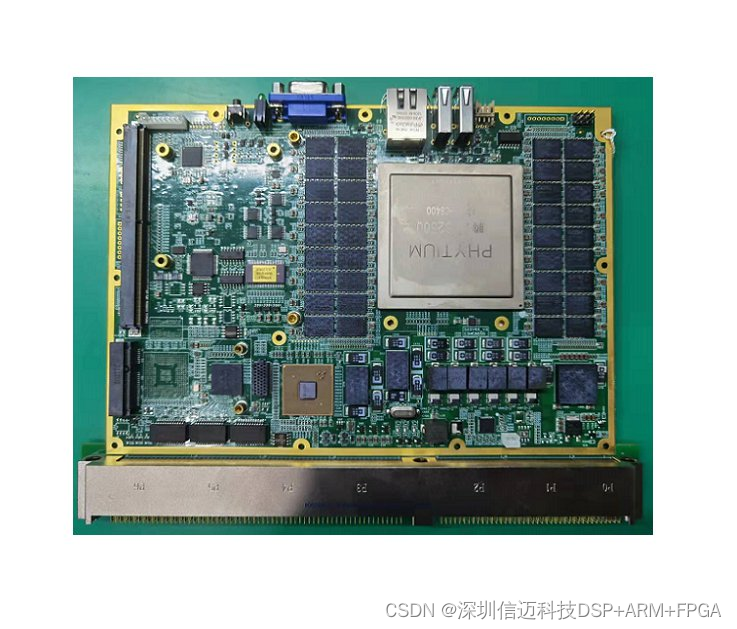
China's push toward domestically sourced computing hardware has produced a growing ecosystem of processors, chipsets, and system boards designed to reduce reliance on foreign silicon. The Phytium (飞腾) S2500 processor — branded under the Tengyun (腾云) line — sits near the top of that stack, targeting high-reliability embedded and server applications. This post covers a VPX 6U form-factor motherboard built around the S2500, examining its specifications and the industrial use cases it is designed to serve, particularly in marine and transportation environments.
What Is the Phytium S2500?
The Phytium S2500 is a server-class processor developed by Tianjin Phytium Information Technology, a Chinese CPU vendor focused on ARM-architecture designs for domestic government, defense-adjacent, and industrial markets. The S2500 is an octa-channel DDR4 capable, multi-core ARMv8 processor, positioned as an enterprise and embedded server chip. It pairs naturally with the ZX-200 chipset — a domestically designed PCH-equivalent from Zhaoxin — completing a fully domestic processor-plus-chipset platform stack. This combination satisfies requirements for critical infrastructure deployments where foreign-origin silicon may be restricted.
VPX 6U: The Right Form Factor for Harsh Environments
VPX (VITA 46) is a ruggedized backplane standard widely adopted in defense, aerospace, rail, and maritime computing. The 6U form factor (233.35 mm × 160 mm) provides more real estate than the compact 3U variant, accommodating richer I/O and larger thermal spreaders without sacrificing the mechanical robustness that VPX demands. Boards mount into ruggedized chassis using wedge-lock retention, making them suitable for high-vibration platforms such as vessels underway or rail vehicles traversing rough track.
This particular board hits the canonical 6U footprint at 233.35 mm (length) × 160 mm (height) with a 2 mm board thickness — compliant with the VITA 46 mechanical envelope and compatible with standard VPX chassis from multiple integrators.
Full Specification Breakdown
| Parameter | Value |
|---|---|
| Processor | Phytium Tengyun S2500 |
| Chipset | ZX-200 |
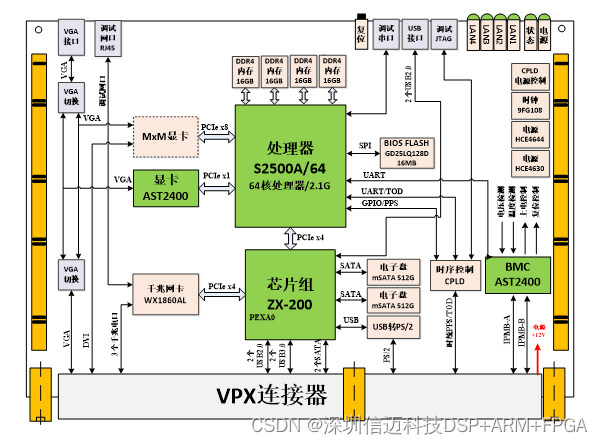
| Memory | Quad-channel DDR4, domestic memory ICs, 64 GB |
| Solid-State Storage | mSATA; 128 GB / 256 GB / 512 GB / 1 TB options |
| USB | 6 ports |
| Ethernet | 4 ports |
| Display Output | DVI, VGA |
| Serial | Yes (count per integration configuration) |
| Dimensions | 233.35 mm (L) × 160 mm (H), 2 mm thick |
| Industrial Temperature | −40 °C to +65 °C |
| Commercial Temperature | −20 °C to +55 °C |
| Firmware | Phytium UEFI |
| OS Support | Kylin OS Server Edition 4.0.2 |
The memory subsystem deserves attention: four DDR4 channels with domestically sourced memory ICs. Quad-channel operation on the S2500 platform delivers substantially higher aggregate memory bandwidth than dual-channel configurations, which matters for network packet processing and sensor data aggregation tasks common in transportation management systems.
Storage: mSATA for Vibration-Prone Deployments
The board uses an mSATA slot rather than a 2.5-inch SATA or NVMe M.2 connector. mSATA modules solder or clip directly to the board footprint with no moving mechanical interfaces, making them inherently more vibration-tolerant than drives with larger connectors. Supported capacities top out at 1 TB, sufficient for local data logging, edge inference model storage, or operating system plus application workloads.
For deployments requiring higher IOPS or larger capacity, integrators would typically look to the backplane fabric for additional storage over VPX serial fabric lanes, but the onboard mSATA covers most embedded OS-plus-application scenarios without external storage dependency.
Temperature Range and Environmental Suitability
The dual temperature rating is practically significant. The industrial grade (−40 °C to +65 °C) covers scenarios where the board may be installed in an unheated equipment bay on a vessel operating in cold northern waters, or in a trackside cabinet in a desert rail corridor. The commercial grade (−20 °C to +55 °C) suits climate-controlled operator consoles and control room rack applications.
Marine environments additionally impose concerns around humidity, salt fog, and vibration that the VPX mechanical standard addresses at the chassis and card-retention level. The board itself would typically be deployed inside a sealed or filtered VPX chassis with conformal coating applied during integration for salt-fog protection.
Firmware and OS: A Fully Domestic Software Stack
The board runs Phytium UEFI firmware rather than AMI or Phoenix BIOS implementations tuned for x86. Phytium UEFI is maintained internally and distributed with the processor platform, providing a firmware chain that remains under domestic control for organizations subject to supply-chain security requirements.
Kylin OS Server Edition 4.0.2 — developed by the National University of Defense Technology and maintained commercially by Kylin Software — is the validated operating system. Kylin OS is Linux-based (derived from Ubuntu LTS and RHEL lineage depending on edition) and carries certification for domestic government and military-adjacent procurement. Version 4.0.2 specifically targets the server workload profile and includes drivers optimized for Phytium ARMv8 platforms.
For transportation and maritime system integrators, this means the full stack — processor, chipset, firmware, and OS — is available through domestic supply chains, simplifying procurement compliance and long-term support commitments for 10- to 15-year deployment lifecycles typical of ship and rail infrastructure.
Typical Use Cases
Ship navigation and control systems: Vessels increasingly rely on integrated bridge systems, AIS processing, radar data fusion, and engine monitoring — all compute workloads that benefit from a rugged, multi-port Ethernet board with long operational temperature range. The four Ethernet ports allow simultaneous connection to navigation network segments without an additional managed switch in smaller installations.
Rail traffic management: Trackside and onboard computing for signaling, video surveillance aggregation, and passenger information systems need boards that survive vibration, wide temperature swings, and long maintenance intervals. The VPX form factor and industrial temperature certification align with these demands.
Domestic infrastructure compliance: Many Chinese public-sector transportation projects now mandate domestic silicon. The S2500 plus ZX-200 combination on Kylin OS satisfies these requirements out of the box, reducing the certification burden compared to porting a foreign-silicon board to a domestic OS.
Summary
This VPX 6U board around the Phytium S2500 and ZX-200 chipset represents a mature, production-ready option for system integrators working on marine, rail, and general industrial applications that require domestic silicon compliance. The combination of quad-channel 64 GB DDR4, flexible mSATA storage, six USB and four Ethernet ports, a wide industrial temperature range, and validated Kylin OS support makes it a capable baseline for edge server and embedded control applications where foreign-origin components are restricted or undesirable.