Phytium FT2000/4 + Galaxy Kylin Fully Domestic VPX Architecture 6U Standard Board Card, Suitable for Marine, Transportation, and Other Fields
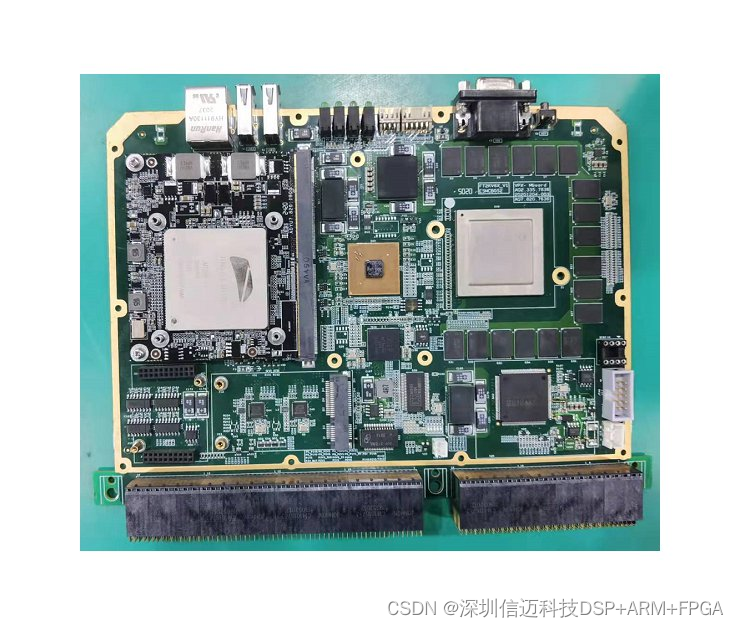
The XM-FT2000-VPX is a fully domestically-sourced single-board computer built around the VPX open standard, designed for mission-critical embedded deployments in marine systems, railway signaling, transportation infrastructure, and other harsh-environment applications. This post walks through the board's hardware architecture, interface complement, and key design decisions that make it suitable for defense-adjacent and industrial programs demanding Chinese supply-chain independence.
The Case for a Fully Domestic VPX Platform
VPX (VITA 46) is the ruggedized successor to VME, offering high-speed switched-fabric backplane interconnects in standard 3U or 6U form factors. It is the dominant architecture for military, avionics, and industrial signal-processing applications worldwide. Until recently, virtually every commercially available VPX SBC relied on x86 or PowerPC silicon from US or European vendors—an untenable dependency for Chinese defense and critical-infrastructure procurement under the current regulatory environment.
The XM-FT2000-VPX directly addresses that gap by pairing a domestically fabbed processor with a domestic chipset and domestic DRAM, all running a fully localized operating system, while conforming to the internationally recognized VPX mechanical and electrical standard.
Processor and Chipset: The Phytium FT2000/4
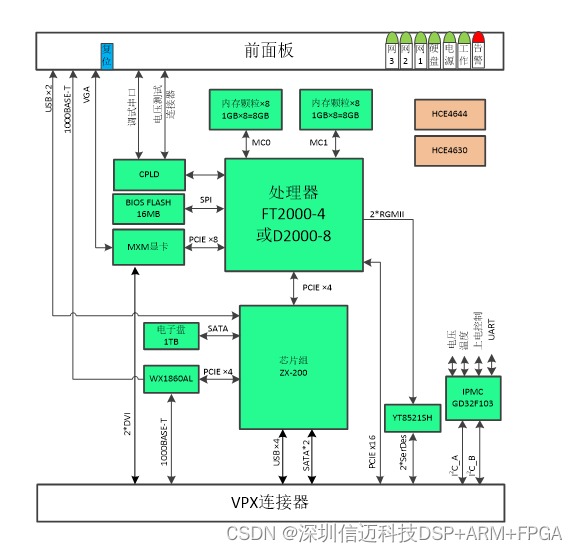
The heart of the board is the Phytium FT2000/4, a quad-core 64-bit ARMv8 processor developed by Tianjin Phytium Information Technology. The FT2000/4 is purpose-built for embedded and edge applications: it targets a lower thermal envelope than Phytium's server-class FT-2000+ (which scales to 64 cores), while still providing enough compute for real-time data acquisition, HMI workloads, protocol conversion, and lightweight AI inference at the edge.
The companion chipset is the Zhaoxin ZX-200, sourced from Shanghai Zhaoxin Semiconductor—a joint venture between VIA Technologies and the Shanghai municipal government. The ZX-200 handles southbridge functions: USB hub logic, SATA/mSATA PHY, PCIe root complex support, and legacy I/O. Using a domestic chipset alongside a domestic CPU is essential for supply-chain audit compliance; importing a foreign PCH would reintroduce a potential single point of procurement risk.
Memory Subsystem
The board ships with 16 GB of dual-channel DDR4 using domestically sourced DRAM dies. Dual-channel configuration doubles the theoretical memory bandwidth compared with single-channel, which matters for workloads that stream large buffers—think video decoding for surveillance or buffering high-rate sensor data from radar or sonar systems. At 16 GB the board sits comfortably above the minimum threshold for running a full GUI desktop environment under Galaxy Kylin while still leaving headroom for application data.
Storage: Onboard mSATA
The design includes an onboard mSATA socket with a standard configuration of 1 TB. mSATA was chosen over M.2 because it has a longer ruggedized track record in VPX and VME ecosystems and is widely available in industrial-temperature variants. For shock and vibration environments—shipborne systems, rail vehicles—solid-state storage with no moving parts is mandatory; the mSATA form factor satisfies this while remaining field-replaceable without requiring a full board swap.
Interface Complement
The XM-FT2000-VPX provides a broad I/O portfolio for a single 6U card:
- 6× USB ports — sufficient to connect HID devices, external storage, or USB-attached modems simultaneously, useful when the board acts as a consolidated I/O node in a multi-function chassis.
- 4× Gigabit Ethernet — quad GbE is a deliberate choice for transportation and marine deployments, where separate physical networks for control, management, passenger services, and sensor data are common practice. Keeping all four ports on-board eliminates the need for an add-in NIC mezzanine in many configurations.
- 1× PCIe 2.0 ×16 — the full-width PCIe slot enables high-bandwidth expansion: a dedicated GPU for display processing, a FPGA acceleration card, or a high-speed capture card can be added without chassis-level re-engineering. PCIe 2.0 ×16 delivers up to 8 GB/s bidirectional bandwidth, adequate for most embedded acceleration workloads.
- DVI video output — DVI is the practical choice for industrial panel PCs and ruggedized displays that do not yet universally support DisplayPort.
- UART interfaces — serial ports remain essential for communicating with legacy sensors, GPS receivers, industrial PLCs, and embedded microcontrollers that predate Ethernet-based fieldbus.
- UEFI BIOS firmware — UEFI replaces legacy BIOS and is required for GPT disk support, Secure Boot capability, and the kind of remote management features (network boot, PXE) that centralized fleet management depends on.
Mechanical and Environmental Specifications
| Parameter | Value |
|---|---|
| Form factor | 6U VPX |
| PCB dimensions | 233.35 mm × 162 mm |
| Board thickness | 2 mm |
| Operating temperature | −40 °C to +65 °C |
The 6U VPX form factor (233.35 mm × 162 mm) is the larger of the two standard VPX heights and is preferred when the I/O count, power budget, or cooling requirements exceed what a 3U card can accommodate. At 2 mm board thickness, the PCB itself conforms to standard VPX slot pitch, allowing it to populate any VITA 46-compliant chassis without mechanical modification.
The −40 °C to +65 °C industrial-grade temperature range is meaningful in context. Marine engine rooms can exceed +55 °C; topside electronics on Arctic research vessels can drop well below −20 °C; rail-side cabinets in northern China see similar extremes. Qualifying across this full range—rather than the commercial 0–70 °C envelope—is a prerequisite for unattended deployment in these environments.
Software Stack: Galaxy Kylin Desktop 4.0.2 SP4
The board is pre-validated against Galaxy Kylin Operating System Desktop Edition 4.0.2 SP4, developed by Kylin Software (a joint venture with deep roots in China's defense OS ecosystem). Galaxy Kylin is Linux-based and provides a familiar GNOME-derived desktop environment, but its significance here is regulatory: it appears on China's approved software catalog for government and critical-infrastructure procurement, and it ships with localized drivers, security policies, and long-term support commitments from a domestic vendor.
SP4 (Service Pack 4) of the 4.0.2 line is a mature, well-patched release. Having explicit factory-level validation—rather than a generic "Linux compatible" claim—means the board ships with confirmed driver support for the FT2000/4's specific PCIe topology, USB controller, and GbE MACs under this exact kernel and distribution combination.
Target Applications
The combination of quad-core ARMv8 compute, quad GbE, PCIe expansion, wide-temperature qualification, and VPX mechanical compliance positions the XM-FT2000-VPX for several categories of deployment:
- Marine command and control: shipborne systems require salt-fog tolerance, wide thermal range, and multi-network isolation—all addressed by this platform.
- Rail and highway transportation management: trackside or vehicle-mounted controllers benefit from the −40 °C cold-start rating and the consolidated Ethernet ports for separating operational and diagnostic traffic.
- Power and energy infrastructure: substation automation and grid-edge monitoring nodes increasingly require domestically sourced computing under national infrastructure security mandates.
- Defense-adjacent signal processing: the VPX standard itself is the architecture of choice for radar, EW, and communications payloads; a fully domestic SBC opens the door for integration into those chassis without foreign-component waivers.
The XM-FT2000-VPX represents a practical, production-ready answer to the demand for fully localized embedded computing in regulated industries—combining a recognized open-standard form factor with a processor, chipset, memory, and operating system that each satisfy domestic-sourcing requirements.