Intel Atom + Kintex-7 70T FPGA, 8-Slot CompactRIO Controller
The NI cRIO-9047 is a rugged embedded controller built around an Intel Atom quad-core processor and a Xilinx Kintex-7 70T FPGA, targeting industrial test, measurement, and control applications that demand real-time determinism, extended temperature operation, and tight hardware-software integration. This post walks through the hardware architecture, connectivity options, and key use cases for the cRIO-9047, with notes on where the FPGA and TSN capabilities provide the most leverage.
Hardware Architecture Overview
At its core, the cRIO-9047 pairs two distinct processing layers that operate concurrently:
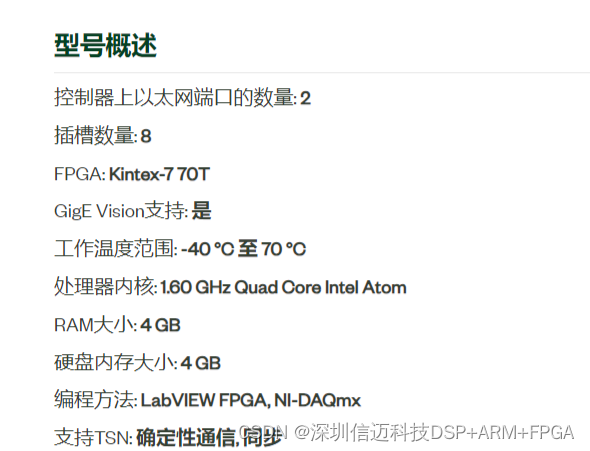
Real-Time Processor — Intel Atom Quad-Core at 1.60 GHz The host processor runs NI Linux Real-Time OS and handles high-level application logic, communication stacks, and data management. With 4 GB of DRAM and 4 GB of onboard storage, it can sustain logging-intensive workloads without relying on an external PC. The Intel Atom family is well-suited here: it delivers x86 compatibility for porting existing code while keeping thermal dissipation low enough for sealed industrial enclosures.
FPGA Layer — Xilinx Kintex-7 70T The Kintex-7 70T sits below the real-time layer and communicates with C Series I/O modules installed in the chassis slots. The "70T" designation refers to roughly 70,000 logic cells, putting it in mid-range Kintex-7 territory — large enough for custom signal processing, hardware-timed loops, and multi-axis control, but not so large that resource planning becomes burdensome for typical cRIO workloads. LabVIEW FPGA Module exposes the fabric through a graphical programming model, so teams without RTL experience can implement high-speed I/O scanning, custom filtering, or hardware-in-the-loop (HIL) logic without writing VHDL or Verilog.
The FPGA and real-time processor communicate over a high-bandwidth DMA channel, enabling the FPGA to pass large data buffers — waveform acquisitions, encoder counts, PWM measurements — to the real-time CPU with deterministic latency.
Eight-Slot Chassis and NI-DAQmx Support
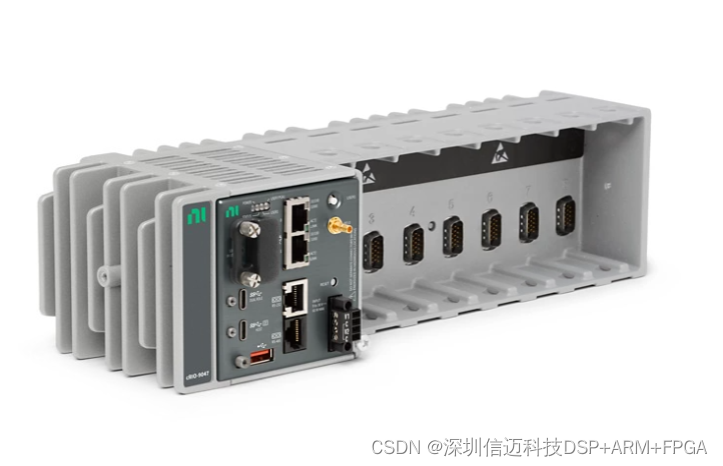
The cRIO-9047 supports eight C Series module slots, giving engineers significant I/O flexibility. C Series modules span analog input/output, digital I/O, CAN, serial, strain, thermocouple, and motion categories, so a single chassis can address mixed measurement problems without an external breakout box.
NI-DAQmx driver support is a notable addition for a cRIO platform. Traditionally, cRIO systems required all I/O to be managed through FPGA-level scan engine or custom FPGA VIs. DAQmx support on the 9047 allows compatible modules to be addressed using the familiar DAQmx API — the same API used with PXI and USB DAQ devices — reducing the learning curve for teams migrating from benchtop acquisition systems to an embedded deployment.
Time-Sensitive Networking (TSN) for Distributed Measurement
The cRIO-9047's Gigabit Ethernet port supports IEEE 802.1 Time-Sensitive Networking (TSN) standards. TSN is a set of IEEE 802.1 amendments that add deterministic packet scheduling, bounded latency, and network-level time synchronization (via IEEE 802.1AS, a profile of IEEE 1588 PTP) to standard Ethernet infrastructure.
For distributed measurement systems — where multiple cRIO chassis, drives, or sensors must share a common time base — TSN eliminates the need for dedicated hardware trigger lines running between chassis. Instead, all nodes synchronize clocks over the same Ethernet cable that carries data traffic. This is particularly valuable in large-scale test cells, wind turbines, or factory automation cells where running trigger wiring across tens of meters is impractical.
TSN's traffic shaping (802.1Qbv time-aware shaper) ensures that time-critical measurement frames are not delayed by bulk data transfers, giving the system deterministic end-to-end latency even on a shared network segment.
Connectivity Ports
Beyond the TSN-capable Gigabit Ethernet port, the cRIO-9047 provides:
- USB 3.1 (Gen 1) — primarily intended for attaching a local HMI display or touch panel, enabling operator interfaces directly on the controller without a separate PC. Also used for software deployment and debugging during development.
- USB 2.0 — general-purpose peripheral attachment (USB drives, barcode scanners, peripheral I/O).
- RS-232 — point-to-point serial communication to legacy instruments, PLCs, or GPS receivers.
- RS-485 — multi-drop serial bus for connecting to Modbus RTU devices, sensors, or actuators over longer cable runs in electrically noisy environments.
The combination of RS-485 and TSN Ethernet means the 9047 can serve as a gateway between legacy serial fieldbus infrastructure and a modern deterministic Ethernet backbone.
Extended Temperature and Rugged Construction
The -40 °C to 70 °C operating range reflects genuine industrial hardening rather than commercial-grade derating. This range covers unheated outdoor enclosures in cold climates, engine compartments, and foundry-adjacent installations. NI CompactRIO controllers are rated for shock and vibration per IEC 60068-2 standards and carry certifications for hazardous location operation in many variants.
The SD card slot adds a removable, field-replaceable storage medium — useful for transferring configuration files or log archives without network access, or for field firmware updates where an isolated network prevents remote deployment.
Typical Use Cases
- Engine and powertrain test cells — high-channel-count analog acquisition via DAQmx modules, synchronized across multiple chassis using TSN.
- Renewable energy monitoring — long-duration logging on onboard storage with SD card overflow, RS-485 Modbus to inverters, Ethernet upstream to SCADA.
- Hardware-in-the-loop simulation — FPGA executes plant models at microsecond loop rates while the real-time CPU runs the control algorithm under test.
- Machine vision + motion control — USB 3.1 camera attachment, FPGA-based encoder decoding, and multi-axis coordinated motion via C Series drive modules.
Summary
The cRIO-9047 occupies a well-defined niche: applications that need more processing headroom than entry-level cRIO controllers, require hardware-customizable I/O at the FPGA level, and must operate reliably across an industrial temperature range. The addition of NI-DAQmx compatibility lowers the integration barrier for teams already familiar with NI's PC-based acquisition ecosystem, while TSN support future-proofs the platform for distributed architectures that are increasingly common in modern industrial IoT deployments. For teams evaluating CompactRIO platforms, the 9047's eight-slot capacity and Kintex-7 70T FPGA make it a strong candidate for mid-to-large channel counts where custom timing or signal processing logic is a requirement.