Alternative to Imported Controllers: Intel Atom + Kintex-7 70T FPGA, 4-Slot CompactRIO Controller
When high-stakes industrial applications demand real-time determinism, synchronized multi-node communication, and FPGA-level flexibility in a ruggedized package, NI's cRIO-9040 stands out as a compelling alternative to imported proprietary controllers. This post walks through the key hardware architecture and connectivity features of the cRIO-9040, explaining why its combination of Intel Atom processing, Kintex-7 FPGA fabric, and Time-Sensitive Networking makes it a practical choice for distributed measurement, embedded control, and coprocessing applications.
Hardware Architecture Overview
The cRIO-9040 is a 4-slot CompactRIO chassis-and-controller combo built around a 1.30 GHz dual-core Intel Atom processor paired with 2 GB of DRAM and 4 GB of onboard storage. The Intel Atom platform brings x86-64 compatibility with a low thermal envelope — important in sealed industrial enclosures where active cooling may be limited or undesirable.
On the programmable logic side, the controller integrates a Xilinx Kintex-7 70T FPGA. The Kintex-7 family sits between Artix-7 (cost-optimized) and Virtex-7 (high-end) in Xilinx's 7-series portfolio, offering a substantial slice of DSP48E1 blocks, block RAM, and high-speed transceivers. The 70T variant specifically provides enough fabric resources for non-trivial coprocessing tasks — custom communication protocols, hardware-in-the-loop timing loops, or parallel sensor acquisition — without the cost and power overhead of a larger device. LabVIEW FPGA Module support means engineers can target this fabric using graphical dataflow programming rather than writing raw VHDL or Verilog, lowering the barrier to custom FPGA logic for test and measurement teams.
Real-Time Operating Environment
The processor runs NI Linux Real-Time, a deterministic OS that isolates time-critical tasks from general-purpose housekeeping. NI-DAQmx support is included, providing a consistent API across NI's broad I/O module ecosystem — the same function calls used in desktop DAQ development translate directly to the embedded cRIO target, which shortens porting time considerably.
An SD card slot is provided for removable data logging. In long-running monitoring deployments — think structural health monitoring on a bridge or vibration trending on rotating machinery — the ability to offload logged datasets onto SD without halting acquisition or requiring a network connection is operationally useful.
Time-Sensitive Networking (TSN) for Distributed Systems
One of the differentiating features of the cRIO-9040 relative to older CompactRIO hardware is its use of IEEE 802.1 Time-Sensitive Networking (TSN) over Gigabit Ethernet. TSN is a set of IEEE 802.1 standards extensions that layer deterministic, bounded-latency traffic scheduling and hardware-based clock synchronization (IEEE 802.1AS, a profile of IEEE 1588 PTP) onto standard Ethernet infrastructure.
In practical terms, this means multiple cRIO-9040 nodes on the same TSN-capable switch can maintain sub-microsecond clock alignment without a dedicated timing bus. For applications like synchronized multi-axis motion control, distributed power grid monitoring, or phased-array sensor fusion, this eliminates the need for proprietary backplane timing schemes or dedicated IRIG-B/GPS receivers on every node. The deterministic communication guarantee also means latency jitter from network congestion can be bounded and scheduled, which is a requirement in safety-instrumented and time-critical control loops.
Connectivity Ports
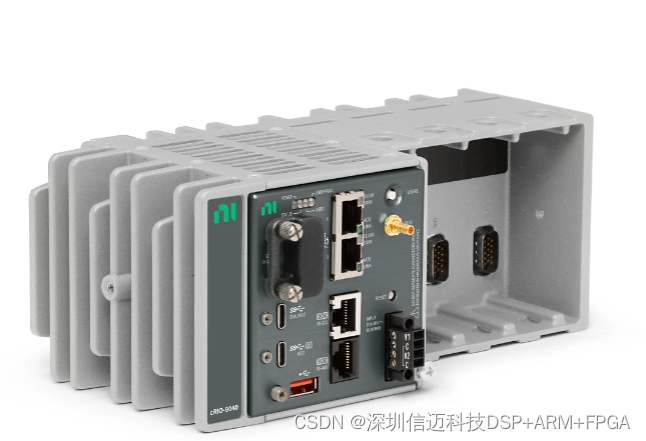
The controller's I/O panel covers the range of interfaces a typical industrial or lab deployment needs:
- Gigabit Ethernet — primary network interface; also the TSN-capable port for inter-controller synchronization and deterministic data exchange
- USB 3.1 — high-bandwidth host port; can drive a local HMI display (touch panel, industrial monitor) and doubles as a programming/deployment/debug interface, so a separate network connection is not required during bring-up
- USB 2.0 — lower-bandwidth peripheral port for dongles, storage, or auxiliary devices
- RS-232 — standard serial for legacy sensors, barcode readers, or serial console access
- RS-485 — differential serial supporting multi-drop bus topologies at longer cable runs; common in industrial fieldbus environments and MODBUS RTU networks
The USB 3.1 programming interface deserves emphasis: being able to plug a laptop directly into the controller to deploy LabVIEW RT and FPGA VIs, inspect the file system, and debug without touching the Ethernet network simplifies commissioning in environments where network access is locked down by IT or where the target network is air-gapped.
Environmental Ratings and Deployment Context
The operating temperature range of -20 °C to 55 °C reflects a genuinely industrial-grade design. Many commercial embedded PCs are rated only to 0 °C at the lower bound; the -20 °C floor accommodates outdoor equipment enclosures in cold climates, unheated factory floors, and transportation applications where startup in sub-zero conditions is a real scenario.
The ruggedized chassis construction of CompactRIO — shock and vibration rated per IEC 60068 standards — combined with the wide thermal envelope makes the cRIO-9040 suitable for deployment contexts where a standard rack PC would fail prematurely: machine tools, test stands with high vibration, mobile platforms, and remote substations.
Positioning as an Alternative to Imported Controllers
For engineering teams in China's industrial automation and test-and-measurement sectors evaluating alternatives to imported proprietary controllers, the cRIO-9040 represents a hardware-software stack with a well-documented ecosystem. The combination of a standard x86-based real-time processor, a mid-range Kintex-7 FPGA, TSN-synchronized networking, and NI-DAQmx module compatibility provides a configurable platform rather than a fixed-function controller — the 4-slot chassis accepts any C Series I/O module, covering analog input/output, digital I/O, motion, CAN, serial, and RF measurement in the same form factor.
For new designs targeting distributed sensing, real-time closed-loop control, or FPGA-accelerated coprocessing, the cRIO-9040's TSN capability and Kintex-7 fabric make it worth evaluating closely — particularly where synchronization across multiple nodes is a hard system requirement rather than a nice-to-have.