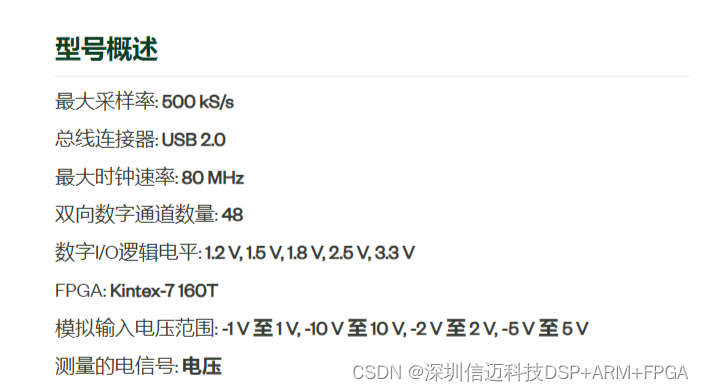
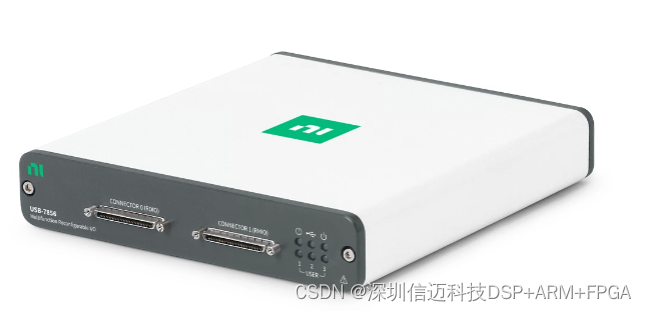
[Domestic Alternative to NI] USB‑7846 Kintex-7 160T FPGA, 500 kS/s Multifunction Reconfigurable I/O Device
The Chinese source and current English body both contain real (if brief) technical product content — dedicated-ADC-per-channel architecture, FPGA programmability, LabVIEW FPGA Module integration, and specific application domains. Expanding.
Finding a domestic, cost-effective alternative to National Instruments hardware has become a priority for many Chinese engineering teams working in test, measurement, and industrial automation. The USB-7846 — built around a Xilinx Kintex-7 160T FPGA and capable of 500 kS/s multifunction reconfigurable I/O — represents exactly that kind of alternative: a device that matches the architectural philosophy of NI's R-Series instruments while remaining accessible to local supply chains and procurement pipelines.
What Makes the Kintex-7 160T a Strong Foundation
The Xilinx Kintex-7 160T is a mid-range FPGA from the 7-series family, offering roughly 162,240 logic cells, 600+ DSP slices, and high-speed SelectIO resources. In a data acquisition context, this silicon headroom matters: it gives the instrument enough fabric to host user-defined signal processing pipelines, custom communication state machines, and real-time control loops — all running deterministically on-chip, independent of the host PC's operating system scheduling.
For engineers familiar with NI's R-Series or CompactRIO philosophy, this is the same fundamental idea: put a programmable gate array close to the analog front end so that latency between sensing and acting can be measured in microseconds rather than milliseconds.
User-Programmable FPGA for Onboard Processing
The USB-7846's FPGA is user-programmable, meaning the firmware running on the Kintex-7 is not locked to a fixed acquisition mode. Using the LabVIEW FPGA Module, engineers can write custom FPGA VIs that compile down to hardware bitstreams and deploy directly to the device. This opens up a class of applications that generic DAQ boards simply cannot address:
- Hardware-in-the-loop (HIL) testing — The FPGA can close a control loop in real time, responding to sensor inputs and driving actuator outputs with deterministic sub-microsecond latency. This is critical for simulating plant dynamics in automotive, aerospace, or power electronics test rigs.
- Custom protocol communication — Serial protocols like RS-422, SSI encoder interfaces, or proprietary industrial bus formats can be implemented directly in FPGA logic, eliminating the need for external interface cards.
- Sensor simulation — The FPGA can generate analog or digital waveforms that mimic sensors (thermocouples, resolvers, pressure transducers) to stress-test ECUs or control modules before physical prototypes are available.
- High-speed control — Switching power supplies, motor drives, and fast servo loops require update rates and jitter performance that CPU-based control cannot reliably deliver. FPGA-based PWM generation and current-loop closure handles this natively.
The LabVIEW FPGA Module provides a graphical dataflow environment for writing this logic, which lowers the barrier compared to writing raw VHDL or Verilog — though engineers comfortable with HDL can still integrate IP cores directly.
Per-Channel Dedicated ADC Architecture
One of the USB-7846's most significant hardware design decisions is giving each analog input channel its own dedicated analog-to-digital converter. On conventional multiplexed DAQ hardware, a single ADC is shared across all channels through a multiplexer: the channels are sampled sequentially, which means there is an inherent skew between the first and last channel in a scan. For slow signals this is inconsequential, but for anything involving phase relationships — motor current sensing, vibration analysis, multi-axis synchronization — that skew introduces measurement error that no amount of software correction can fully eliminate.
With a dedicated ADC per channel, all channels can be sampled simultaneously. Each converter has its own timing and triggering path, which unlocks two capabilities that the article specifically highlights:
Multi-rate sampling — Different channels can run at different sample rates within the same acquisition session. An engineer monitoring a slow thermal process on one channel while capturing a fast transient on another no longer needs to run everything at the highest rate and discard the excess data. Each channel is configured independently.
Single-channel triggering — A trigger condition can be defined on any individual channel without affecting the sampling of the others. This is useful in fault-capture scenarios where the event of interest (a voltage spike, a current overcurrent condition) appears on one channel and must be used to arm or gate acquisition on other channels without introducing pipeline delays.
Positioning as a Domestic NI Alternative
The "domestic alternative" framing in the device's positioning reflects a broader trend in the Chinese industrial electronics market. NI (now part of Emerson) hardware has long been the reference standard for reconfigurable instrumentation, but import costs, lead times, and export-control considerations have driven demand for locally designed equivalents. A device built on a well-supported Xilinx FPGA, compatible with the LabVIEW ecosystem, and offering the same per-channel ADC architecture as NI's R-Series devices addresses that demand directly — particularly for defense-adjacent, aerospace, and energy sector customers where supply chain provenance matters.
Summary
The USB-7846 combines a Kintex-7 160T FPGA with a 500 kS/s per-channel dedicated ADC architecture to produce a reconfigurable I/O platform suited for demanding test and control applications. Its programmability via the LabVIEW FPGA Module makes it a credible drop-in for NI R-Series workflows, while the per-channel ADC design delivers simultaneous sampling, multi-rate operation, and single-channel triggering that multiplexed DAQ hardware cannot match. For teams navigating the shift toward domestic instrumentation alternatives, it represents a technically sound option where FPGA flexibility and analog precision are both non-negotiable.