[NI Domestic Alternative] NI‑9232, 3-Channel, 102.4 kS/s/ch, ±30 V, C Series Sound and Vibration Input Module
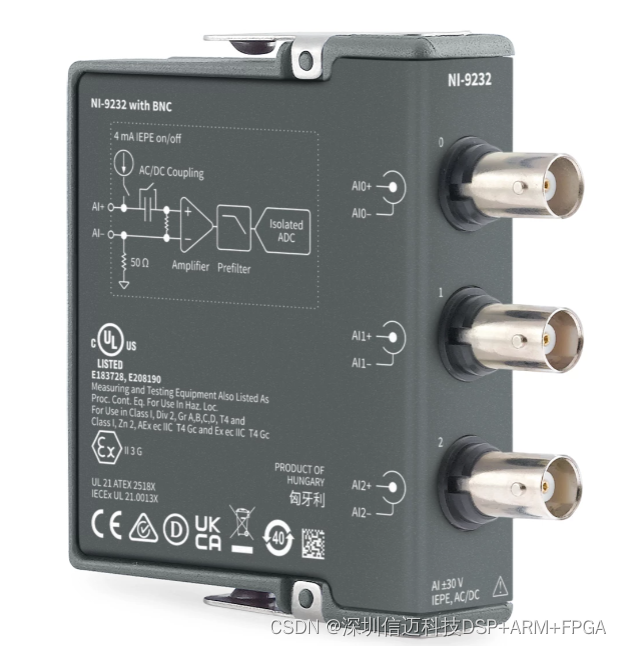
The NI-9232 is a C Series sound and vibration input module designed for high-fidelity dynamic signal acquisition in industrial condition monitoring and structural analysis applications. This post covers the module's core capabilities, explains how its hardware features translate to real-world measurement tasks, and discusses what to look for when evaluating domestic NI alternatives for this class of measurement hardware.
What the NI-9232 Does
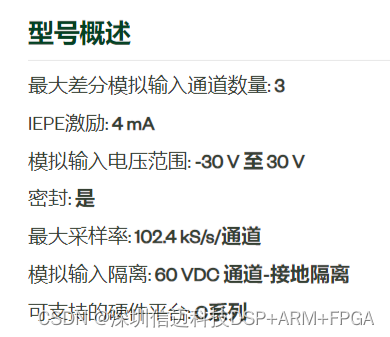
The NI-9232 provides three channels of simultaneous analog input, each capable of sampling at up to 102.4 kS/s. The ±30 V input range is unusually wide for a vibration front-end — most IEPE-oriented modules target ±5 V or ±10 V — which gives this module headroom to accommodate both low-level piezoelectric accelerometer outputs and higher-voltage signals from proximity probes or tachometers without external attenuation.
All three channels acquire synchronously, meaning their samples are time-aligned at the hardware level. This is a critical requirement for any measurement that depends on phase relationships between channels, such as cross-spectral analysis, transfer function estimation, or multi-plane balancing.
IEPE Signal Conditioning
IEPE (Integrated Electronic Piezoelectric) is the sensor interface standard — sometimes branded as ICP by PCB Piezotronics — used by the vast majority of industrial accelerometers, microphones, and force sensors. An IEPE sensor is a piezoelectric transducer with a built-in charge amplifier that requires the measurement front-end to supply a constant current (typically 2–4 mA) over the same coaxial cable that carries the signal.
The NI-9232 integrates this excitation circuitry directly. Software-selectable AC/DC coupling means the module can:
- AC coupling: block the DC bias voltage introduced by the IEPE current source, presenting only the dynamic signal to the ADC. This is the normal operating mode for vibration and acoustic measurements.
- DC coupling: pass the full signal including the DC component, which is needed for quasi-static measurements or when working with non-IEPE sensors that provide a true differential or single-ended DC output.
The module also includes IEPE open/short circuit detection. An open circuit (broken cable or disconnected sensor) removes the return path for the excitation current, causing the bias voltage to rail. A short circuit collapses the bias entirely. Both conditions produce saturated or zeroed readings that look like valid data if you aren't watching. Hardware detection flags these fault conditions in software before data is logged, preventing silent measurement errors during long-running tests.
Anti-Aliasing Filters
Each channel includes a built-in anti-aliasing filter that automatically tracks the configured sampling rate. This is not a fixed-cutoff filter — the cutoff adjusts so that the filter always attenuates energy above the Nyquist frequency regardless of which sample rate the user selects. For a module sampling at 102.4 kS/s, this means a Nyquist limit of 51.2 kHz, which comfortably covers the full audible range and extends into the ultrasonic band relevant for high-frequency bearing fault detection.
Automatic filter adjustment eliminates a common operator error: forgetting to re-configure an analog filter when changing the sample rate mid-test. It also simplifies system validation, since the filter characteristic is always consistent with the acquisition rate.
TEDS Sensor Support
The NI-9232 is compatible with TEDS (Transducer Electronic Data Sheet) sensors, an IEEE 1451.4 standard that stores calibration coefficients, sensor type, serial number, and engineering unit conversion data in a small memory chip embedded in the sensor connector or cable. When a TEDS sensor is plugged in, the module reads this metadata automatically and can apply the correct sensitivity scaling without manual entry. This reduces setup errors and improves traceability in regulated or ISO-certified test environments.
Condition Monitoring with NI Software
When paired with NI software (LabVIEW, NI-DAQmx, or Sound and Vibration Measurement Suite), the NI-9232 unlocks additional signal processing workflows:
- Frequency analysis: FFT-based spectral measurement, octave analysis, and narrowband tracking for identifying resonance frequencies or rotating machinery fault signatures.
- Order tracking: resampling vibration data relative to a tachometer reference so that spectral content is expressed as multiples of shaft speed rather than in Hz. This is the standard approach for analyzing variable-speed machinery such as wind turbine gearboxes, automotive engines during run-up/coast-down, or compressor trains with variable-frequency drives.
Evaluating Domestic Alternatives
When qualifying a domestic alternative to the NI-9232, the following specifications are the minimum checklist:
| Parameter | NI-9232 Specification |
|---|---|
| Channels | 3 (simultaneous) |
| Sample rate per channel | 102.4 kS/s |
| Input range | ±30 V |
| IEPE excitation | Yes (software-selectable) |
| AC/DC coupling | Software-selectable per channel |
| IEPE fault detection | Open and short circuit |
| Anti-aliasing filter | Automatic, tracks sample rate |
| TEDS support | IEEE 1451.4 |
| Form factor | NI C Series |
Beyond raw specs, verify that the alternative module's driver supports synchronous multi-channel start triggers, exposes per-channel coupling and IEPE enable as runtime-configurable properties (not just firmware flash settings), and that the IEPE fault flags are surfaced through the driver API rather than requiring manual inspection of raw ADC codes. These software-side details are where many lower-cost alternatives cut corners that only surface during integration, not during bench evaluation.