[NI Alternative] NI‑9218, 51.2 kS/s/ch, 2-Channel C Series Universal Analog Input Module
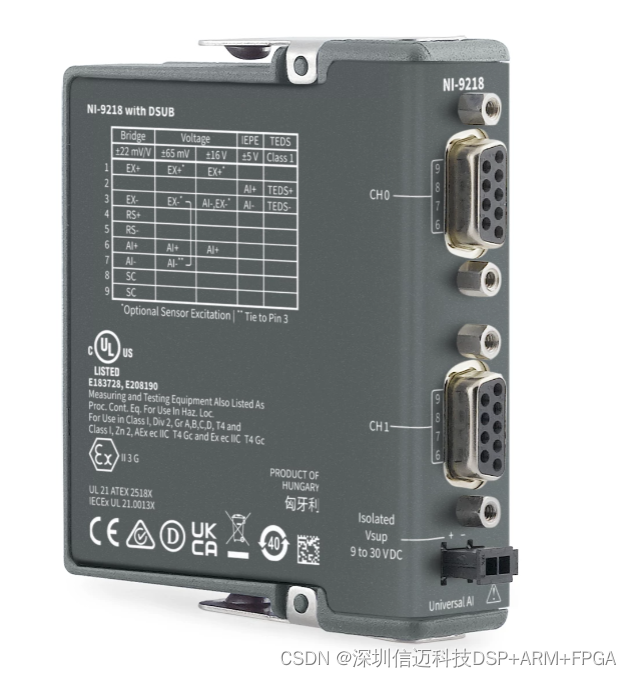
The NI-9218 is a two-channel, 51.2 kS/s/ch C Series universal analog input module designed for engineers who need one hardware platform to cover a wide range of sensor types without swapping modules between test campaigns. This post breaks down what makes the NI-9218 distinctive, how its adapter-based architecture works, and why it shows up so frequently in automotive, off-highway, and portable data-logging applications — along with what to look for if you are evaluating drop-in alternatives.
What Is the C Series Platform?
C Series modules slot into National Instruments CompactDAQ (cDAQ) chassis and CompactRIO (cRIO) controllers. The chassis handles timing, synchronization, and USB/Ethernet/Wi-Fi connectivity to a host PC, while each C Series module provides a specific analog or digital I/O function. Because every module shares the same mechanical form factor and backplane interface, a single chassis can mix signal-conditioning types — strain gauges in slot 1, thermocouples in slot 2, and a universal module like the NI-9218 in slot 3 — all time-synchronized at the chassis level.
NI-9218 Key Specifications
| Parameter | Value |
|---|---|
| Channels | 2 (individually configurable) |
| Sample rate | 51.2 kS/s per channel |
| Module type | C Series Universal Analog Input |
| Supported measurement classes | Accelerometer (IEPE), powered sensor (4–20 mA / voltage excitation), full-bridge, half-bridge, quarter-bridge, differential voltage, ±60 V voltage, current |
The 51.2 kS/s rate is deliberately chosen: it aligns with standard audio and vibration-analysis sample rates and gives you more than enough bandwidth to capture typical structural resonances, NVH (noise, vibration, harshness) signatures, and transient shock events well below the Nyquist limit.
Adapter-Based Signal Conditioning
The NI-9218's defining feature is its adapter system. Rather than building separate modules for every sensor class, NI designed the module around a universal analog front end and uses snap-on adapters — sold separately — to reconfigure the input circuitry for each measurement type:
- IEPE / accelerometer adapter — supplies the constant-current excitation (typically 2 mA) that IEPE accelerometers and microphones require, then AC-couples the signal for dynamic measurements.
- Full-bridge / half-bridge / quarter-bridge adapters — provide bridge excitation voltage and the completion resistors needed for resistive strain-gauge circuits.
- 60 V voltage adapter — extends the input range for higher-voltage measurements, useful for monitoring bus voltages in automotive electrical systems (12 V, 24 V, 48 V architectures).
- Current adapter — converts a 4–20 mA or similar current-loop signal for process-control sensors.
This approach keeps capital cost low: one module handles many measurement scenarios, and only the inexpensive adapter changes when the sensor type changes.
Per-Channel Independence
A key practical advantage of the NI-9218 is that its two channels are independently configurable. Channel 0 can run with an IEPE accelerometer adapter capturing vibration at 51.2 kS/s while Channel 1 uses a quarter-bridge adapter for a strain gauge — all within the same module and synchronized to the same timebase. This flexibility matters on crowded test rigs where space inside the chassis is limited.
Target Applications
Automotive and powertrain testing — Engine and transmission development labs need to simultaneously capture accelerometer data (for knock detection or bearing health), bridge-based torque and force measurements, and voltage signals from ECU outputs. The NI-9218's multi-modal capability reduces the number of modules — and therefore chassis slots — required per test stand.
Off-highway and heavy equipment — Construction, agricultural, and mining equipment testing faces wide temperature ranges and high vibration environments. The NI-9218 is rated for the rugged C Series operating envelope, and its 60 V input range accommodates the higher supply voltages common in heavy-vehicle electrical systems.
Data logging systems — Portable CompactDAQ chassis paired with the NI-9218 serve as compact field data loggers. A single two-slot cDAQ-9171 (USB) chassis plus an NI-9218 fits in a small enclosure and can log accelerometer and bridge data simultaneously to a laptop or embedded controller in the field.
Evaluating Alternatives
If you are sourcing NI-9218 replacements — whether for cost reduction, supply-chain diversification, or end-of-life planning — the relevant criteria to match are:
- Sample rate: 51.2 kS/s/ch is a specific ADC clock rate. Alternatives at 50 kS/s or 48 kS/s may introduce subtle timing differences in synchronized multi-module setups.
- Measurement mode breadth: Confirm the alternative supports IEPE excitation current, bridge excitation voltage and completion, and the ±60 V range natively — not just differential voltage.
- Adapter ecosystem: Some alternatives integrate signal conditioning directly on the module (no adapter required), which simplifies the BOM but reduces reconfigurability.
- Software compatibility: If your test code targets NI-DAQmx, an alternative based on the same driver stack will require the least code rework. Alternatives with their own SDK require driver-layer abstraction.
- C Series mechanical compatibility: The module must comply with the C Series connector and locking tab standard to seat properly in cDAQ and cRIO chassis.
Summary
The NI-9218 earns its place in multi-purpose test systems by collapsing accelerometer, bridge, voltage, and current measurement into a single two-channel module with per-channel configurability and a 51.2 kS/s sample rate suited for vibration and dynamic signal work. Its adapter architecture makes it unusually flexible for a fixed-form-factor instrument. When evaluating alternatives, prioritize matching the measurement mode breadth and sample rate before assuming pin-compatible modules are functionally equivalent.