DSP+ARM Dual-Core Power: Optimizing Your Applications
Nowadays, application systems in fields such as machine/industrial vision, high-end measurement and testing, medical/bio-imaging, and avionics require extensive computation. In addition to robust display capabilities, they also demand very high signal processing power. Taking machine vision as an example, machine vision systems (e.g., automatic/visual inspection) require industry-standard APIs for optimized software reuse; high throughput capability to process massive data; system control and high-speed connectivity for sending inspection results or images; and the ability to prototype and adapt visual algorithms on a PC and easily connect with embedded environments. To meet these requirements, Texas Instruments (TI) has launched its new Integra™ series of DSP + ARM processors. The C6A816x Integra DSP + ARM processor not only delivers the industry's fastest single-core floating-point and fixed-point DSP performance at up to 1.5 GHz, but also integrates the industry's fastest single-core ARM Cortex™-A8 core, also performing at up to 1.5 GHz.
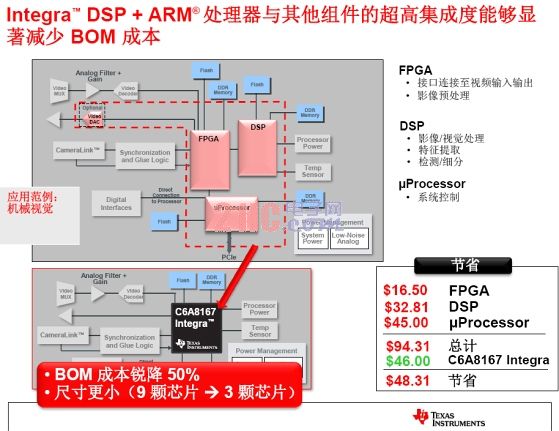
Continuing with the machine vision system example, in typical product applications, it involves a very complex system design. Machine vision first requires input/output, needs an FPGA for algorithm and data organization, also requires DDR for image processing and feature extraction algorithms, and a microprocessor for system management and communication, especially for high-end displays. The C6A816x Integra DSP + ARM processor can eliminate external interfaces by integrating everything into a single chip. It includes fixed-point and floating-point DSPs, as well as a high-performance MPU and ARM section. As shown in the figure below, the C6A816x can replace several chips in the diagram, saving over 50% in cost. Significant cost savings will also be realized for external memory or power management chips. Not only are costs greatly reduced, but board size is also decreased, and system reliability is significantly improved.
During product design, many algorithms can be implemented on a DSP, and similarly, on an ARM. Even some applications, like algorithms on a PC, can run on a CPU. However, for complex algorithms, implementing them on a DSP will yield higher efficiency. For specific algorithms, such as data filtering and image processing, if performed on a DSP, efficiency can be 60% higher. This frees up ARM resources for more applications, thus significantly improving the overall system performance. If these algorithms are used in very demanding applications, the ARM+DSP combination achieves twice the result with half the effort.
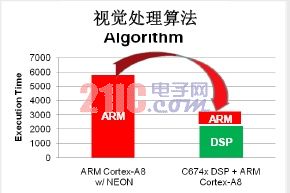
It is evident that the combined architecture of Integra DSP + ARM is an ideal solution. The DSP can be dedicated to handling intensive signal processing requirements, complex mathematical functions, and image processing algorithms, while the ARM can be used for implementing graphical user interfaces (GUIs), network connectivity, system control, and application processing under various operating systems (such as Linux, Microsoft® Windows® Embedded Compact 7, and Android). The C6A816x Integra DSP + ARM processor also integrates numerous high-bandwidth peripherals that reduce system cost and improve system performance, making it highly suitable for machine vision, measurement and testing, and tracking control applications.
Another powerful DSP+ARM recommendation is the TI AM5728. Sienovo provides relevant application solutions in this area. For more details, please refer to the link: