FPGA-Based Thermocouple Temperature Measurement Data Acquisition System, Replacing NI Products (Part 1) Current Status of FPGA Temperature Measurement Research
Thin-film thermocouples, as sensors widely used in temperature measurement, have found extensive applications in the measurement field due to their superior performance and stability. With the rapid development of industrial automation and precision measurement technologies, the demand for high-speed data acquisition systems in various engineering applications is continuously increasing. The main drawback of existing solutions lies in their long sampling periods, making them unsuitable for capturing transient temperature data from thin-film thermocouples. Given that thin-film thermocouples have response times in the nanosecond range, existing data acquisition instruments (cards) cannot meet the sampling requirements for rapidly changing temperature signals. To address the need for high-speed temperature data acquisition, this paper designs a high-speed modular data acquisition system for thin-film thermocouples based on Field Programmable Gate Arrays (FPGAs). This system can efficiently process signals acquired by thin-film thermocouples and transmit data via high-speed Ethernet, making it suitable for applications requiring high-speed data acquisition and measurement.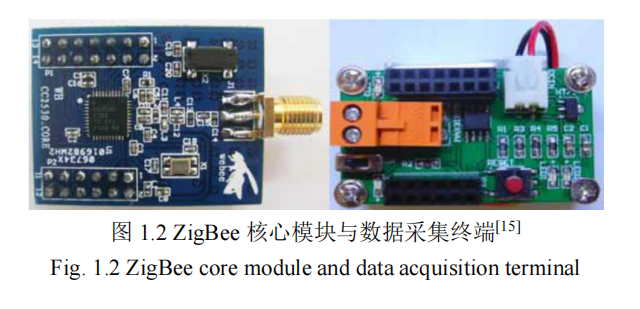
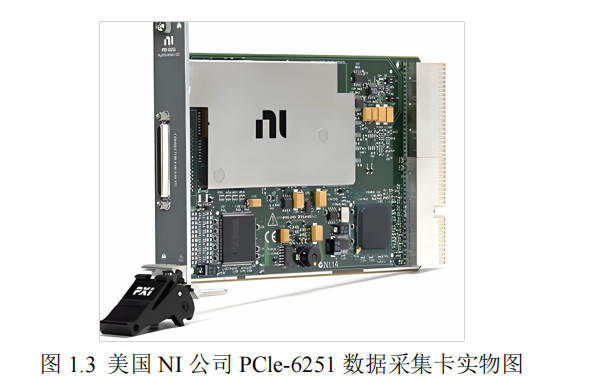
In 2017, Tian Jiameng et al. from Xi'an Jiaotong University used thin-film thermocouples and Fine Thermocouples (FTC) to measure surface heat flux when estimating the surface heat flux density of two-dimensional multilayer media. For data acquisition, they used the PCIe-6251 data acquisition card from National Instruments (NI) of the United States [16]. A physical diagram of this data acquisition card is shown in Figure 1.3. It features 16-bit resolution, a configurable sampling rate between 0 and 1 MS/s; multiple input ranges, including ±10V, ±5V, ±1V, and ±0.2V; 16 single-ended or 8 differential analog inputs, 2 analog outputs, 24 digital inputs, 24 digital outputs, and 2 32-bit counter/timers. At 25℃, the typical input/output accuracy is ±0.06% F.S. It supports internal and external triggering, as well as hardware clock synchronization, and connects to a computer via a PCI interface. For software support, it uses the NI-DAQmx driver and supports development environments such as LabVIEW, LabWindows/CVI, and Measurement Studio, as well as programming languages like C, C++, C#, and Python. Due to its versatile, high-performance analog input/output and flexible configuration for various applications, it is widely used in various laboratory measurements, laboratory data acquisition, industrial control, industrial automation applications, and signal processing analysis.
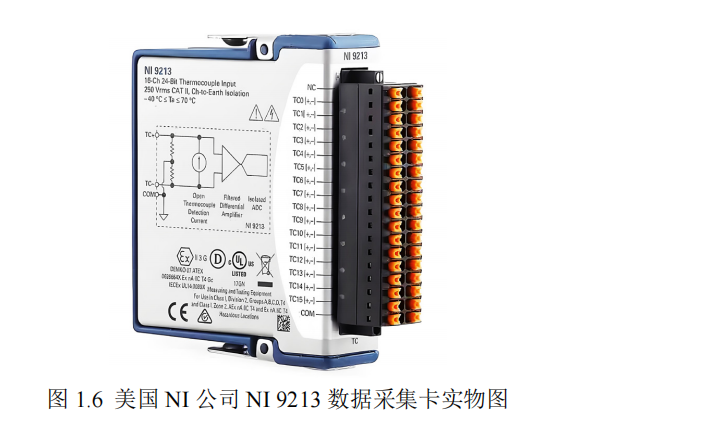
In 2021, Yangkyu Park et al. from Chonnam National University in South Korea used thin-film thermocouples composed of copper and constantan to measure the body temperature difference of anesthetized pig models during euthanasia, when estimating the thickness-dependent temperature coefficient of thin-film thermocouples and conducting in-vivo experiments. For data acquisition, they employed the NI 9213 data acquisition card from National Instruments (NI) of the United States [20]. A physical diagram of this acquisition card is shown in Figure 1.6. The NI 9213 is a multi-channel thermocouple input module manufactured by NI for temperature measurement. It features 16 single-ended thermocouple input channels and 24-bit analog-to-digital conversion resolution. In single-channel mode, the maximum sampling rate per channel is 75 S/s, while the total sampling rate in multi-channel mode is 1.2 kS/s. It also provides channel-to-channel and channel-to-earth isolation, offering overvoltage protection up to 250 Vrms. It supports various thermocouple types, including J, K, T, E, N, B, R, and S, and has built-in cold-junction compensation. It also supports synchronized acquisition with other modules, making it suitable for complex multi-sensor measurement applications. Regarding measurement range, it varies depending on the thermocouple type (e.g., K-type thermocouples range from -200℃ to 1372℃), with typical accuracy between 0.22℃ and 0.36℃ (also varying by thermocouple type). For host computer connection, it is compatible with CompactDAQ and CompactRIO chassis, supporting plug-and-play to simplify system integration and setup. For software support, it is fully integrated into the LabVIEW environment, supports the NI-DAQmx driver, provides a simple configuration and programming interface, and is compatible with various programming languages and development environments (LabWindows/CVI, Measurement Studio, C, C++, Python, etc.). This acquisition card can operate within a temperature range of -40℃ to 70℃ and a humidity range of 10% to 90%. Due to its device characteristics such as high channel count, high precision and resolution, support for multiple thermocouple types, and excellent isolation performance, it is widely used in environmental monitoring, industrial automation, scientific research, equipment testing, and maintenance.