Domestic NI Alternative: 32-Channel Vibration/Voltage (Configurable Hybrid) High-Precision Data Acquisition Board for Complex, Large-Scale Measurement Scenarios
Industrial test and measurement has long been dominated by platforms such as National Instruments (NI) CompactDAQ and CompactRIO. For Chinese manufacturers and system integrators working on rotating machinery diagnostics, structural health monitoring, or multi-axis vibration analysis, import costs, lead times, and export-control exposure have driven demand for domestically engineered alternatives. This post covers one such alternative: a 32-channel, FPGA-based high-precision dynamic signal acquisition system built around a configurable board architecture that targets exactly the large-scale, cost-tolerant measurement scenarios where NI hardware has traditionally dominated.
Hardware Architecture Overview
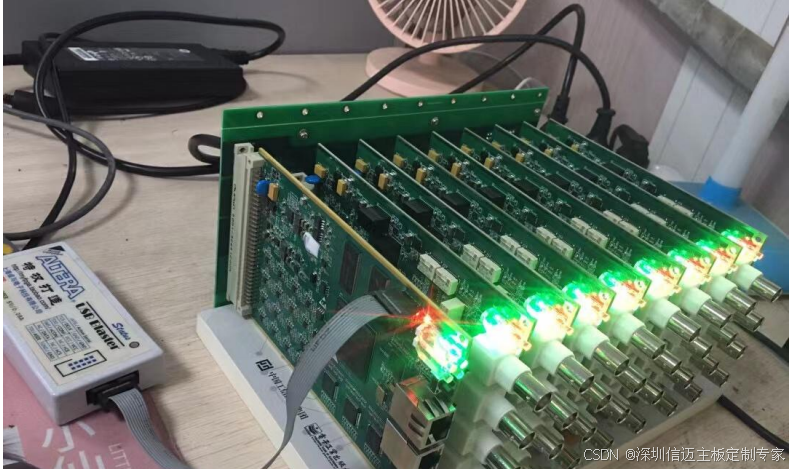
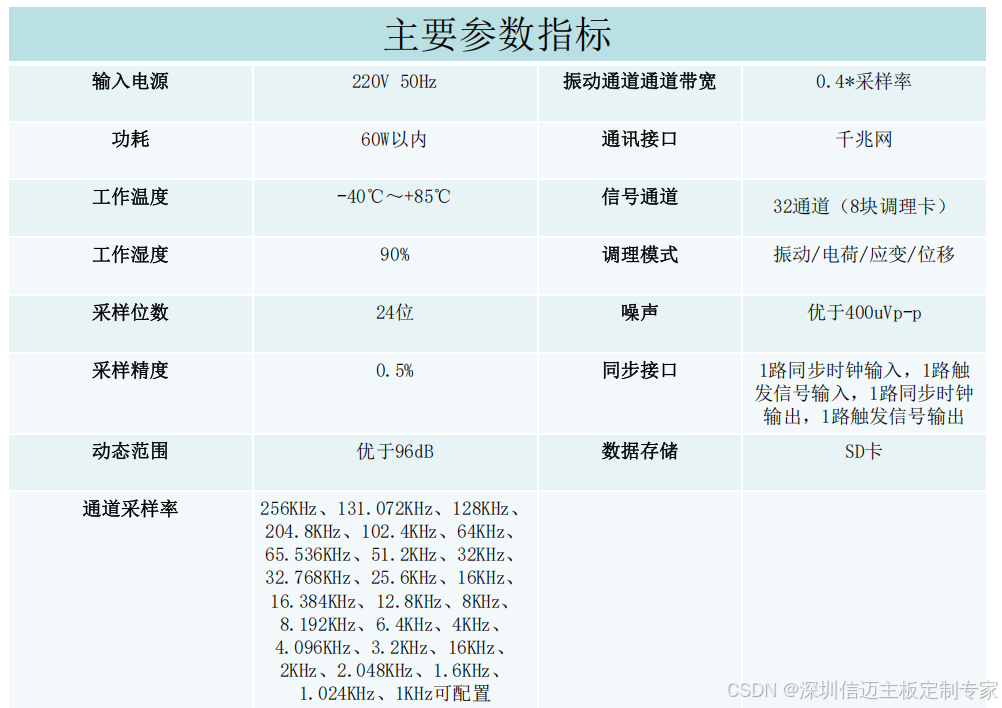
The system is built around an Altera EP4CE115F29I7 FPGA — a Cyclone IV E device with 114,480 logic elements, 3,888 Kbits of embedded RAM, and 266 18×18 multipliers in a 780-ball FBGA package, rated for the industrial temperature range (–40 °C to +100 °C). Cyclone IV FPGAs are widely used in real-time data acquisition front-ends because they offer enough fabric to implement parallel ADC control, sample synchronization, digital filtering, and high-speed data transfer without the cost or power budget of a high-end FPGA family.
The default configuration installs 8 measurement boards, each carrying 4 measurement channels, giving the system 32 channels in total. All channels run simultaneously and are synchronized through the FPGA fabric, which is the key capability that separates a true dynamic signal analyzer from a multiplexed DAQ board — phase relationships between channels are preserved, making the system suitable for modal analysis, operational deflection shape (ODS) measurements, and cross-correlation studies.
Configurable Signal Conditioning Architecture
The distinguishing design choice is that each of the 8 boards is field-replaceable and type-selectable. Supported board types include:
- Vibration — typically IEPE/ICP-compatible inputs for piezoelectric accelerometers, with constant-current excitation and AC coupling
- Strain — bridge completion and excitation for strain gauges, with support for quarter-, half-, and full-bridge configurations
- Charge — charge amplifier front-ends for charge-output piezoelectric sensors (useful at very high temperatures where IEPE buffers cannot operate)
- Displacement — voltage-output conditioned inputs for eddy-current probes (e.g. Bently Nevada-style proximity probes) used in shaft orbital analysis
- Custom — customer-specified conditioning boards for non-standard transducers or proprietary sensor interfaces
This modular approach mirrors the philosophy of NI's C Series module ecosystem, but implemented as a single integrated chassis rather than a controller-plus-module stack. The implication for the user is that a single frame can serve a turbine test cell that needs vibration and displacement channels on the same acquisition front-end without an external signal conditioner rack.
Target Applications
The product is positioned explicitly for complex, large-scale measurement applications where cost is not the primary constraint. This language is significant: it signals that the system competes on channel density, synchronization quality, and flexibility rather than on price. Typical use cases in this category include:
- Rotating machinery diagnostics on large turbines, compressors, or generators, where dozens of vibration and proximity-probe channels must be sampled simultaneously for bearing fault detection and rotor dynamics analysis
- Structural health monitoring (SHM) of bridges, dams, or large civil structures, combining accelerometers and displacement sensors across many nodes
- Engine test cells requiring simultaneous vibration, strain, and charge-mode pressure transducer inputs
- Modal testing on aerospace or automotive structures, where channel count and phase coherence drive measurement quality
EMC Considerations
For deployments in electromagnetically harsh environments — motor drive cabinets, high-power RF test environments, or heavy industrial switchgear installations — the existing chassis structure may need to be modified to achieve the required shielding effectiveness. The product note emphasizes that the PCB circuitry has already been specifically designed for EMC: differential signaling, guard traces, proper grounding, and filtered supply rails are implemented at the board level. The remaining EMC gap is typically at the chassis and connector level (apertures, cable entry points, seam attenuation), which is addressed through custom enclosure modifications rather than board-level rework. This is a practical and honest disclosure — it tells the integrator where the work lies without overstating the base design.
Positioning vs. NI and Other Alternatives
Comparable NI configurations — a PXIe chassis with 32 synchronous analog input channels using NI PXIe-4499 or PXIe-4492 sound and vibration modules — carry significant hardware and software licensing costs, plus dependency on NI's LabVIEW or NI-DAQmx ecosystem. This system targets integrators who need the channel density and synchronization quality of a PXI-class platform but want a domestic supply chain, the ability to customize conditioning hardware, and freedom from third-party software licensing constraints.
The FPGA-centric architecture also means that custom real-time processing (order tracking, tachometer-synchronous averaging, digital filtering) can be implemented directly in the acquisition front-end, reducing host-side computational load — an advantage in embedded or ruggedized deployments where a full PC-class host is impractical.