NXP LS1046 + FPGA-based 3U CPCI Multi-Port Network Solution for Rail Transit, Supporting QNX/VxWorks/Linux
Rail transit systems demand computing platforms that can handle real-time network aggregation, deterministic timing, and extended environmental operating ranges — all within strict form-factor constraints. This post covers a family of three embedded computing modules built around the NXP LS1046A processor and FPGA acceleration, designed specifically for rail transit network infrastructure and certified to operate under QNX, VxWorks, and Linux.
Why LS1046A for Rail Transit Networking
The NXP LS1046A is a quad-core ARM Cortex-A72 SoC clocked at up to 1.4 GHz. Beyond raw compute, what makes it well-suited to network-intensive rail applications is its integrated packet-forwarding engine and hardware-accelerated cryptography — allowing it to move and inspect traffic at line rate without burdening the application cores. The SoC also supports ECC memory, which is mandatory for safety-critical transportation environments where silent data corruption is unacceptable.
All three modules in this family pair the LS1046A with QSPI NOR flash for bootloader storage and eMMC for the OS and application filesystem. QSPI provides fast, reliable boot even after power interruptions — a common occurrence in rail environments — while eMMC gives the OS a wear-leveled, managed-NAND target with predictable write performance. DDR4 SDRAM provides the working memory, with capacities scaled to the board's intended role.
Debug access is provided via JTAG and the NXP CodeWarrior-compatible COP (Common On-chip Processor) debug port on all three variants, enabling source-level debugging of both bare-metal firmware and RTOS-based applications without requiring a live serial connection.
Module 1 — 3U Standard CPCI Network Gateway
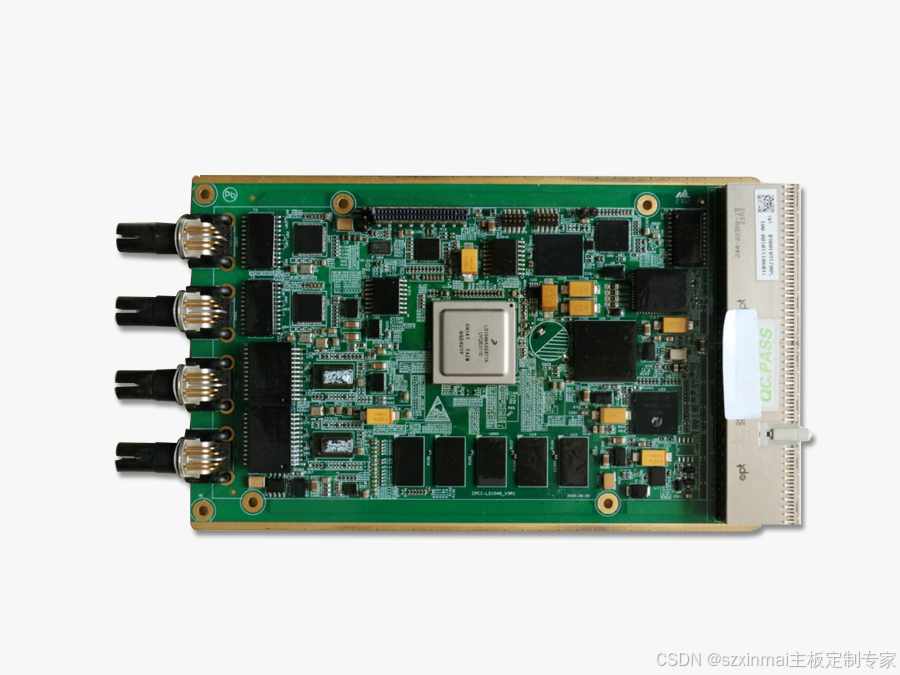
| Specification | Description |
|---|---|
| Processor | NXP LS1046A at up to 1.4GHz |
| Storage | DDR4, 16GB eMMC, 16MB QSPI FLASH |
| Form Factor | 3U Standard CPCI Board |
| Dimensions | 160.00 × 100.00mm |
| Interfaces | 2x 2.5GE, 2x 1GE, 1x RS232, 1x IRIG-B |
| Debug Interface | JTAG / COP debug port |
This module slots directly into a standard 3U CompactPCI chassis, making it a drop-in upgrade for existing rail wayside and onboard equipment racks. The mixed Ethernet configuration — two 2.5GE ports alongside two 1GE ports — is a practical design choice: the 2.5GE ports serve as uplinks or inter-node trunks, while the 1GE ports connect to legacy line-side equipment without requiring speed negotiation adapters.
The IRIG-B interface is the critical differentiator for rail timing. IRIG-B is an analogue or digital time-code standard used throughout rail and aerospace for synchronizing distributed equipment to a GPS-derived time reference. Having IRIG-B on the gateway module means all network timestamps and log entries can be correlated across the entire train consist or wayside network with sub-millisecond accuracy — essential for fault analysis and regulatory compliance.
Module 2 — Dual CPU Custom Module for High-Density I/O
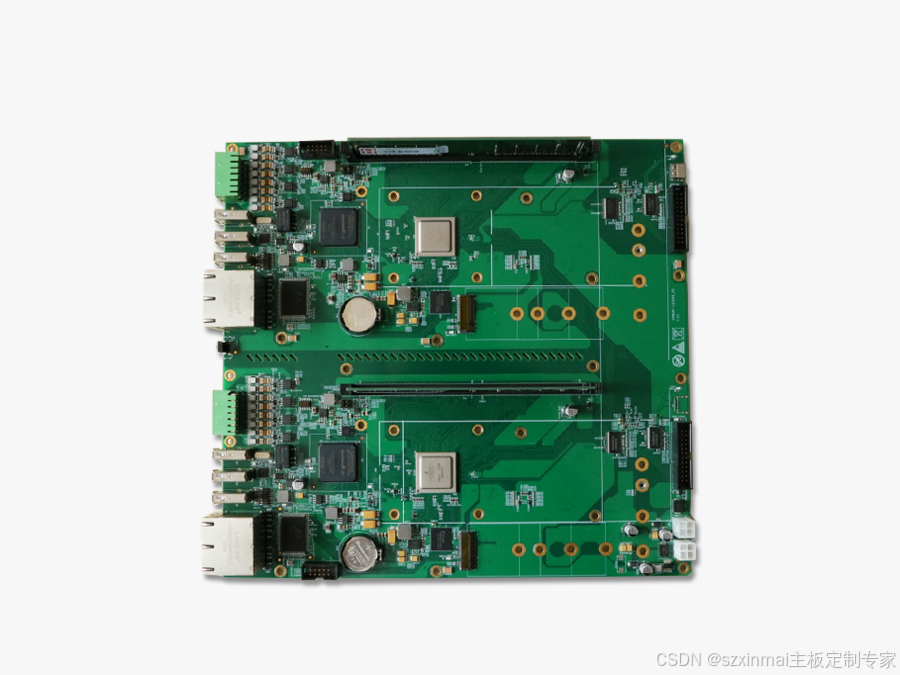
| Specification | Description |
|---|---|
| Processor | NXP LS1046A at up to 1.4GHz, Dual CPU |
| Storage (per module) | 8GB DDR4, 8GB eMMC, 16MB QSPI FLASH |
| Form Factor | Custom Board, Dual CPU Module |
| Dimensions | 270.00 × 254.99mm |
| Interfaces (per module) | 4x 1000MBase-TX RJ45, 3x USB2.0, 1x RS232, 4x RS485 |
| Debug Interface | JTAG / COP debug port |
This larger custom board houses two independent LS1046A CPU modules on a single carrier, each with its own 8 GB DDR4 and 8 GB eMMC. The dual-CPU architecture supports either a redundant active-standby configuration — where one CPU takes over if the other fails — or a partitioned workload model where each CPU runs a separate RTOS partition with hardware isolation between safety-critical and non-safety functions.
The RS485 interfaces (four per CPU module) are directly applicable to MVB (Multifunction Vehicle Bus) and CAN-adjacent serial protocols used throughout rolling stock for sensor polling, door control, HVAC, and braking system telemetry. USB 2.0 ports allow firmware updates via USB storage or connection of diagnostic tools without needing a network path — valuable during depot maintenance when the full network may not be available.
Module 3 — High-Port-Density Custom Network Aggregator
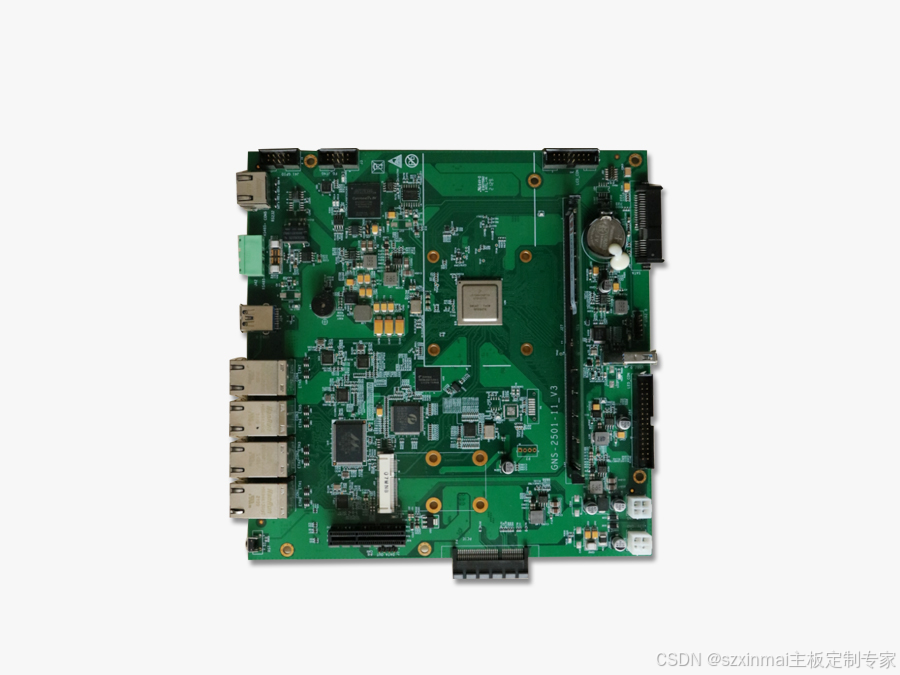
| Specification | Description |
|---|---|
| Processor | NXP LS1046A at up to 1.4GHz |
| Storage | 16GB DDR4, 8GB eMMC, 16MB QSPI FLASH |
| Form Factor | Custom Board |
| Dimensions | 212.00 × 210.00mm |
| Interfaces | 8x 1000MBase-TX RJ45, 2x USB3.0, 1x RS232, 1x IRIG-B |
| Debug Interface | JTAG / COP debug port |
With eight Gigabit Ethernet ports, this module functions as a managed switch and aggregation point for a train consist or a wayside communications cabinet. The LS1046A's packet-forwarding engine can handle L2/L3 switching between those eight ports at line rate, enabling VLAN segmentation between passenger Wi-Fi, train control, and diagnostic traffic on a single physical fabric.
The upgrade to USB 3.0 (vs 2.0 on Module 2) reflects this board's role as a data concentrator: high-speed USB allows rapid offload of recorded event logs, video, or diagnostic captures to portable storage at the end of a service cycle. Like Module 1, this board includes IRIG-B for precise time-stamping of all network events.
The 16 GB DDR4 — double that of the per-module allocation on the dual-CPU board — gives the aggregator headroom for deep packet buffers, flow tables, and in-memory event logging without spilling to eMMC.
RTOS and OS Support
All three modules are validated for QNX Neutrino, VxWorks, and Linux. QNX and VxWorks are the dominant RTOSes in rail safety applications; their deterministic scheduling guarantees are required by standards such as EN 50155 (railway electronics) and IEC 62280 (railway communication security). Linux is commonly used for non-safety subsystems — passenger information displays, onboard Wi-Fi controllers, diagnostic servers — where the rich networking stack and open-source driver ecosystem outweigh the need for hard real-time guarantees.
The LS1046A's hardware partitioning capabilities, combined with a hypervisor layer, allow mixed-criticality deployments where a safety-certified RTOS runs in one partition and Linux runs concurrently in another, sharing the physical board but with memory and interrupt isolation enforced in hardware.
Summary
These three NXP LS1046A + FPGA-based modules address the full spectrum of rail transit networking needs: a standards-compliant 3U CPCI gateway for chassis-based deployments, a dual-CPU custom module for redundant or partitioned high-I/O applications, and an eight-port aggregator for consist-level network consolidation. Consistent use of the LS1046A across all three variants simplifies BSP maintenance and allows a single RTOS build tree to target the entire product family.