CPCI-Compatible Rail Transit Health Monitoring Data Acquisition and Analysis Solution Based on NXP LS1043 + FPGA
Rail transit fleets operate under punishing duty cycles — vibration, temperature swings, and continuous 24/7 loads that would shorten the life of commodity hardware within months. Health monitoring systems on trains and metro lines must therefore combine real-time signal acquisition with deterministic edge processing, all within a ruggedized, hot-swap-capable chassis standard. This post covers Sienovo's CPCI-compatible data acquisition and analysis boards built around the NXP LS1043 processor paired with FPGA fabric, and explains why this architecture is well-suited to rail transit health monitoring applications.
Why NXP LS1043 + FPGA for Rail Applications
The NXP LS1043A is a quad-core ARM Cortex-A53 SoC designed for embedded networking and industrial control. Running at up to 1.2 GHz in these configurations, it brings enough compute headroom to run Linux-based condition-monitoring software, protocol stacks, and on-board analytics simultaneously, without the power envelope or cooling demands of a server-class CPU.
FPGA co-processing complements the LS1043 where deterministic, low-latency I/O matters most. In rail health monitoring, sensors for axle bearing vibration, pantograph contact force, brake pressure, and door actuator loads all produce high-frequency analog or digital streams that need timestamping and pre-filtering before being handed to the ARM cores. An FPGA handles this front-end conditioning in hardware, decoupled from OS scheduling jitter.
The CompactPCI (CPCI) form factor is the natural chassis choice for this environment. CPCI defines a Eurocard mechanical standard with a rugged pin-and-socket connector that tolerates vibration and allows field replacement without powering down the entire chassis — a critical property for onboard train equipment where maintenance windows are measured in minutes during turnaround.
Board Variants and Specifications
Sienovo offers three board variants in this family, differentiated by form factor and Ethernet port count to fit different installation locations and bandwidth requirements on a train consist.
Variant 1 — 4U Eurocard, Quad Gigabit Ethernet
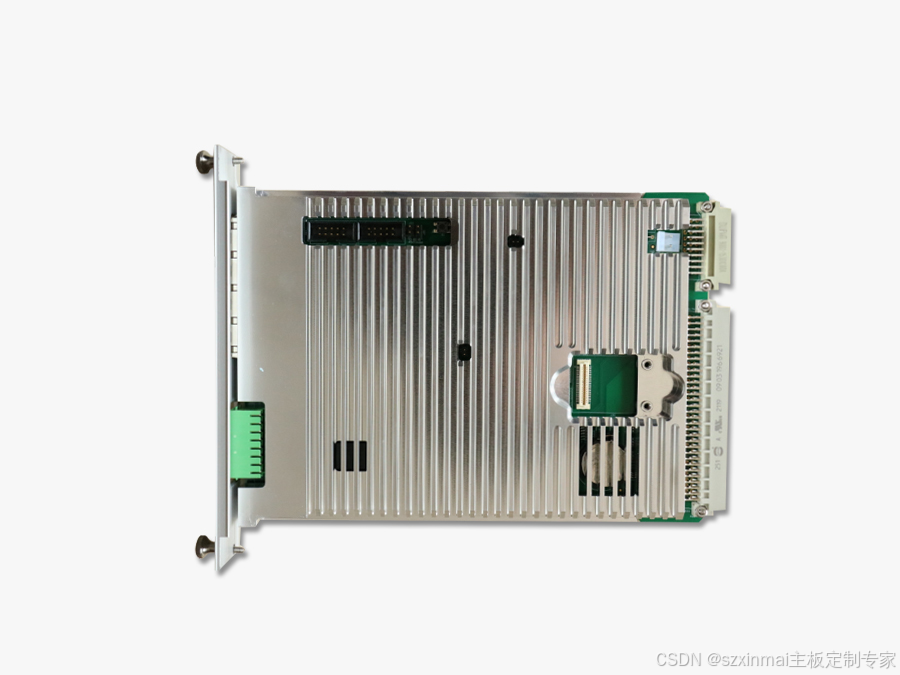
Feature Summary
| Specification | Description |
|---|---|
| Processor | NXP LS1043 at up to 1.2 GHz |
| Memory | DDR4, 8 GB eMMC, 64 MB NOR FLASH |
| Form Factor | 4U Eurocard Form Factor |
| Dimensions | 201.82 × 144.43 mm |
| Interfaces | 4× 10/100/1000 Mbps Ethernet |
| Debug Interface | JTAG / COP debug port |
This is the highest-connectivity variant, with four independent Gigabit Ethernet ports. It is suited for aggregation nodes that collect data from multiple downstream sensor subsystems — for example, a central monitoring unit that receives streams from bogies at both ends of a car and bridges them to the train backbone network (typically Ethernet Train Backbone, ETB, or a proprietary consist network).
The 8 GB eMMC provides local buffering for data that cannot be offloaded to a trackside server in real time, such as during tunnel sections with no wayside connectivity. The 64 MB NOR FLASH carries the bootloader and firmware images, benefiting from NOR's byte-addressable read capability for reliable in-field firmware update.
Variant 2 — 4U Eurocard, Dual Gigabit Ethernet
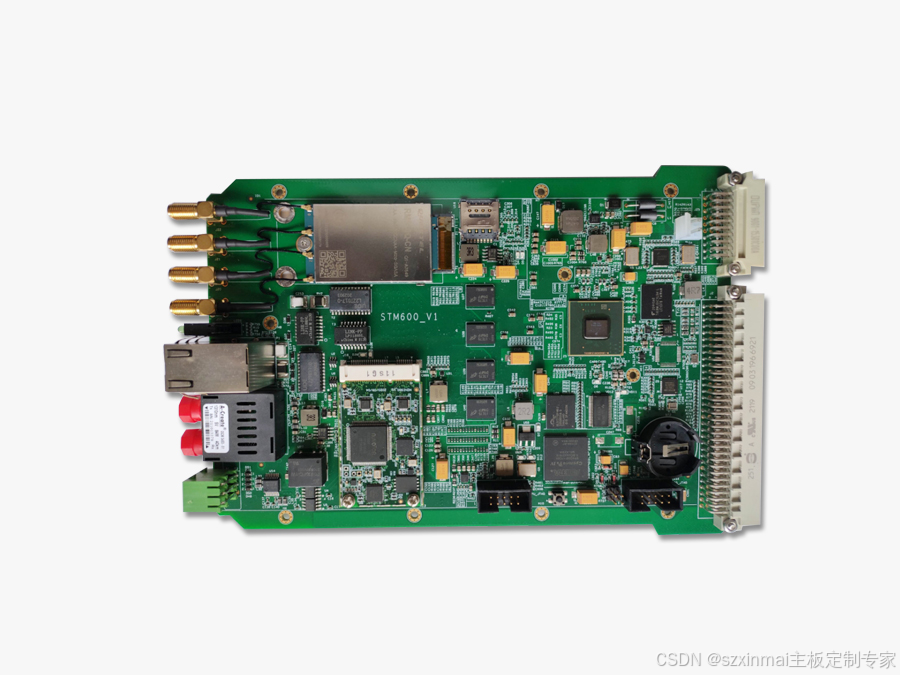
Feature Summary
| Specification | Description |
|---|---|
| Processor | NXP LS1043 at up to 1.2 GHz |
| Memory | DDR4, 8 GB eMMC, 64 MB NOR FLASH |
| Form Factor | 4U Eurocard Form Factor |
| Dimensions | 201.82 × 144.43 mm |
| Interfaces | 2× 10/100/1000 Mbps Ethernet |
| Debug Interface | JTAG / COP debug port |
Mechanically identical to Variant 1, this board reduces the Ethernet port count to two. This configuration fits subsystem nodes where a single sensor cluster (e.g., one bogie's bearing monitors plus traction motor temperature sensors) feeds into the monitoring chain. The saved routing and connector budget can be redirected to additional FPGA I/O expansion or power conditioning circuitry depending on the integration design.
Variant 3 — 3U Standard CPCI, Dual Fast Ethernet
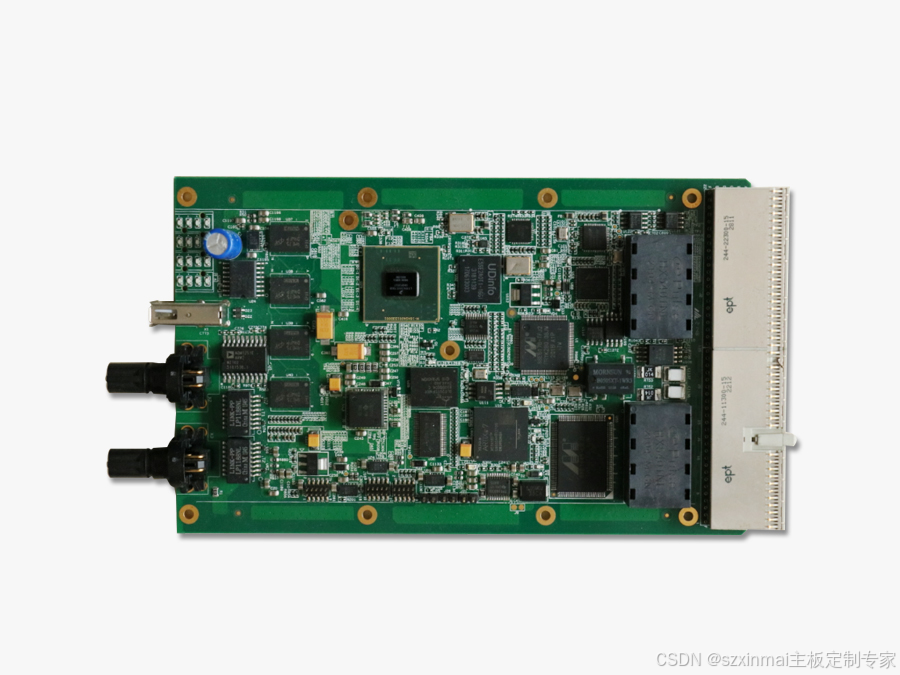
Feature Summary
| Specification | Description |
|---|---|
| Processor | NXP LS1043 at up to 1.2 GHz |
| Memory | DDR4, 16 GB eMMC, 64 MB NOR FLASH |
| Form Factor | 3U Standard CPCI Board |
| Dimensions | 160.00 × 100.00 mm |
| Interfaces | 2× 10/100 Mbps Ethernet |
| Debug Interface | JTAG / COP debug port |
The 3U variant trades physical height (and slot pitch) for space efficiency in tighter enclosures. At 160 × 100 mm it fits standard 3U CPCI chassis used throughout the rail industry, opening compatibility with existing trackside equipment racks and onboard cabinets already built to that slot depth. The Ethernet interfaces cap at 100 Mbps rather than Gigabit, appropriate for lower-bandwidth sensor endpoints where the primary data paths are serial buses (CAN, RS-422, MVB) converted internally and reported as status frames rather than raw waveforms.
Notably, this variant ships with 16 GB eMMC — double the other two — which compensates for the lower network bandwidth by providing more local storage for extended offline data capture before an upload window is available.
Deployment Considerations
All three boards share the same processor, memory architecture, and debug interface, which simplifies software maintenance across a mixed fleet. A single Linux BSP built for the LS1043 can run on any variant; board-specific differences (Ethernet port count, FPGA pinout, chassis backplane signaling) are handled through device-tree overlays rather than separate firmware branches.
The JTAG / COP debug port is a standard NXP CodeWarrior-compatible interface, allowing engineers to attach a debug probe for bare-metal bringup, FPGA configuration verification, or post-fault memory inspection without removing the board from the chassis.
For rail operators evaluating health monitoring architectures, this board family provides a clear scaling path: deploy 3U boards at individual sensor clusters near the bogie, feed their 100 Mbps links into a 4U aggregation node with Gigabit uplinks, and connect that aggregation node to the consist backbone. The CPCI chassis standard ensures that any board in the chain can be swapped in the field within a maintenance cycle, keeping fleet availability high.