Solution for Fully Automatic Chemiluminescence Immunoassay Analyzer Based on NXP IMX8P, FPGA, and AI
Fully automatic chemiluminescence immunoassay (CLIA) analyzers sit at the intersection of precision fluidics, high-speed signal processing, and real-time embedded computing. This post walks through a hardware platform solution for such an analyzer, built around the NXP i.MX 8M Plus (IMX8P) application processor, an FPGA co-processor, and an on-device AI inference engine — a combination that addresses the demanding mix of real-time motion control, photon-counting signal acquisition, image processing, and clinical reporting that modern CLIA instruments require.
What a Fully Automatic CLIA Analyzer Does
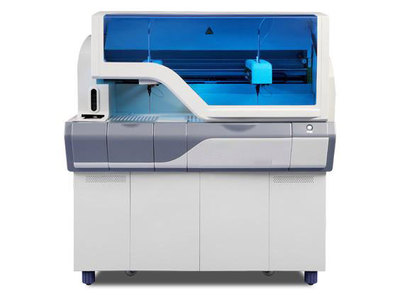
A chemiluminescence immunoassay analyzer automates the detection of proteins, hormones, infectious-disease markers, and cardiac biomarkers by exploiting light emitted during a chemical reaction between a labeled antibody and the target antigen. The instrument accepts whole blood, serum, or plasma specimens, runs reagent-mixing and incubation cycles, and then measures photon output from a photomultiplier tube (PMT) or similar detector. Results feed directly into clinical decision support, making both throughput and measurement accuracy safety-critical requirements.
The fully automatic variant adds sample loading carousels, on-board reagent refrigeration, robotic pipetting arms, and a barcode/RFID sample-tracking subsystem — all of which must be orchestrated in real time while simultaneously capturing and interpreting luminescence signals.
Why a Heterogeneous Compute Platform?
No single processor class handles all of these workloads optimally:
- Motion and I/O control (stepper motors, solenoid valves, pipette actuators) requires deterministic, sub-millisecond timing that general-purpose Linux kernels cannot reliably guarantee.
- PMT signal acquisition and photon counting involves high-speed pulse detection and accumulation logic that maps naturally onto FPGA fabric.
- Image processing and AI inference (for result verification, QC flagging, or barcode reading) benefits from the high-throughput compute and modern OS ecosystem available on a 64-bit application processor.
- Human-machine interface (HMI) demands a smooth GUI with touch input, color waveform display, and network connectivity for LIS (Laboratory Information System) integration.
The solution addresses this by pairing the NXP i.MX 8M Plus with an FPGA, delegating real-time I/O and analog front-end control to the FPGA while running the application stack, AI pipeline, and HMI on the i.MX 8M Plus.
NXP i.MX 8M Plus: The Application Processor
The i.MX 8M Plus (IMX8P) is built on a quad-core ARM Cortex-A53 architecture running at up to 1.8 GHz, supplemented by a Cortex-M7 real-time core, a dedicated NPU (Neural Processing Unit) capable of up to 2.3 TOPS, and a powerful multimedia subsystem.
Key attributes relevant to this application:
| Feature | Detail |
|---|---|
| CPU cores | 4× Cortex-A53 @ 1.8 GHz |
| Real-time core | 1× Cortex-M7 @ 800 MHz |
| On-board NPU | ~2.3 TOPS, supports TensorFlow Lite / ONNX |
| Standard memory | 2 GB LPDDR4 |
| Video output | Dual MIPI-DSI / LVDS, supports 1080p |
| OS support | Linux (Yocto / Ubuntu), Android |
| Connectivity | Gigabit Ethernet, USB 3.0, PCIe, SDIO |
The 2 GB of standard memory comfortably holds the Linux OS, instrument firmware, reagent databases, QC calibration curves, and an active AI inference model simultaneously. The integrated NPU offloads neural-network inference — for example, a convolutional model that classifies reaction-curve shapes to flag anomalous results or detect pipetting errors from camera images — without burdening the Cortex-A53 cluster.
The robust video processing pipeline drives the color touchscreen HMI that clinicians and lab technicians interact with directly. With a high-version Linux OS (typically a recent Yocto-based BSP from NXP), the device benefits from up-to-date security patches and driver support for peripherals like Ethernet, USB printers, and barcode scanners.
FPGA Co-Processor: Real-Time Control and Signal Acquisition
The FPGA handles tasks that demand cycle-accurate timing or high-speed digital signal processing:
- Stepper motor step/direction generation for the pipetting arm and carousel with sub-step interpolation
- PMT pulse counting and integration windows synchronized to the optical measurement cycle
- Analog front-end control (ADC/DAC interfaces for temperature regulation, pressure sensing, and reagent level detection)
- Interlock and safety logic (reagent cap detection, door interlocks, overflow sensors) with guaranteed response latency
Communication between the FPGA and the i.MX 8M Plus typically occurs over a high-speed parallel bus, SPI, or PCIe, depending on bandwidth requirements. The FPGA can also implement a soft real-time OS partition (e.g., a small RISC-V or ARM Cortex-M soft core) to run instrument sequencing state machines independently of the Linux host.
Solution Topology
The architecture below illustrates how subsystems are partitioned across the platform:
At a high level:
- Sample and reagent handling layer — carousel motors, pipette Z/θ axes, temperature-controlled reagent bays — all commanded by FPGA real-time control logic.
- Detection layer — PMT or photodiode array with trans-impedance amplifier, digitized and pulse-counted in FPGA fabric.
- Application layer — i.MX 8M Plus running Linux, receiving aggregated measurement data from the FPGA, applying calibration curves, running AI-assisted QC, and presenting results on the HMI.
- Connectivity layer — Gigabit Ethernet to hospital LIS/HIS, USB for barcode reader and printer, optional Wi-Fi.

AI Integration for Quality Control and Anomaly Detection
The on-chip NPU on the i.MX 8M Plus opens the door to on-device AI inference without cloud round-trips — critical in a clinical context where network availability cannot be assumed and patient data privacy must be maintained. Practical AI applications in this architecture include:
- Reaction curve classification: A lightweight neural network trained on normal vs. anomalous luminescence time-series can flag substrate degradation, air bubbles in the light path, or reagent lot drift before a result is reported.
- Pipetting verification: A camera module watching the pipette tip can run an image classifier to detect failed aspiration or clot-blocked tips.
- Predictive maintenance: Vibration or current-draw telemetry from motor drivers, aggregated over time, can feed an anomaly-detection model to anticipate mechanical wear.
Models are typically quantized to INT8 and compiled for the i.MX 8M Plus NPU using NXP's eIQ ML software toolkit, achieving inference times well under the inter-measurement cycle window.
Clinical and Regulatory Considerations
A CLIA analyzer is an IVD (in vitro diagnostic) medical device, subject to regulatory frameworks such as the EU IVDR, FDA 510(k)/PMA, or China's NMPA registration. The software stack must therefore address:
- Traceability: all measurement data, calibration runs, and QC results logged with timestamps to non-volatile storage.
- Software lifecycle: IEC 62304 compliance for medical device software development.
- Cybersecurity: network interfaces must implement access controls; over-the-air firmware update mechanisms require cryptographic signing.
The i.MX 8M Plus supports ARM TrustZone, secure boot, and hardware-accelerated cryptography (AES, RSA, SHA), providing a hardware foundation for these requirements.
Summary
The combination of the NXP i.MX 8M Plus, an FPGA co-processor, and an integrated AI pipeline provides a well-matched hardware foundation for a fully automatic chemiluminescence immunoassay analyzer. The i.MX 8M Plus quad-core Cortex-A53 at 1.8 GHz with 2 GB RAM handles the HMI, application logic, LIS connectivity, and on-device AI inference through its dedicated NPU; the FPGA provides the deterministic real-time control and high-speed signal acquisition that clinical measurement accuracy demands. Together, this heterogeneous architecture lets instrument manufacturers deliver high-throughput, AI-enhanced diagnostic capability in a platform that is both clinically capable and regulatory-ready.