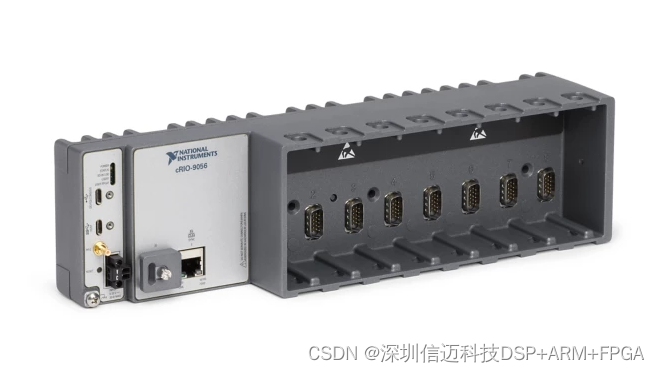
【NI Domestic Virtual Instrument】Domestic Alternative to NI-9056, 1.33 GHz Dual-Core CPU, 1 GB DRAM, 4 GB Storage, -20 °C to 55 °C, Artix-7 75T FPGA, 8-Slot CompactRIO Controller
As industrial automation and test-and-measurement engineering teams in China navigate supply-chain diversification, NI's cRIO-9056 CompactRIO controller has become a reference benchmark that domestic vendors must match. This post breaks down exactly what the cRIO-9056 delivers — processor, FPGA fabric, I/O connectivity, real-time OS, and environmental rating — and explains what engineers should look for when evaluating a domestic alternative targeting the same application space.
What Is CompactRIO and Why Does It Matter?
CompactRIO is NI's rugged embedded platform that combines a real-time processor with a reconfigurable FPGA in a single chassis. The key architectural insight is the tight coupling between the CPU and the FPGA: the processor handles high-level logic, communication, and data management, while the FPGA provides deterministic, hardware-timed I/O at nanosecond-level precision. C-Series modules — analog input, analog output, digital I/O, CAN, serial, and dozens of other types — plug directly into the chassis and connect to the FPGA fabric, giving engineers hardware-level control over every signal.
This architecture makes CompactRIO popular in applications where software-timed PC-based DAQ is not fast or deterministic enough: hardware-in-the-loop (HIL) testing, machine condition monitoring, power electronics control, and aerospace ground-support equipment.
cRIO-9056 Specifications in Detail
Processor and Memory
The cRIO-9056 is built around an Intel Atom dual-core processor running at 1.33 GHz, paired with 1 GB DRAM and 4 GB of onboard eMMC flash storage. The Intel Atom choice reflects NI's preference for x86 compatibility and low power draw in an embedded form factor — the same LabVIEW Real-Time VIs and NI Linux Real-Time applications compiled for other Atom-based cRIOs can typically be redeployed with minimal changes.
FPGA: Xilinx Artix-7 75T
The onboard FPGA is a Xilinx (AMD) Artix-7 75T, which provides approximately 75,000 logic cells, 105 DSP slices, and 4.86 Mb of block RAM. In practical CompactRIO terms, this fabric is more than sufficient for high-speed waveform acquisition, custom triggering logic, closed-loop PID control running at hundreds of kilohertz loop rates, and parallel signal processing across all eight C-Series slots simultaneously. Engineers program the FPGA using LabVIEW FPGA Module, which compiles graphical block diagrams down to VHDL and synthesizes against the Artix-7 target — no HDL expertise required, though experienced users can drop in IP cores or hand-written VHDL for performance-critical paths.
Eight C-Series Module Slots
The 8-slot chassis is the key capacity differentiator. Each slot connects directly to the FPGA through the RIO (Reconfigurable I/O) backplane, so there is no communication bottleneck between the module and the FPGA logic. A typical deployment might populate the chassis with a mix of analog input modules (e.g., voltage, thermocouple, or strain), digital I/O, and communication modules — all running in hardware-synchronized lockstep.
Real-Time Operating System and Software Stack
The controller runs NI Linux Real-Time, a deterministic Linux distribution hardened for embedded control. Application code executes in a priority-based RTOS environment where loop jitter is typically in the low-microsecond range. I/O access from the real-time processor goes through either:
- NI-DAQmx driver — the standard NI driver API for scan-based or on-demand I/O, familiar to anyone coming from NI's USB or PXI DAQ products.
- LabVIEW FPGA Module — for direct, hardware-timed FPGA access where the real-time VI communicates with custom FPGA logic through FIFO queues and direct memory-mapped registers.
TSN Networking for Deterministic Communication
The cRIO-9056 is built on Time-Sensitive Networking (TSN), an IEEE 802.1 standard suite that adds deterministic, time-synchronized traffic scheduling to standard Ethernet. TSN eliminates the packet-jitter problems of conventional Ethernet for distributed control loops, enabling multiple CompactRIO systems on the same network segment to share a synchronized clock and coordinate measurements to sub-microsecond precision. This is critical in distributed test rigs where a trigger generated on one chassis must correlate to a measurement captured on another.
Connectivity Interfaces
| Interface | Detail |
|---|---|
| Gigabit Ethernet | TSN-capable, for real-time network synchronization |
| USB 3.1 Host | External mass storage, peripherals |
| USB 2.0 Device | PC-to-controller programming/communication |
| Trigger Lines | Hardware trigger input/output for multi-device sync |
| μSD Card Slot | Removable local storage for data logging |
Environmental Rating
The -20 °C to 55 °C operating temperature range covers most industrial deployment environments — factory floors, outdoor cabinets in temperate climates, and transportation test benches — without requiring active cooling beyond what the chassis fan (if present) provides.
Evaluating a Domestic Alternative
When Sienovo or another domestic vendor positions a product as a cRIO-9056 alternative, the meaningful checklist is:
- FPGA fabric equivalence — Does the domestic FPGA (or Artix-7 license) match the logic cell count, DSP slices, and block RAM? Undersized FPGA fabric will limit parallel I/O processing and high-speed loop rates.
- C-Series module compatibility — True pin-for-pin and protocol-for-protocol compatibility with NI C-Series modules eliminates re-qualification cost for existing sensor and actuator libraries.
- Real-time OS determinism — NI Linux Real-Time achieves microsecond-range jitter; a domestic alternative should publish loop jitter benchmarks under realistic I/O load.
- TSN support — Hardware TSN support (not software-emulated timestamping) is essential for multi-chassis synchronization applications.
- LabVIEW FPGA toolchain compatibility — If the engineering team has existing LabVIEW FPGA IP, a target that accepts standard LVBITX bitfiles eliminates FPGA recompilation.
- Long-term supply and support — The domestic alternative should provide datasheets, a software SDK, calibration certificates, and a repair/calibration service path matching the NI standard.
The cRIO-9056's specification set — dual-core 1.33 GHz Atom, Artix-7 75T, 8 slots, TSN Gigabit Ethernet, NI Linux Real-Time, -20 °C to 55 °C — defines the minimum viable bar. Any domestic CompactRIO-class controller competing in this space must meet or exceed each of these parameters to qualify as a true drop-in alternative for existing and new industrial deployments.