ZYNQ-7020 Integrates Real-Time Processor Running NI Linux Real-Time, Supports FPGA Secondary Development
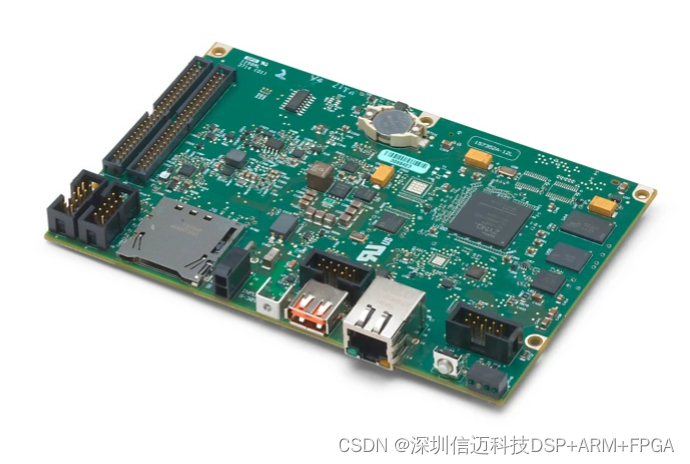
The NI sbRIO-9637 is a CompactRIO Single-Board Controller that brings together a real-time processor, a user-reconfigurable Xilinx Zynq-7020 FPGA, and a full complement of analog and digital I/O onto a single printed circuit board. Designed for engineers who need deterministic control, signal acquisition, and custom FPGA logic in a compact, embeddable package, the sbRIO-9637 is particularly well suited for high-volume OEM deployments where board-level integration is a hard requirement.
Processor and Memory Architecture
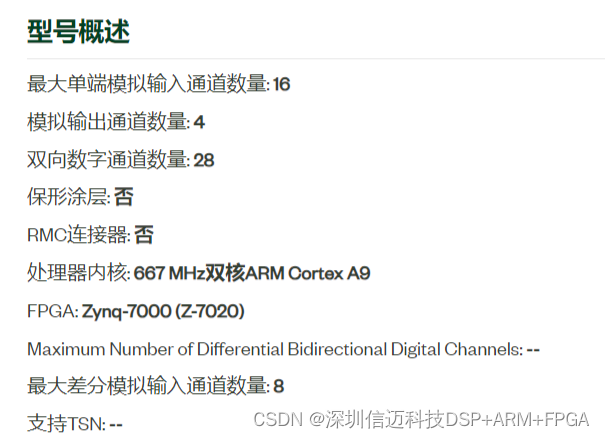
At the heart of the sbRIO-9637 is the Xilinx Zynq-7020 SoC — a tightly coupled heterogeneous device that pairs a dual-core ARM Cortex-A9 processing system (PS) running at 667 MHz with a Artix-7-class programmable logic (PL) fabric. This architecture is what allows NI to run a full real-time operating system on the PS side while simultaneously offloading time-critical or parallel tasks to the FPGA fabric on the PL side, all within a single chip and without the latency penalties of a discrete CPU-to-FPGA interface.
The controller ships with 512 MB of DRAM and 512 MB of non-volatile storage. The DRAM is shared between the processor subsystem and, via AXI interconnects, the FPGA logic, giving custom IP cores direct access to large data buffers when needed. The 512 MB of onboard storage provides enough capacity for the NI Linux Real-Time OS image, application binaries, and local data logging without requiring an external drive for most use cases.
NI Linux Real-Time and Deterministic Execution
The real-time processor runs NI Linux Real-Time, NI's deterministic Linux-based operating system. Unlike a general-purpose Linux distribution, NI Linux Real-Time is a preempt-RT patched kernel configured specifically for deterministic task scheduling. This means loop rates in the hundreds of microseconds are achievable on the processor side, and any tasks that demand sub-microsecond timing can be offloaded to the FPGA. The combination gives system designers a two-tier execution model: high-level application logic and communications on the RT processor, and cycle-accurate I/O sampling or custom protocol handling in the FPGA fabric.
I/O Capabilities
The sbRIO-9637 provides a practical mix of analog and digital I/O directly on the board:
- 16 analog inputs at 16-bit resolution — suitable for precision sensor acquisition, strain gauges, thermocouples (with appropriate signal conditioning), or general-purpose voltage measurement
- 4 analog outputs at 16-bit resolution — useful for driving actuators, setpoint references, or generating test stimuli
- 28 digital I/O lines at 3.3 V logic levels — configurable for general-purpose digital control, PWM generation, encoder interfaces, or custom serial protocols implemented in the FPGA
Because all I/O lines connect directly to the FPGA fabric rather than through a discrete ADC controller, timing relationships between analog samples and digital events can be managed at the hardware level with determinism that software-only solutions cannot match.
Connectivity Ports
For a board aimed at OEM integration, the sbRIO-9637 offers a well-rounded set of connectivity options:
- Gigabit Ethernet — for high-throughput data transfer to a host PC, cloud historian, or embedded HMI
- CAN — widely used in automotive, industrial automation, and motion control applications for robust, noise-tolerant field bus communication
- USB — for peripheral attachment, firmware updates, or mass storage
- Serial (RS-232/RS-485) — for legacy instrument communication or custom device protocols
- SDHC — for removable storage, useful for data logging, configuration file distribution, or firmware deployment in the field
The operating temperature range of the sbRIO-9637 is specified to cover demanding industrial environments, making it appropriate for applications that would rule out commercial-grade embedded PCs.
FPGA Secondary Development
One of the key selling points of the sbRIO-9637 for OEM customers is that the Zynq-7020's programmable logic is fully user-accessible. NI exposes the FPGA for secondary development through LabVIEW FPGA, allowing engineers to implement custom I/O timing, signal processing pipelines, or custom communication protocols without writing RTL from scratch. The LabVIEW FPGA compilation toolchain targets the Zynq-7020's PL fabric and handles the AXI interconnect plumbing between the FPGA logic and the RT processor automatically.
For teams that prefer working closer to the hardware, the Zynq-7020 is also supported by Xilinx Vivado, and NI provides documentation on integrating custom Vivado IP cores into the LabVIEW FPGA project flow. This gives advanced users the option to bring in hand-optimized VHDL or Verilog IP — for instance, a custom motor control algorithm, a vision pre-processing pipeline, or a proprietary communication protocol — and still benefit from the NI software stack for the processor-side application.
OEM Integration Considerations
The single-PCB form factor is what differentiates the sbRIO series from rack-mount or chassis-based CompactRIO systems. Because all the compute, FPGA logic, and I/O conditioning sit on one board, the sbRIO-9637 can be mounted directly onto a customer's backplane or housed in a custom enclosure without additional NI chassis hardware. This significantly reduces bill-of-materials cost and system volume in production OEM quantities, at the expense of the modularity that a chassis-based system provides.
For high-volume OEM applications — industrial robots, medical devices, automated test equipment, energy monitoring systems — the sbRIO-9637 offers a compelling combination of a mature software ecosystem (LabVIEW, NI Linux Real-Time, TestStand), deterministic dual-tier execution, and the flexibility of a user-reconfigurable FPGA, all pre-qualified for industrial temperature operation on a single, certifiable PCB.