PXIe-6396 Domestic Alternative, 8-channel AI (18-bit, 14 MS/s/ch), 2-channel AO, 24-channel DIO, PXI Multifunction I/O Module
The PXIe-6396 is a high-performance, simultaneously sampling multifunction data acquisition (DAQ) module from National Instruments, widely deployed in demanding test and measurement environments. This article introduces its core capabilities and explores the domestic alternative offered by Sienovo for engineers seeking a drop-in replacement without sacrificing measurement fidelity.
What Is the PXIe-6396?
The PXIe-6396 is a PXI Express multifunction I/O module built around simultaneous sampling — meaning all analog input channels are sampled at the same instant rather than multiplexed in sequence. This is a critical distinction for applications where phase relationships between channels must be preserved, such as vibration analysis, multichannel impedance characterization, or coherent signal detection in radar and sonar systems.
Its key electrical specifications are:
- 8 analog input (AI) channels at 18-bit resolution and 14 MS/s per channel (simultaneous)
- 2 analog output (AO) channels
- 24 digital I/O (DIO) lines
- Four 32-bit counters/timers
- Both analog and digital triggering support
The 18-bit ADC resolution at 14 MS/s places the PXIe-6396 in a class that bridges high-speed digitizers and general-purpose DAQ cards. With a theoretical dynamic range exceeding 100 dB (before practical noise floor limitations), it is well suited for capturing low-level signals buried alongside high-amplitude interference — a common scenario in ultrasound imaging, high-energy physics detector readout, and telecommunications conformance testing.
Onboard NI-STC3 Timing and Synchronization
A distinguishing hardware feature is the NI-STC3 (System Timing Controller 3) ASIC integrated on the module. NI-STC3 provides:
- Independent analog and digital timing engines — analog and digital I/O tasks can run on separate clocks without interfering with each other, enabling complex mixed-signal test sequences.
- Retriggerable measurement tasks — the module can automatically restart an acquisition on each trigger edge without host CPU intervention, reducing latency and jitter in repetitive stimulus-response tests.
- PXI Express star trigger and reference clock — the module locks to the PXI chassis backplane reference, allowing deterministic multi-module synchronization across an entire rack.
This timing architecture is what separates the PXIe-6396 from lower-cost multiplexed DAQ cards and makes it a preferred choice for IF (intermediate frequency) digitization, where the capture window must align tightly with an external RF event.
Target Application Domains
The PXIe-6396 was specifically positioned for several demanding industries:
Telecommunications manufacturing test (ISDN, ADSL, POTS): Production lines for DSL and POTS chipsets require both stimulus generation (AO) and high-speed capture (AI) with tight timing to characterize echo cancellation, line impedance, and codec distortion. The module's simultaneous AI channels eliminate the inter-channel skew that would otherwise corrupt crosstalk measurements.
Ultrasound and sonar: Phased-array transducer systems rely on phase-coherent multichannel acquisition. Simultaneous sampling at 14 MS/s covers the ultrasonic frequency range (typically 1–10 MHz for medical; lower for sonar) with adequate oversampling for accurate time-of-flight estimation.
Transient recording: Capturing single-shot events such as power-line disturbances, ignition pulses, or mechanical shock requires the retriggerable task capability and sufficient sample memory depth to record the full transient without gaps.
High-energy physics: Particle detector front-ends generate short-duration analog pulses that must be digitized across many channels simultaneously. The 18-bit depth helps resolve both the large baseline pedestal and the small signal pulse in the same acquisition window.
IF digitization: In software-defined radio and radar test, an IF signal (typically 10–500 MHz after downconversion) is digitized directly. At 14 MS/s, the module covers IF bandwidths up to 7 MHz per Nyquist; for wider IF, it is used downstream of an external downconverter or bandpass filter stage.
Software Ecosystem: NI-DAQmx
The module ships with the NI-DAQmx driver, which provides a hardware abstraction layer across NI's entire DAQ portfolio. From an integration standpoint, NI-DAQmx offers:
- A task-based API available in C, C++, Python (
nidaqmxpackage), LabVIEW, and .NET - The DAQ Assistant configuration utility for no-code channel setup and signal verification
- Built-in calibration routines that store correction coefficients in onboard EEPROM
Because NI-DAQmx is the de facto standard in automated test equipment (ATE) built with NI hardware, any domestic replacement must expose a compatible or equivalent driver interface to avoid costly software re-engineering.
Domestic Alternative from Sienovo
Sienovo's domestic alternative to the PXIe-6396 targets the same PXI Express form factor and matches the core I/O profile: 8-channel simultaneous AI at 18-bit/14 MS/s, 2-channel AO, 24-channel DIO, and four 32-bit counters with hardware triggering. The module is designed for customers in defense, industrial automation, and scientific instrumentation who require a domestically sourced solution to meet procurement regulations or supply-chain requirements.
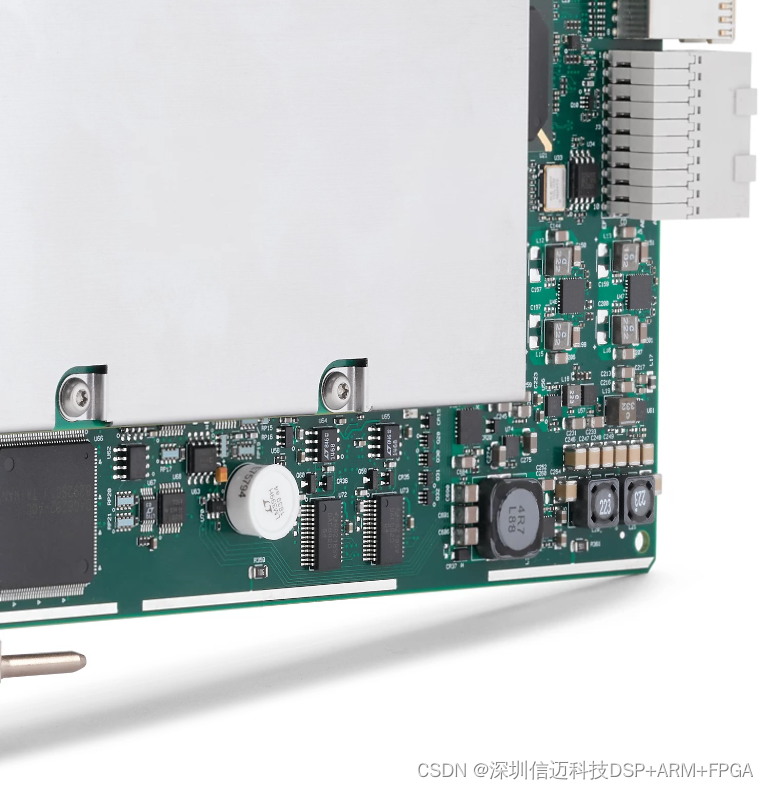
Key considerations when evaluating the Sienovo module as a drop-in replacement:
- PXI Express compliance: Confirm the module adheres to the PXIe electrical and mechanical standard so it seats correctly in any compliant chassis without modification.
- Driver compatibility: Check whether the vendor provides an NI-DAQmx-compatible shim or its own SDK. If existing LabVIEW or Python code uses the
nidaqmxAPI, a compatibility layer avoids rewriting test sequences. - Calibration and certification: For applications in regulated industries (medical, aerospace), verify that the module ships with a NIST-traceable calibration certificate and that the calibration interval matches your quality system requirements.
- Synchronization: Multi-module systems that rely on PXI star trigger lines or the 10 MHz chassis reference clock need the replacement module to expose the same trigger routing architecture as the original.
Summary
The PXIe-6396 sets a high bar for simultaneous-sampling multifunction DAQ: 18-bit resolution, 14 MS/s per channel, onboard NI-STC3 timing, and a mature software ecosystem. Its domestic alternative from Sienovo addresses the same specification envelope and is worth evaluating for procurement-sensitive projects. Engineers considering the switch should validate driver compatibility, synchronization behavior, and calibration traceability against the specific requirements of their test system before committing to a platform migration.