Architecture and Operating Principles of a DSP+FPGA+ADC-Based High-Speed Data Acquisition System
Architecture and Operating Principles of a DSP+FPGA+ADC-Based High-Speed Data Acquisition System
High-speed data acquisition systems are critical components in various industries, including industrial automation, scientific research, and medical applications. These systems require high-speed data processing and analysis capabilities to capture and process large amounts of data in real-time. In this article, we will explore the architecture and operating principles of a high-speed data acquisition system based on a DSP+FPGA+ADC configuration.
System Hardware Architecture
The hardware composition of the high-speed data acquisition platform, which employs a time-interleaved sampling structure, is shown below:
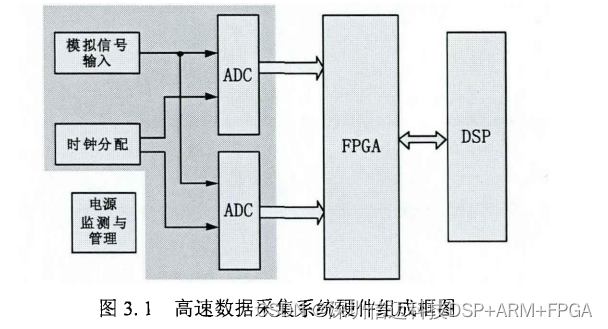
The high-speed data acquisition system is mainly divided into four modules:
Power Monitoring and Management Module
The power monitoring and management module is responsible for monitoring the power supply and managing the system's power consumption. This module ensures that the system operates within safe power limits and provides real-time monitoring of power consumption.
ADC Module
The ADC (Analog-to-Digital Converter) module is responsible for converting analog signals into digital signals. The ADC module uses a time-interleaved sampling structure to achieve high-speed data acquisition. This structure involves alternating between multiple ADC channels to capture data at high speeds.
FPGA Module
The FPGA (Field-Programmable Gate Array) module is responsible for processing and analyzing the digital signals captured by the ADC module. The FPGA module uses its programmable logic to implement custom algorithms and processing functions for data analysis.
DSP Module
The DSP (Digital Signal Processing) module is responsible for performing advanced signal processing and analysis on the data captured by the ADC module. The DSP module uses its digital signal processing capabilities to extract meaningful information from the data.
System Operating Principles
The high-speed data acquisition system operates as follows:
- The ADC module captures analog signals and converts them into digital signals using a time-interleaved sampling structure.
- The FPGA module processes and analyzes the digital signals to extract relevant information.
- The DSP module performs advanced signal processing and analysis on the data to extract meaningful information.
- The power monitoring and management module monitors the system's power consumption and ensures safe operation.
The system's operating principles are designed to achieve high-speed data acquisition and processing capabilities while ensuring safe and efficient operation.
Conclusion
In conclusion, the high-speed data acquisition system based on a DSP+FPGA+ADC configuration is a powerful tool for capturing and processing large amounts of data in real-time. The system's architecture and operating principles are designed to achieve high-speed data acquisition and processing capabilities while ensuring safe and efficient operation.