Cyclone V-based USB3.0/GIGE Industrial Camera Module Design Solution
Designing a compact industrial camera module requires careful selection of every component in the signal chain — from the image sensor front-end through ISP processing, memory subsystem, and host interface. This post walks through a Cyclone V FPGA-based camera module design that supports up to 2-megapixel image sensors and offers either USB 3.0 or GigE Vision connectivity, making it a flexible platform for machine-vision and edge-AI inspection applications.
Design Goals
Industrial camera modules differ from consumer webcams in several key ways: they demand deterministic low-latency image delivery, robust noise immunity in electrically harsh factory environments, and long product-lifecycle component availability. The design described here targets:
- Up to 2 MP sensor support with a scalable ISP pipeline
- Dual host interface support: USB 3.0 (SuperSpeed, up to 5 Gbps) and GigE Vision (1 Gbps with standardized GenICam control)
- Compact form factor suitable for integration into inspection heads, robotic vision systems, and embedded edge-AI platforms
The first production camera module populates the design with an On-Semi PYTHON 480A color sensor running at 800×600 resolution (0.5 MP), providing a validated baseline before scaling to higher-resolution sensors.
Key Components
FPGA: Intel Cyclone V — 5CEFA2M13C8N
The central processing element is an Intel (Altera) Cyclone V E device in the 5CEFA2M13C8N variant. Cyclone V E devices are cost-optimized FPGAs built on a 28 nm process, offering hard memory controllers and high-speed LVDS I/O that are well-suited to parallel sensor interfaces. The FPGA hosts the ISP pipeline — including debayering, white balance, gamma correction, and noise reduction — as well as the GigE Vision framing logic. Using an FPGA rather than a fixed-function SoC gives the designer the flexibility to swap in different sensors and tune the ISP for each.
Image Sensor: ON Semiconductor PYTHON 480A
The PYTHON 480A is a 1/2.5-inch global-shutter CMOS sensor from ON Semiconductor, delivering 800×600 pixels at high frame rates. Its global shutter architecture eliminates the rolling-shutter distortion that plagues fast-moving inspection targets. The PYTHON family uses an LVDS/SPI control interface, which maps cleanly onto Cyclone V LVDS I/O banks, minimising external level-translation components.
USB 3.0 Bridge: Cypress CYUSB3014-BZXI
When the module is configured for USB connectivity, a Cypress (now Infineon) CYUSB3014 acts as the USB 3.0 peripheral controller. The CYUSB3014 is a USB 3.0/2.0 peripheral controller with a 32-bit GPIF II programmable interface that connects directly to the FPGA fabric. It handles all USB protocol stack processing autonomously, so the FPGA only needs to feed bulk image data into the GPIF II FIFO — keeping the FPGA logic budget focused on ISP work. USB 3.0 SuperSpeed bandwidth (up to ~400 MB/s practical throughput) is more than sufficient for 2 MP at typical industrial frame rates.
Memory: MT41J256M16HA-125IT (DDR3) and MT25QL256ABB8E12-0SIT (NOR Flash)
Frame buffering and ISP scratch memory are provided by a Micron MT41J256M16HA-125IT DDR3 SDRAM (256 M × 16-bit, 800 MHz data rate). DDR3 gives the FPGA's hard memory controller enough bandwidth to buffer full frames while the ISP pipeline processes them in real time.
Non-volatile configuration and firmware storage uses a Micron MT25QL256ABB8E12-0SIT — a 256 Mb (32 MB) SPI NOR Flash. This stores the FPGA bitstream and any persistent calibration data (dark frame corrections, flat-field coefficients). SPI NOR is preferred over NAND in industrial designs for its byte-addressable random read access and immunity to the bad-block management complexity of NAND.
Power Management: EN5329, EP53A8, EV1320
The power supply chain uses three regulators:
- EN5329 — an Enpirion (Intel) integrated DC-DC converter that delivers a regulated core voltage rail with very low output ripple, important for stable FPGA operation.
- EP53A8 — another Enpirion synchronous step-down converter used for I/O and peripheral supply rails.
- EV1320 — a low-dropout (LDO) linear regulator for noise-sensitive analog supplies, typically feeding the image sensor's analog and PLL domains.
Using a combination of switching converters (efficiency) and an LDO (noise isolation) is standard practice in mixed-signal camera designs to prevent switching noise from coupling into the sensor's analog circuitry.
System Architecture
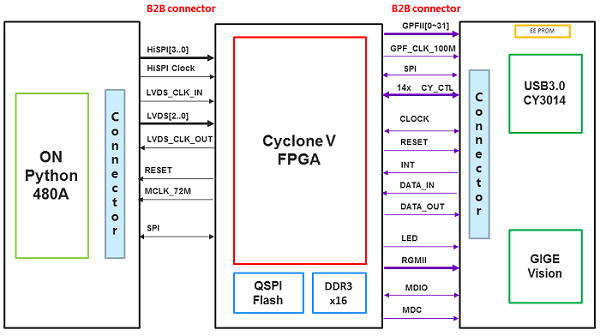
The functional block diagram (below) shows the signal flow from sensor to host:
- The PYTHON 480A outputs raw Bayer data over LVDS to the Cyclone V FPGA.
- The FPGA's ISP pipeline processes the raw frames — debayer, color correction, sharpening — and writes the results to DDR3 frame buffers.
- For USB 3.0 output, completed frames are streamed from DDR3 through the GPIF II interface to the CYUSB3014, which presents them as a USB Video Class (UVC) or bulk-transfer device on the host.
- For GigE Vision output, the FPGA's integrated MAC and an external PHY implement the GigE Vision / GenICam protocol stack, delivering frames over standard Cat5e/Cat6 Ethernet — providing up to 100 m cable runs without active repeaters.
USB 3.0 vs. GigE Vision: Interface Trade-offs
| USB 3.0 | GigE Vision | |
|---|---|---|
| Max bandwidth | ~400 MB/s practical | ~125 MB/s (1 GbE) |
| Cable length | ≤ 5 m (standard) | ≤ 100 m |
| Protocol standard | UVC / bulk | GigE Vision (AIA) |
| Power over cable | Yes (up to 900 mA) | No (requires PoE or local PSU) |
| Typical use | Bench inspection, lab, short-run automation | Factory floor, long-distance, multi-camera networks |
USB 3.0 is preferred where high frame rates over short distances matter, while GigE Vision is the go-to for distributed factory automation where cable runs are long and GenICam-compatible host software is already in place.
Summary
This Cyclone V-based module demonstrates a pragmatic industrial camera architecture: an FPGA at the centre provides ISP flexibility and multi-interface support, a global-shutter CMOS sensor delivers distortion-free images of moving targets, DDR3 provides adequate frame buffering headroom for up to 2 MP, and the dual USB 3.0 / GigE Vision output capability lets a single hardware design address two major segments of the machine-vision market. The component selection — all industrial-temperature or extended-range parts — also satisfies the long-lifecycle procurement requirements typical of industrial OEM programmes.