Hardware Design of a Parallel Six-legged Robot Based on the Jetson Platform
I. Introduction
With the rapid development of society, robotics technology has been widely applied in various fields of modern society. Mobile robots, with their mobility, are continuously expanding their application scope, and among them, multi-legged robots have developed particularly rapidly in recent years. Typical multi-legged robots are usually equipped with four or more mechanical legs, each driven by multiple joints. While these robots offer high flexibility, they also have drawbacks such as complex mechanical structures, limited load capacity, and higher hardware costs.
This paper designs and develops a novel six-legged robot based on a 6-DOF parallel structure. This robot boasts advantages such as omnidirectional movement capability, high load performance, and high reliability, while also featuring a simple mechanical structure, low hardware cost, and a futuristic design. This type of robot is particularly suitable for indoor environments like museums, science and technology museums, and shopping malls, demonstrating promising application and market prospects. Furthermore, this research holds significant value for expanding the application domains of 6-DOF parallel structures.
II. Hardware Design of the Parallel Six-legged Robot
2.1 Robot Mechanical Structure Design
This six-legged robot adopts a typical 6-DOF parallel structure design, primarily composed of the following components:
- Upper and lower platforms
- Six servo electric cylinders connecting the platforms
- Six support legs with shock-absorbing springs (effectively mitigating mechanical impact during walking)
The robot's main body is made of aluminum alloy, characterized by light weight, high surface finish, and excellent processing performance.
The overall dimensions are:
- Height: 1.15 meters
- Width: 1.25 meters
- Length: 1.35 meters
The large volume design not only ensures structural stability but also enhances visual impact.
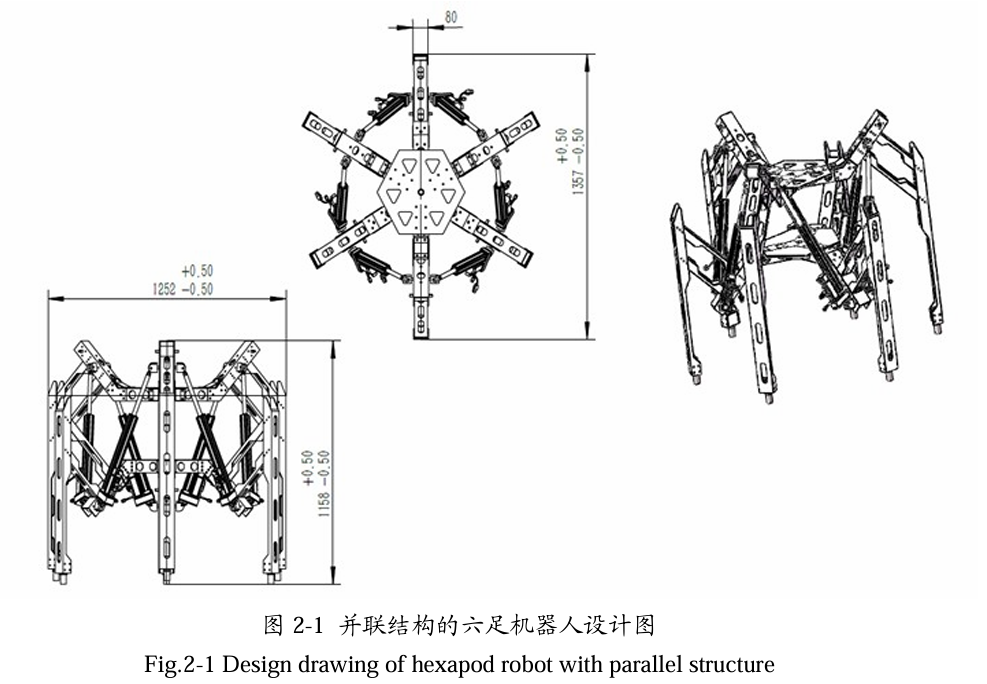
This six-legged robot features a parallel structure design, with six servo electric cylinders articulated to connect the upper and lower platforms. The robot's feet are alternately fixed between the upper and lower platforms, achieving alternating motion through the coordinated action of the platforms, thereby enabling various movement modes such as walking and turning.
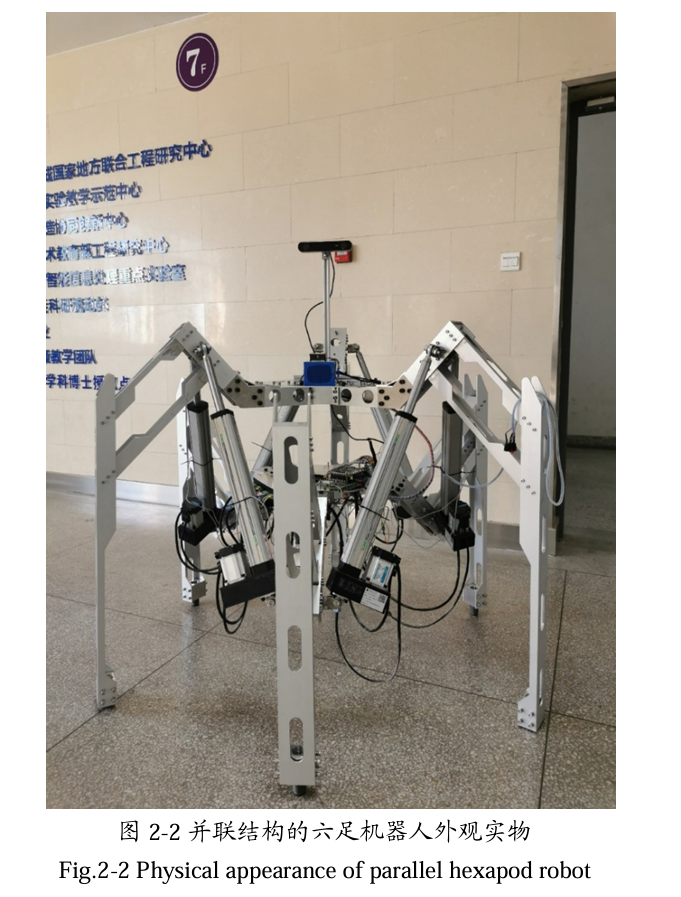
System configuration includes:
- 24V mobile power supply
- Jetson Nano mini-computer
- Main control circuit board
- DC servo drivers
- Servo electric cylinder actuators
- ZED vision camera
After installing the vision camera, the robot's overall height is approximately 1.55 meters.
(1) Upper and Lower Platforms
Both