Fully Domestic Phytium-based PCIe 4.0/5.0 Switch + GPU Expansion Card Solution
As AI inference workloads push server interconnect bandwidth to its limits, system integrators face a familiar bottleneck: how do you fan out a single CPU's PCIe lanes to a full rack of GPUs without resorting to foreign silicon? Shenzhen Xinmai (深圳信迈) has developed a fully domestic solution built around Phytium-compatible infrastructure — a PCIe 4.0/5.0 Switch-based GPU expansion card paired with an NVMe hybrid backplane — that addresses this problem end-to-end while supporting OEM/ODM customization.
The PCIe Switch GPU Expansion Card
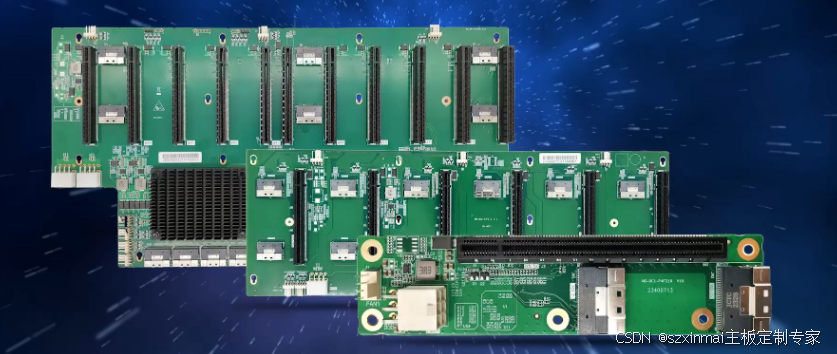
The expansion card sits at the heart of the solution. Its role is to take high-bandwidth PCIe host links from the server CPU and distribute them across a dense array of GPU slots, effectively acting as a non-blocking PCIe fabric within a single chassis. The card's key specifications are:
- 1 direct-connect single-width slot — allows a primary accelerator or NIC to connect to the host with minimal hop latency
- 14× SFF-8654 x4 PCIe 4.0/5.0 host interfaces — the SFF-8654 (SlimSAS) connector carries four PCIe lanes per port at Gen 4 (16 GT/s) or Gen 5 (32 GT/s) speeds; fourteen such ports provide up to 56 PCIe lanes of upstream bandwidth, sufficient to aggregate multiple CPU root complexes in a multi-socket or co-design topology
- 11× PCIe 4.0 x16 downstream slots — each slot can accept a full double-wide GPU, giving the card the capacity to host up to eleven discrete accelerators in a single expansion shelf
- 4× CPU 8-pin power connectors — auxiliary power inputs to the board's own power delivery network, separate from slot power, ensuring stable delivery to the switch ASICs and fan circuitry under heavy GPU load
- 11× 4-pin fan headers — one per GPU slot zone, enabling per-zone thermal management directly from the expansion card rather than delegating all fan control to the host BMC
Why SFF-8654 for Host Links?
SFF-8654 (also marketed as SlimSAS or OCuLink-adjacent in some vendor literature) has become the preferred cable interconnect for high-density PCIe expansion because it packs four lanes into a compact, latching connector that can be routed over a cable run of up to one metre at Gen 4 speeds. Using 14 of these ports rather than a single fat x16 or CXL connector gives system designers flexibility: CPU root port lanes can be distributed across multiple cables, different lane-width CPUs can be accommodated, and failed cables can be isolated without taking down the full fabric. For Phytium-based platforms — which often expose PCIe root ports in groups of x4 or x8 — this granularity maps naturally to the CPU's internal topology.
Switch ASIC Role
Although Xinmai does not name the specific PCIe switch ASIC in the published specifications, the combination of Gen 4/5 support, 14 upstream ports, and 11 downstream x16 slots implies a high-radix PCIe switch with non-transparent bridging (NTB) capability. PCIe switches in this class (from vendors such as Microchip/Microsemi PM9xxx or equivalent domestic alternatives) provide credit-based flow control and virtual channel arbitration so that multiple GPUs can simultaneously DMA to host memory without head-of-line blocking. The domestic emphasis in the product positioning suggests this is paired with a Phytium FT-2000+ or D2000 host, both of which expose PCIe Gen 4 root complexes.
NVMe Hybrid Expansion Drive Backplane
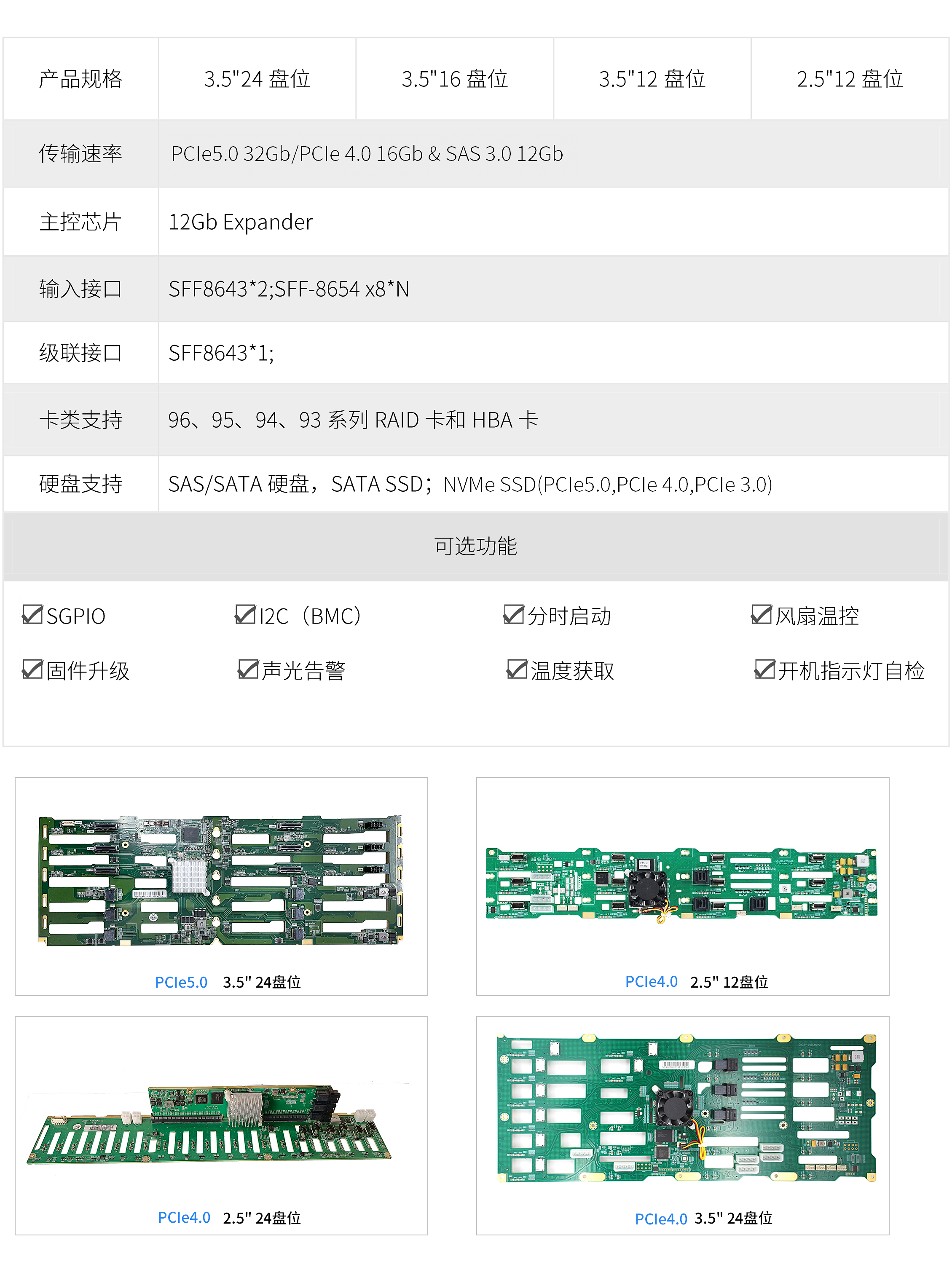
Alongside the GPU expansion card, Xinmai offers a companion NVMe hybrid backplane designed for storage-intensive AI server configurations. "Hybrid" in this context typically means the backplane supports both U.2 NVMe SSDs and traditional SAS/SATA drives through a common physical bay, allowing operators to mix hot storage tiers without separate enclosures.
The backplane's feature set is production-oriented rather than merely spec-compliant:
- Hot-swap drive support — drives can be inserted or removed under power without host reboot, a requirement for any storage system that must maintain uptime during drive replacement or capacity expansion
- Tri-state LED indicators (power / read-write / error) — each bay has individual LED logic covering drive enumeration (power-on), I/O activity (read/write), and fault signaling (error), making it straightforward for a datacenter operator to visually locate a failed or degraded drive in a dense shelf without remote KVM access
- SPGIO drive error reporting — SPGIO (Storage Plane General-Purpose I/O) is a standardized sideband interface used to route drive fault signals to the server's management controller independently of the data path; this ensures that a drive failure is reported to the BMC even if the PCIe data link is degraded
- Staggered drive spin-up — inrush current during simultaneous drive power-on can trip PSU overcurrent protection in high-density backplanes; staggered spin-up sequences drive power-on events over a configurable time window, keeping aggregate inrush within PSU ratings
- Fan temperature control — the backplane incorporates its own thermal zone management, adjusting fan speed based on drive and ambient temperature sensors; this reduces the need for the host BMC to directly manage every fan in the storage enclosure
- I2C (BMC) management interface — a standard I2C bus connects the backplane controller to the server's Baseboard Management Controller, enabling out-of-band monitoring of backplane health, LED state, and fan RPM without a functioning host OS
Domestic Supply Chain and Customization
The "fully domestic" positioning reflects China's broader push toward self-sufficient AI infrastructure. Phytium processors are domestically designed ARMv8-based CPUs produced by Tianjin Phytium Information Technology, used extensively in government and defense-adjacent server deployments where foreign silicon sourcing carries regulatory risk. Pairing a Phytium host with a domestic PCIe switch fabric and backplane closes the supply chain for the full accelerator shelf, reducing exposure to export control restrictions on components like GPU interconnect ASICs.
Xinmai supports OEM and ODM customization on both the GPU expansion card and the NVMe backplane. For system integrators building Phytium-based AI training or inference racks, this means slot count, connector type, power budgets, and management interface protocols can be tailored to a specific chassis or rack unit form factor without requiring the integrator to design the PCIe fabric layer from scratch.
Deployment Considerations
For teams evaluating this solution in an AI server context, several practical points are worth noting:
-
Lane budget planning: 14 upstream SFF-8654 x4 ports at Gen 4 deliver a theoretical aggregate of 224 GT/s upstream bandwidth. Eleven x16 downstream GPU slots at Gen 4 consume up to 176 GT/s at full saturation. Ensuring the host CPU root complex can actually feed the upstream ports — rather than leaving links idle — requires careful PCIe topology mapping at the CPU level.
-
Power delivery: With 11 high-TDP GPUs, the 4× 8-pin auxiliary connectors serve as supplemental board power, but per-GPU power is still delivered through the slot. Chassis PSU sizing must account for both slot power and the expansion card's own switch ASIC and fan overhead.
-
BMC integration: The I2C backplane management interface needs to be mapped into the host BMC's device tree. On Phytium platforms running OpenBMC or a compatible firmware stack, this is typically a matter of adding the backplane's I2C address to the appropriate bus definition in the BMC device tree source.
-
Thermal zoning: The 11 independent 4-pin fan headers allow per-GPU thermal zones, but the fan control algorithm must be tuned to the chassis airflow path. GPU workloads have highly variable thermal envelopes — an LLM inference GPU may run at 50% TDP while a training GPU next to it runs at 100% — and static fan curves will either thermally throttle or generate unnecessary noise.
For procurement inquiries or customization discussions, Xinmai can be contacted directly through their official channels. ☑ OEM/ODM customization services are available for both the PCIe switch expansion card and the NVMe backplane.