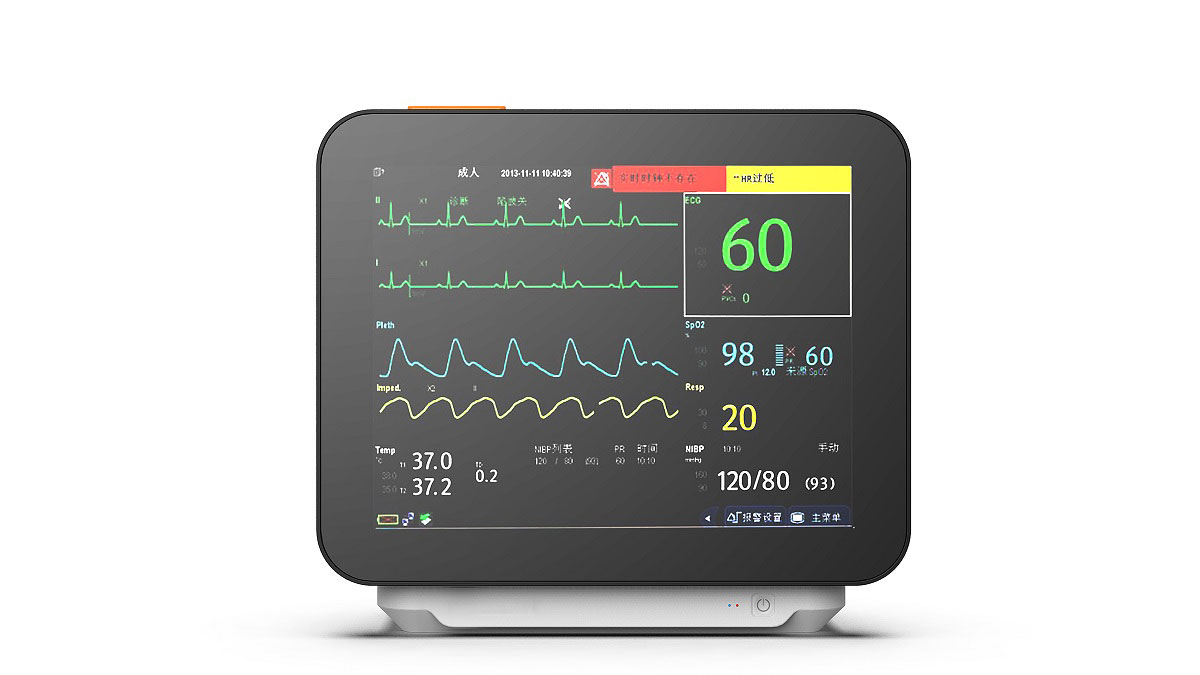
NXP i.MX8M Mini-based Anesthesia Depth Monitor Solution
Anesthesia depth monitoring is one of the most clinically sensitive measurement tasks in the operating room. Under-sedation risks patient awareness during surgery; over-sedation prolongs recovery and increases cardiovascular risk. This post covers Sienovo's hardware solution for a next-generation anesthesia depth monitor built around the NXP i.MX8M Mini SoC, explaining why the processor's heterogeneous architecture is well-suited to the real-time signal acquisition and display demands of this application.
What an Anesthesia Depth Monitor Does
An anesthesia depth monitor continuously acquires physiological signals — most commonly processed EEG (electroencephalogram) derived from frontal scalp electrodes — and computes a dimensionless index that represents the patient's level of consciousness. The most widely recognized index format is the Bispectral Index (BIS), though proprietary algorithms vary by manufacturer. The device must:
- Sample and digitize weak bio-electrical signals with high fidelity (typically μV-range EEG)
- Run signal processing algorithms in real time to suppress artifact (EMG, electrocautery interference)
- Compute and display a continuously updated depth-of-anesthesia index
- Log trends over the duration of a procedure
- Interface with the hospital's patient data management infrastructure
This combination of low-latency hard real-time signal processing and a responsive, clinician-facing graphical interface is precisely the scenario where a heterogeneous multi-core SoC shines.
Core Hardware: NXP i.MX8M Mini
The solution centers on the NXP i.MX8M Mini, a member of NXP's i.MX 8M family targeting multimedia and industrial edge applications. Key specifications relevant to this design:
- Application cores: Quad ARM Cortex-A53 @ up to 1.8 GHz — a 64-bit in-order superscalar cluster well-suited to running Linux or Android with a full GUI stack, data logging, and network connectivity
- Real-time core: One ARM Cortex-M4F @ 400 MHz — a low-latency deterministic core ideal for bare-metal or RTOS-based sensor acquisition, interrupt servicing, and closed-loop control tasks
- Memory: Supports LPDDR4 DRAM and eMMC/SD flash, suitable for storing trend data and firmware
- Display: Integrated MIPI-DSI and parallel LCD interfaces enable direct connection to high-definition touchscreen panels — important for clear waveform rendering and index readout in bright OR lighting
- Multimedia IP: Hardware-accelerated 2D/3D graphics engine (GC NanoUltra + GC320) for smooth UI rendering without burdening the A53 cores
- Power envelope: Designed for low-power embedded applications, which supports battery-backup requirements common in transport monitors
The i.MX8M Mini is fabricated on a 14 nm process and integrates all of these subsystems in a compact BGA package, allowing the core board to maintain a small footprint appropriate for bedside or pole-mounted medical equipment.
Why the A53 + M4 Pairing Matters for This Application
The asymmetric multiprocessing (AMP) architecture divides responsibilities cleanly:
Cortex-M4 (real-time domain) The M4 core runs an RTOS (such as FreeRTOS or Zephyr) and owns the time-critical acquisition pipeline: reading ADC data from the analog front-end, applying digital filtering, and passing processed frames to shared memory via inter-processor communication (IPC). Because the M4 operates independently of the Linux kernel's scheduler, it can guarantee deterministic sampling intervals even when the A53 cluster is busy rendering graphics or handling a network event.
Cortex-A53 cluster (application domain) The four A53 cores run the main operating system and handle the computationally intensive tasks: running the depth-of-anesthesia algorithm on the filtered EEG frames, managing the display pipeline, maintaining trend logs, handling USB/Ethernet connectivity, and running any machine learning inference that may be part of proprietary artifact rejection.
This separation is valuable in a medical device context because it also simplifies the software safety architecture: the real-time acquisition layer on the M4 can be independently validated and isolated from the more complex, higher-attack-surface Linux environment on the A53.
Peripheral Interfaces and System Integration
The solution topology (see diagram above) illustrates how the core board connects outward to the rest of the monitor system. Typical interfaces leveraged on an i.MX8M Mini-based medical design include:
- SPI / I²C: Communication with the analog front-end (AFE) ASIC or discrete ADC used for EEG signal digitization
- UART: Debug console and low-speed peripheral integration
- USB OTG: Firmware update, data export, or connection to a host workstation
- Ethernet (via RGMII/RMII): Hospital network integration for EMR/HIS connectivity
- MIPI-DSI / LVDS: High-definition display output for the bedside touchscreen
- GPIO / PWM: Alarm indicators, backlight control, and button inputs
The block diagram provided with this solution shows the signal flow from patient electrodes through the analog front-end, into the SoC, and out to the display and data interfaces — a complete acquisition-to-visualization pipeline on a single compact platform.
Solution Highlights
Deploying the i.MX8M Mini for this class of medical device offers several practical advantages for device manufacturers:
- Mature ecosystem: The i.MX8M family has broad BSP support under both Linux (NXP's Yocto-based BSP) and Android, reducing bring-up time for the application software stack.
- Long-term supply commitment: NXP targets the i.MX8M Mini at industrial and medical applications and publishes an extended product lifecycle, which is critical for FDA/CE-regulated devices that must maintain component availability for years after market clearance.
- Heterogeneous processing without discrete MCU: Integrating the M4 on-chip eliminates the need for a separate microcontroller, reducing BOM cost and board area while simplifying the overall hardware architecture.
- High-definition display without a discrete GPU board: The integrated graphics accelerator handles smooth waveform and trend rendering, important for the clinician experience in a high-stress OR environment.
Summary
Sienovo's anesthesia depth monitor reference design demonstrates how the NXP i.MX8M Mini's dual-domain architecture — a quad Cortex-A53 cluster for application processing and a dedicated Cortex-M4 for real-time acquisition — maps naturally onto the requirements of a clinical monitoring device. The result is a platform that delivers deterministic signal acquisition, responsive high-definition display, and the connectivity expected of a modern connected medical instrument, all within the power and size budget of a bedside monitor.