Fully Domestic CPCI Loongson 3A-3000 Motherboard
China's push toward domestically designed computing infrastructure has produced some compelling hardware for industrial and defense-adjacent applications. These two CPCI form-factor boards based on the Loongson 3A-3000 processor represent a mature point in that roadmap — ruggedized, thermally specified for harsh environments, and running a fully domestic software stack. This post documents the two available variants and explains the key design choices behind each.
The Loongson 3A-3000 in an Industrial Context
The Loongson 3A-3000 is a quad-core MIPS64-compatible processor (Loongson's own GS464E microarchitecture) manufactured on a 28 nm process. With a TDP that remains manageable in passively cooled or conduction-cooled enclosures, it has become a natural fit for CompactPCI (CPCI) carrier boards deployed in telecommunications, rail, energy, and defense equipment — sectors where supply-chain sovereignty matters as much as raw performance.
CPCI (IEC 61076-4-101) uses the Eurocard mechanical standard with a high-density 2 mm connector backplane, giving integrators hot-swap capability and a proven form factor that has been fielded in rugged systems for decades. Choosing CPCI for a Loongson board signals a target audience of system integrators building multi-slot chassis, not desktop or server deployments.
Variant 1 — 7A1000 Chipset
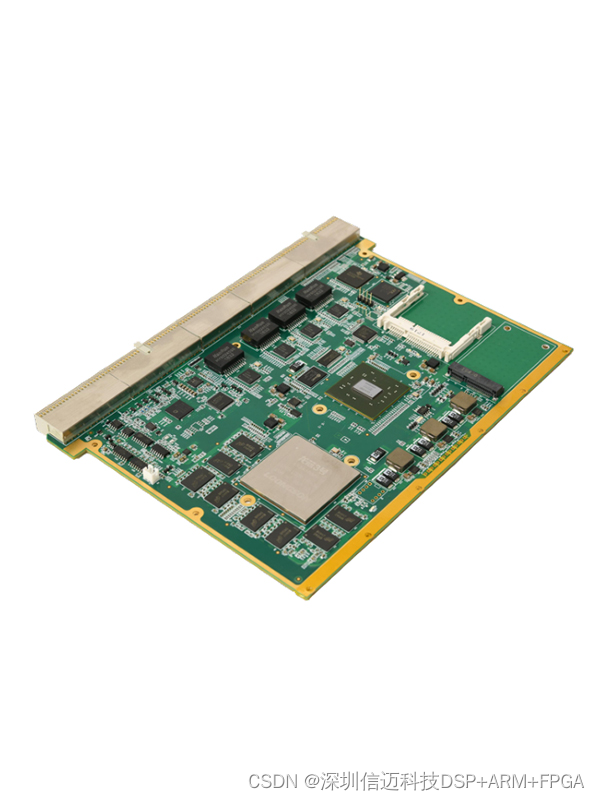
This is the newer of the two designs and pairs the 3A-3000 with Loongson's own 7A1000 bridge chip — a fully domestic SoC-style chipset that handles PCIe, USB, SATA, and display connectivity without any foreign silicon in the critical path.
Specifications at a glance:
| Feature | Detail |
|---|---|
| Chipset | Loongson 7A1000 |
| RAM | 16 GB (international markets) / 8 GB (domestic procurement) |
| Display | 1× VGA + 1× DVI |
| Storage | 256 GB onboard electronic disk |
| USB | 4× USB 2.0 |
| Networking | 4× Gigabit Ethernet |
| OS support | NeoKylin (中标麒麟) |
| Operating temp | −40 ℃ to +65 ℃ |
| Storage temp | −55 ℃ to +70 ℃ |
The memory split between domestic and international SKUs reflects real-world DRAM sourcing constraints in China's procurement environment. The 7A1000 chipset itself integrates display output logic, which is why this variant needs no discrete GPU for standard 2D workloads.
The 256 GB onboard electronic disk (solid-state, likely eMMC or an onboard SATA SSD module) eliminates moving parts and the vibration sensitivity that rotating media would introduce in a CPCI chassis subject to shock and vibration profiles typical of vehicle-mounted or industrial rack installations.
NeoKylin (中标麒麟), maintained by China Standard Software Co., is a Kylin Linux derivative certified for government and defense procurement in China. It ships with MIPS/LoongArch kernel support and a desktop environment suitable for operator workstations, making it a natural software pairing for this hardware.
Variant 2 — RS780E + SB710 Chipset with Discrete GPU
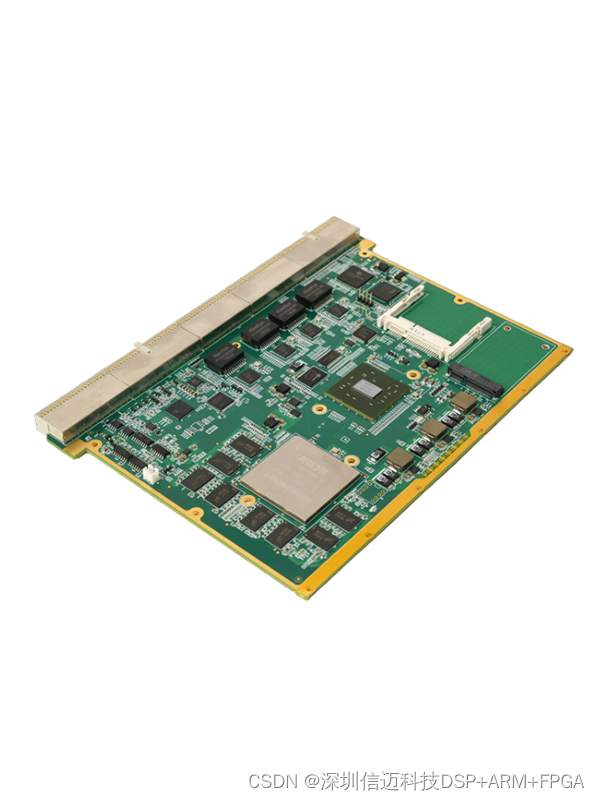
The second design uses an AMD RS780E northbridge paired with an AMD SB710 southbridge — a chipset combination originally developed for embedded and semi-custom applications. While not domestic silicon, this combination was widely qualified for industrial use and offers a proven PCIe and display pipeline.
The significant differentiator here is the addition of an E6465 discrete graphics card. The ATI Radeon E6465 is a low-power embedded GPU (part of AMD's embedded Radeon E6000 series) designed for multi-display industrial applications. Its inclusion here enables a more capable display topology:
Specifications at a glance:
| Feature | Detail |
|---|---|
| Chipset | AMD RS780E + SB710 |
| RAM | 16 GB (international) |
| GPU | E6465 discrete (embedded Radeon) |
| Display | 2× VGA (switchable) + 2× DVI |
| Storage | 256 GB onboard electronic disk |
| USB | 4× USB 2.0 |
| Networking | 4× Gigabit Ethernet |
| OS support | NeoKylin (中标麒麟) |
| Operating temp | −40 ℃ to +65 ℃ |
| Storage temp | −55 ℃ to +70 ℃ |
The switchable dual-VGA outputs are notable for control room or operator console deployments where a single board must drive independent displays for different operators or instrument views. The two DVI outputs add digital signal integrity for higher-resolution panels. Four simultaneous display outputs from a single CPCI slot represents meaningful density for human-machine interface (HMI) applications.
Thermal Specifications and Deployment Suitability
Both variants share identical thermal ratings: −40 ℃ to +65 ℃ operating and −55 ℃ to +70 ℃ storage. These figures align with MIL-STD-810 Grade B environmental profiles and IEC 60068 test conditions common in industrial electronics. The −40 ℃ lower operating bound covers cold-start scenarios in unheated outdoor enclosures or vehicle-mounted equipment in northern climates. The +65 ℃ ceiling is consistent with conduction-cooled CPCI chassis designs where board-level heat is transferred to the card cage rather than relying on forced air.
Choosing Between the Two Variants
- Choose the 7A1000 variant when domestic supply-chain compliance is a hard requirement, display needs are modest (single VGA + DVI is sufficient), or the deployment environment mandates all-Chinese silicon.
- Choose the RS780E+SB710 variant when multi-display HMI capability is the priority — four display outputs from a single slot is a significant advantage for operator workstation and visualization applications — and the chipset provenance is acceptable within procurement rules.
Both boards demonstrate that CPCI-based Loongson deployments are no longer experimental: the 3A-3000 generation is a production-ready platform with mature chipset options, full NeoKylin OS support, and the ruggedized thermal envelope that industrial integrators require.