Hi3519AV100 Processor High-Speed Global Shutter Camera
High-speed imaging has long been a demanding frontier in machine vision: capturing a license plate on a vehicle traveling at highway speed, or freezing the trajectory of a tennis ball at the moment of impact, requires a camera that can deliver sharp frames without motion blur, distortion, or rolling-shutter artifacts. This post introduces a camera module built around the Hi3519AV100 SoC that addresses exactly these requirements — combining a 1-inch global shutter sensor, on-chip AI inference, and high-frame-rate H.264/H.265 encoding in a single compact design.
Why Global Shutter Matters for High-Speed Scenes
Consumer and standard industrial cameras typically use a rolling shutter mechanism: each row of the image sensor is exposed and read out sequentially, top to bottom. When the subject moves faster than the readout time, objects appear skewed or "jello-like" — a well-known artifact in sports footage and traffic enforcement imaging.
A global shutter sensor exposes every pixel simultaneously, then reads the full frame at once. This eliminates rolling-shutter distortion entirely, which is why global shutter designs are mandatory in traffic enforcement, machine vision inspection, and high-speed sports analysis. The 1-inch format used here provides a larger photosensitive area compared to 1/2.9-inch or 1/3-inch sensors common in surveillance cameras, yielding better low-light sensitivity and a higher signal-to-noise ratio — important when imaging at high frame rates where per-frame exposure time shrinks.
Hi3519AV100: The Processing Core
The Hi3519AV100 is HiSilicon's high-performance media SoC targeted at professional IP cameras, traffic enforcement systems, and smart analytics devices. Key characteristics relevant to this design:
- Dual-core ARM Cortex-A53 application processor running the OS and application logic
- Dedicated DSP for image signal processing (ISP), handling noise reduction, wide dynamic range, and color correction in the imaging pipeline
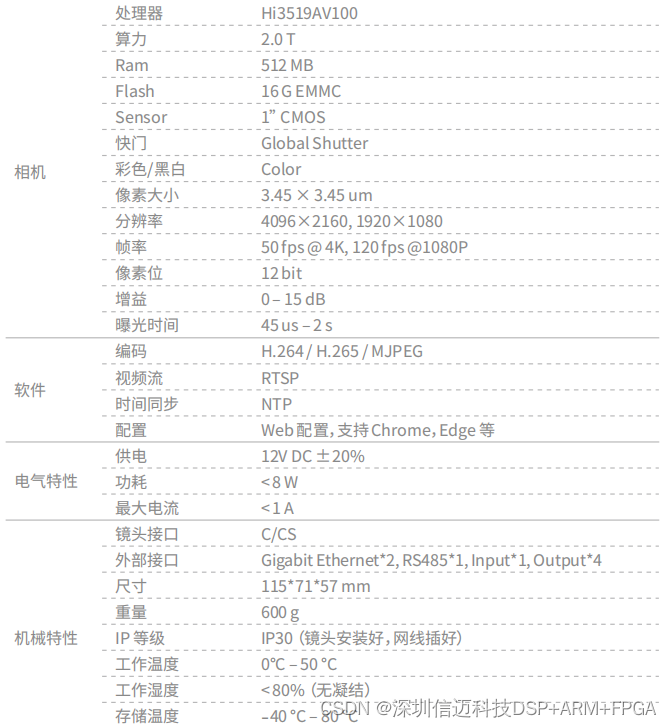
- 2 TOPS Neural Processing Unit (NPU) — an on-chip fixed-function accelerator for deep learning inference. At 2 TOPS (tera-operations per second), it is capable of running CNN-based models such as vehicle detection, license plate localization, and character recognition at real-time throughput without offloading to an external GPU
- Hardware video encoding supporting both H.264 (AVC) and H.265 (HEVC), enabling efficient compression of high-frame-rate streams without burdening the application cores
The integration of a 2 TOPS NPU is the differentiating factor that separates this camera from a conventional high-speed imager. Rather than streaming raw or lightly compressed video to a back-end server for analysis, the Hi3519AV100 enables the device to run inference locally at the edge — reducing bandwidth requirements and end-to-end latency.
Frame Rate and Resolution Modes
The camera supports two primary operating modes:
| Mode | Resolution | Maximum Frame Rate |
|---|---|---|
| 8-megapixel | 3840 × 2160 (approx.) | 50 fps |
| 1080P | 1920 × 1080 | 120 fps |
At 50 fps in 8MP mode, each frame captures roughly 20 milliseconds of scene motion. For a vehicle traveling at 180 km/h (50 m/s), that translates to roughly 1 meter of travel per frame — sufficient for capturing license plate characters without blur when the shutter speed is set appropriately.
At 120 fps in 1080P mode, the inter-frame interval drops to approximately 8.3 milliseconds, and the subject moves less than 42 cm between frames. This mode is well-suited for sports analysis where frame-by-frame breakdown of fast motion is required — tracking a golf swing, a penalty kick, or the path of a ball off a racket.
Both modes output H.264 or H.265 encoded streams, keeping storage and network bandwidth manageable despite the high data rates inherent to high-frame-rate video.
AI at the Edge: On-Device Inference
The 2 TOPS NPU on the Hi3519AV100 enables the camera to run inference workloads that would otherwise require a server-side GPU cluster. Practical applications in traffic enforcement include:
- License plate detection and localization — identifying the region of interest in each frame so that OCR can be applied to the plate characters
- Vehicle classification — distinguishing car types (sedan, truck, motorcycle) for violation reporting
- Violation detection — flagging events such as red-light running or lane violations based on object trajectory analysis
In sports imaging, the NPU can support player tracking, ball detection, and event segmentation (e.g., identifying the moment of ball contact), enabling automated highlight extraction without manual review.
Running these workloads on-device, rather than streaming raw video to a cloud backend, reduces round-trip latency from hundreds of milliseconds to single-digit milliseconds, and eliminates the bandwidth cost of transmitting high-frame-rate streams continuously.
Target Application Scenarios
The combination of global shutter imaging, high frame rates, and on-chip AI inference makes this camera particularly well-suited for:
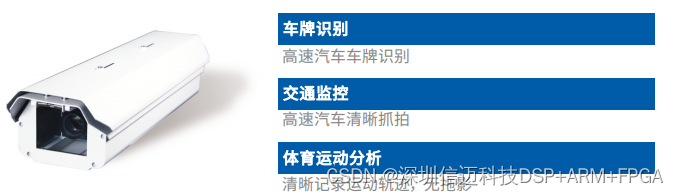
Highway traffic enforcement — License plate capture and recognition at vehicle speeds up to 180 km/h, with no rolling-shutter skew distorting character shapes. The NPU handles plate detection and OCR locally, allowing the device to trigger captures and log violations autonomously.
Vehicle violation detection — Red-light running, illegal lane changes, and speed violations all require short-interval frame capture to reconstruct the event timeline. The 120 fps mode provides the temporal resolution to establish before/after state within a fraction of a second.
Racing and motorsport analysis — Broadcast and technical analysis of racing events benefit from high-frame-rate global shutter video that captures tire contact patches, aerodynamic effects, and wheel motion without distortion.
Ball sports analysis — Tracking fast-moving balls in tennis, baseball, soccer, or golf requires both high frame rates and absence of motion artifacts. The camera's 120 fps 1080P mode, combined with edge-based ball detection via the NPU, enables automated trajectory analysis and event detection.

Summary
This Hi3519AV100-based high-speed global shutter camera delivers a tightly integrated solution for demanding machine vision and traffic enforcement applications. The 1-inch global shutter sensor eliminates rolling-shutter distortion at subject speeds up to 180 km/h; the dual-mode frame rate (50 fps at 8MP, 120 fps at 1080P) covers both high-resolution capture and ultra-smooth motion analysis; H.264/H.265 hardware encoding keeps the output bitstream manageable; and the 2 TOPS on-chip NPU brings license plate recognition, vehicle classification, and object tracking directly onto the device — reducing infrastructure complexity and latency for real-time enforcement and sports analytics systems.