[Domestic NI Alternative] NI-9219 100 S/s/ch, 4-Channel C Series Universal Analog Input Module
Overview
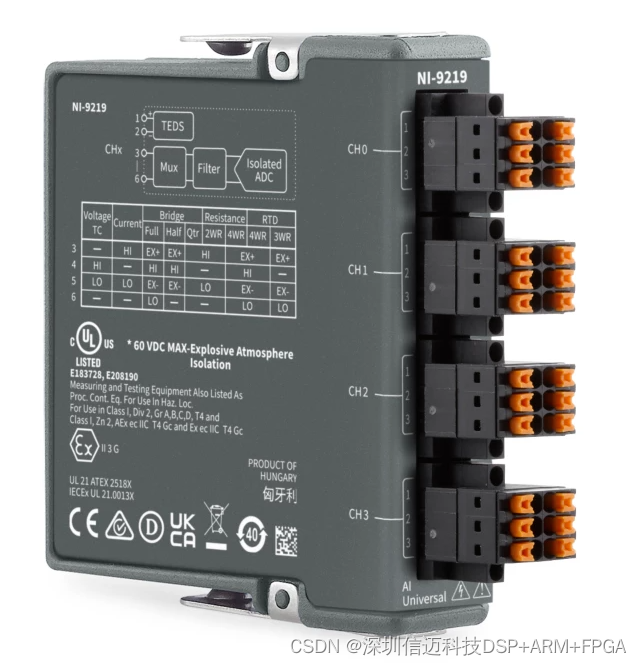
The NI-9219 is one of National Instruments' most versatile C Series modules, purpose-built for engineers who need a single hardware slot to cover a wide variety of sensor types. Rather than committing an entire chassis to one measurement domain, the NI-9219 lets each of its four channels operate independently — measuring a thermocouple on channel 0 while simultaneously reading an RTD on channel 1 and a full-bridge strain gauge on channel 2. This article introduces the module's capabilities and discusses why domestic (Chinese-manufactured) alternatives to this class of instrument are gaining traction in industrial and research applications.
What the NI-9219 Measures
The NI-9219 is rated at 100 samples per second per channel (S/s/ch) — a deliberate design choice. Universal analog input modules like this one prioritise accuracy and flexibility over raw throughput. At 100 S/s/ch the module can resolve slow-moving physical phenomena (temperature, mechanical strain, weight) with high precision, while the low sample rate allows the internal signal-conditioning circuitry to settle fully between conversions.
Supported measurement types include:
- Thermocouples — The module provides cold-junction compensation and supports all standard ITS-90 thermocouple types (J, K, T, E, N, R, S, B). The built-in CJC sensor eliminates the need for an external isothermal terminal block in many lab setups.
- RTDs (Resistance Temperature Detectors) — 2-, 3-, and 4-wire RTD configurations are supported. Built-in current excitation drives the RTD and the module measures the resulting voltage drop, converting it to temperature using the Callendar–Van Dusen equation.
- Strain gauges and Wheatstone bridges — Quarter-bridge (with external completion resistor), half-bridge, and full-bridge configurations are all supported. Built-in voltage excitation supplies the bridge; the module measures the differential output directly.
- Load cells and pressure transducers — These are typically full-bridge devices and benefit from the same built-in excitation and bridge-completion circuitry.
- Other active sensors — Any sensor producing a voltage or current output within the module's input range can be read directly. Current measurement (4–20 mA loops, for example) is supported via a built-in shunt resistor.
Per-Channel Independence
What sets the NI-9219 apart from single-function modules is per-channel programmability. Each channel has its own signal-conditioning path, so you can configure channel 0 as a thermocouple input, channel 1 as a full-bridge strain input with 3.3 V excitation, channel 2 as a 4-wire RTD input, and channel 3 as a ±60 V voltage input — all active simultaneously in a single scan. This is particularly valuable in prototype test rigs and laboratory environments where the sensor mix is heterogeneous and changes frequently.
Built-In Excitation
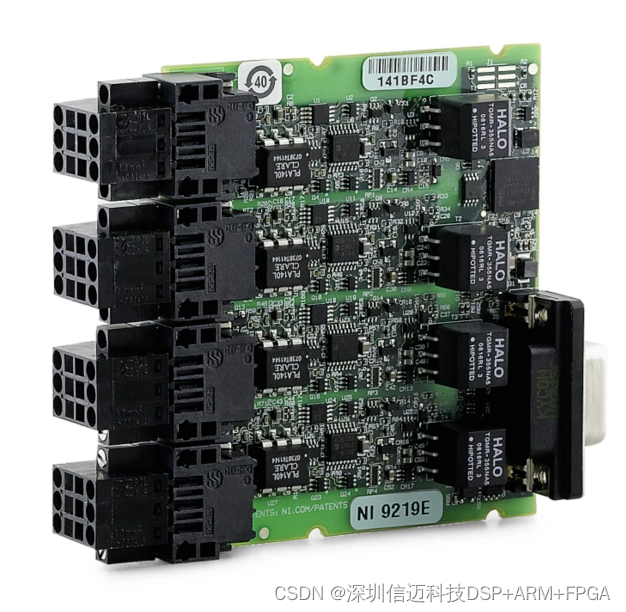
A key hardware feature is the integrated voltage and current excitation source. Passive sensors like RTDs and Wheatstone bridges require a known excitation signal to produce a measurable output. Traditionally this required a separate excitation module or an external power supply with precise regulation. The NI-9219 integrates this directly, reducing channel count, wiring complexity, and overall system cost.
C Series Form Factor and CompactDAQ / CompactRIO Integration
The NI-9219 follows the C Series module standard, meaning it slots directly into any NI CompactDAQ chassis (USB, Ethernet, or Wi-Fi) or any CompactRIO chassis. The chassis provides the backplane power, timing, and synchronisation fabric, while the module handles signal conditioning and analog-to-digital conversion. This architecture makes it straightforward to mix the NI-9219 with other C Series modules — digital I/O, high-speed analog output, counter/timer — in the same chassis.
Domestic Alternatives: Why They Matter
NI C Series hardware is well-regarded but carries a price premium that can be prohibitive for high-volume industrial deployments, budget-constrained research projects, or applications where export-control considerations apply. The market for domestic (guóchǎn, 国产) alternatives to NI C Series modules has grown substantially, particularly in China, driven by:
- Cost reduction — Domestic equivalents typically list at a fraction of the NI price for comparable channel counts and sample rates.
- Supply-chain sovereignty — Procurement no longer depends on US export licensing or international logistics lead times.
- Software compatibility — Many domestic vendors provide NI-DAQmx-compatible drivers or LabVIEW VIs, allowing existing test software to run against the replacement hardware with minimal modification.
- Local technical support — Regional distributors and manufacturers can provide on-site support and faster warranty resolution.
When evaluating a domestic NI-9219 equivalent, engineers should verify the following specifications against their application requirements:
| Parameter | What to Check |
|---|---|
| Sample rate per channel | Must meet or exceed 100 S/s/ch for drop-in equivalence |
| Input ranges | ±60 V, ±15 V, ±4 V, ±1 V, ±125 mV — NI-9219 supports all of these |
| Bridge excitation voltage and current | Confirm supported excitation levels match your sensors |
| Isolation voltage | NI-9219 provides channel-to-channel and channel-to-chassis isolation |
| Driver compatibility | NI-DAQmx API compatibility or equivalent SDK |
| Temperature coefficient | Critical for thermocouple and RTD accuracy |
Typical Use Cases
- Structural health monitoring — Attaching strain gauges to mechanical components to track fatigue over time.
- Thermal characterisation — Mapping temperature across a PCB or mechanical assembly using a mix of thermocouples and RTDs.
- Force and torque measurement — Reading load cells on a test bench during product qualification.
- Process monitoring — Reading 4–20 mA current-loop signals from field transmitters in an industrial control system.
- R&D prototyping — Any lab scenario where the sensor mix is unknown at design time and the engineer needs maximum flexibility in a single module slot.
The NI-9219's combination of multifunction measurement, per-channel configurability, and integrated excitation makes it a practical benchmark for evaluating domestic alternatives. A replacement module that matches these capabilities offers engineers a path to lower-cost, locally-sourced instrumentation without sacrificing measurement flexibility.