Overall Software System Solution Design for Semiconductor and New Energy Intelligent Equipment
Sienovo's software system solution portfolio for semiconductor and new energy intelligent equipment spans the full manufacturing lifecycle — from product development and quality assurance through logistics, deployment, and service. This post walks through two core pillars of that portfolio: the Smart Terminal Testing solution and the Hardware & OS Compatibility Testing solution, covering how each is structured, what testing methods are applied, and what measurable outcomes manufacturers can expect.
Solution Architecture
Sienovo's Smart Equipment Business Unit starts from a single design principle: move manufacturing enterprises along the maturity curve from automation → informatization → intelligence. The architecture shown below ties together proprietary information technology, enterprise digitalization tooling, and domain-specific manufacturing knowledge into a single integrated platform that runs across marketing, R&D, manufacturing, and after-sales service.
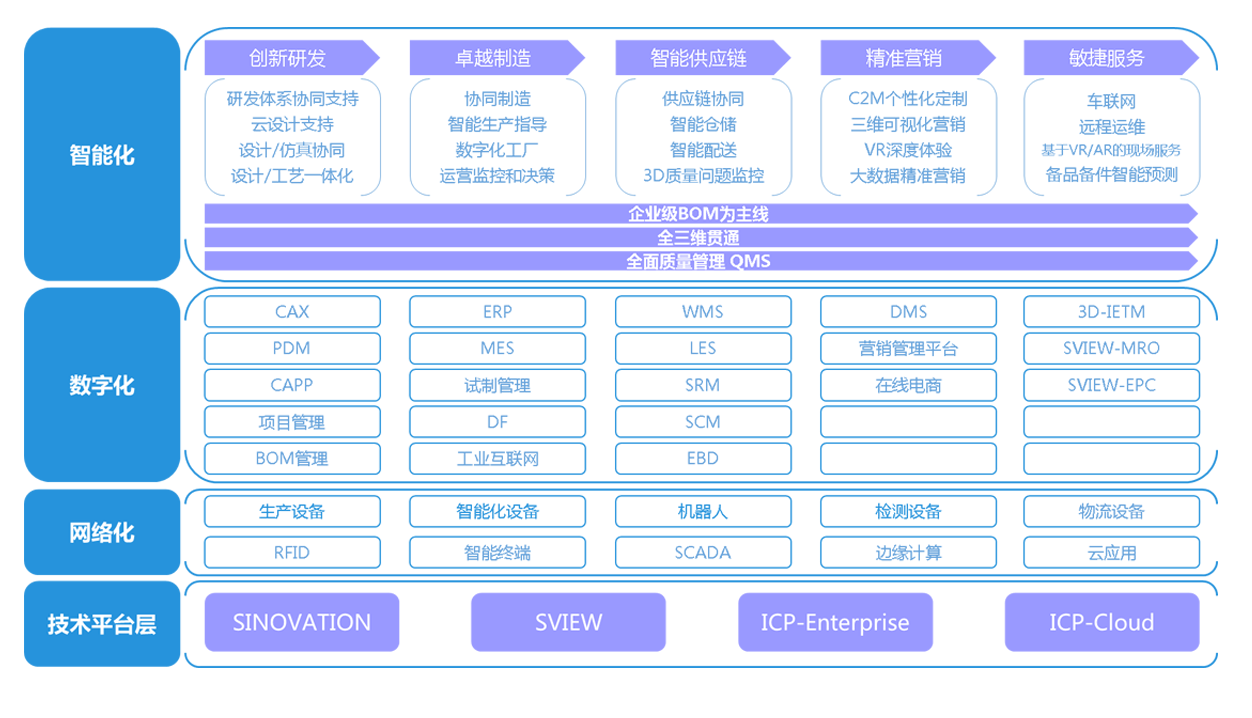
The platform's goals are concrete: reduce or eliminate manual labor on repetitive production and logistics tasks, accelerate defect detection, and improve overall product quality — all while improving working conditions on the factory floor.
Smart Terminal Testing Solution
The Challenge
The 5G era has dramatically expanded the device landscape. Beyond smartphones, modern mobile networks must support smartwatches, fitness bands, smart projectors, home automation hubs, and a growing category of IoT endpoints. At the same time, communication standards are revised continuously, certification requirements from carriers and regulatory bodies are multiplying, and time-to-market pressure is relentless. Terminal manufacturers, mobile network operators, and mobile internet content providers all face rising quality expectations with shrinking test windows.
Testing Methodology
Sienovo's smart terminal testing approach is organized into two tiers:
White-Box Testing White-box methods target code quality and coverage at the source level:
- Static analysis using Checkstyle, PMD, and Findbugs (Java)
- Structured code review
- Unit test coverage via JUnit
- Dynamic analysis
Black-Box Testing Black-box testing covers the full behavioral surface of the device:
- Business function testing
- Protocol conformance testing
- New feature validation
- Performance and stability testing
- KPI measurement
- Third-party application testing
- Localization and globalization testing
- Carrier pre-network entry testing (pre-launch carrier lab validation)
- Carrier acceptance testing
- Carrier-customized application testing
- IoT interoperability testing (IOT)
- Drive testing (field/road test)
- Certification testing
The ODC (Offshore Development Center) lab model is used for close collaboration with terminal OEMs, establishing a dedicated test environment co-managed with the device manufacturer.
Automated Terminal Testing Platform
Manual testing alone cannot scale to cover the full combinatorial space of device models, OS versions, carrier customizations, and application scenarios. Sienovo's automation platform addresses this directly.
The platform is built on the Appium test framework and integrates TestNG and ReportNG, implemented in Java. It natively supports both Android and iOS, and is designed so that test authors do not need to write scripts manually:
- Upload the application package to the platform
- The platform performs automatic UI control recognition
- Test cases are assembled through a simplified control-and-data-validation composition interface
- The backend generates test scripts automatically from the composed cases
- The platform schedules execution on user-specified physical devices
- Structured test reports are generated on completion
The design philosophy is to abstract away framework complexity — encapsulate the technical details, expose only the steps, device selection, and results. This lets QA teams focus on test logic rather than tooling maintenance.
Capability Summary
| Capability Area | Details |
|---|---|
| Team size | 20+ terminal test engineers |
| Platform support | Android, iOS |
| Language coverage | English, Japanese, Korean, and additional languages |
| Client types | Device OEMs, mobile operators, chipmakers, mobile internet service providers |
Service offerings include test management consulting, performance test specialization, security test specialization, test skills training, proprietary test tool development, and test platform construction.
Customer outcomes:
- Reduced time cost through flexible, one-stop outsourced testing
- Lower risk and cost control via comprehensive quality delivery
- Skilled test personnel with customized training for specialized test domains
Hardware & OS Compatibility and Certification Testing
The Challenge
Every data center and cloud computing deployment ultimately rests on large-scale distributed server infrastructure. The server market is fragmented — blade servers, rack servers, high-density configurations, custom boards — and each must be validated against a matrix of operating systems including Redhat, Windows, SUSE, VMware, and Citrix. Without rigorous compatibility certification, failures surface in production, erode customer trust, and create costly remediation cycles.
The performance dimension adds another layer of complexity: next-generation HPC (High Performance Computing) workloads are converging toward ARM architectures and CPU+GPU heterogeneous acceleration platforms, where energy efficiency ratios (currently projected to improve by a factor of 15× to 30×) are as important as raw throughput.
Testing Coverage
Server Hardware and Board Compatibility
- Blade servers, rack servers, high-density configurations, custom-designed boards
- Motherboard-level compatibility across form factors
Component Compatibility
- Network interface cards (NICs)
- Fibre Channel (FC) cards
- GPU cards
- TPM (Trusted Platform Module) cards
- Storage media
OS Certification
- Redhat, Windows, SUSE, VMware, Citrix
- Certification aligned to OS vendor release calendars, including beta-version pre-certification
Performance Testing and Tuning
- Hardware performance benchmarking against industry-standard comparators
- Performance data analysis, solution auditing, and standard compliance
- Profiling and tuning for HPC and mixed-workload environments
Core Technical Capabilities
Sienovo's hardware/OS testing team operates at three layers — hardware, driver, and OS — building a case library of resolved compatibility issues that accelerates future triage. Key capabilities include:
- Automation: Custom-developed compatibility test scripts with ongoing maintenance and operations
- Fast fault localization: Structured methodology for bounding compatibility failures to the correct layer (firmware, driver, OS kernel, application stack)
- Diagnostic tooling: Continuous contributions to hardware fault collection and diagnostic tools used in both pre-sales evaluation and post-sales support
- Lifecycle alignment: Coordinating certification schedules with OS vendor release plans so server certification completes in sync with new OS versions — not weeks behind
Established Partnerships and Track Record
The team maintains active communication channels with all major OS vendors, enabling early access to beta releases and advance knowledge of version roadmaps. Representative past engagements include:
- Full-product-line server compatibility testing and OS certification for a major server OEM
- Server series compatibility and certification for a second server manufacturer
- Communications performance testing for an automotive supply chain system
- Application software performance testing for a biotech customer
Clients served include Huawei and the Barcelona Supercomputing Center (BSC, Spain).
Conclusion
Sienovo's software system solution for semiconductor and new energy intelligent equipment integrates rigorous testing discipline with proprietary automation tooling at every level of the stack. On the terminal side, the Appium-based automated platform removes the manual bottleneck from Android and iOS QA while the structured white-box/black-box methodology ensures protocol conformance and carrier certification readiness. On the infrastructure side, cross-layer expertise spanning hardware, drivers, and OS enables fast, accurate compatibility certification that keeps pace with OS vendor release cadences. Together, these capabilities help manufacturers accelerate time-to-market without trading off quality or compliance.