RK3576+FPGA Energy Storage Coordination Controller for PV, Wind, and Energy Storage
#EmbeddedHardware#FPGADev#Energy#ARMDev#ProgrammersDay
The Energy Storage Coordination Controller is a versatile control device with flexible and customizable logic. It can be tailored with specific control logic according to actual application environment requirements, offering a wide range of applications. It can serve as a coordination controller for new energy stations (photovoltaic, wind power, energy storage), or as a microgrid controller or integrated controller.
Product Features
- Supports a graphical logic configuration tool for on-site visual configuration of device interface signals, processing logic, output control, and fault alarms, as well as program upgrades. Functions can be flexibly customized according to on-site requirements;
- Features multi-channel signal acquisition and multi-channel control output;
- Equipped with various communication interfaces, offering powerful and fast communication capabilities, and fully supporting the IEC61850 standard (including GOOSE);
- The device adopts an integrated design with a fully enclosed rack-mount chassis. Strong and weak currents are strictly separated, significantly enhancing anti-interference capabilities. All electromagnetic compatibility standards meet IEC relay protection levels;
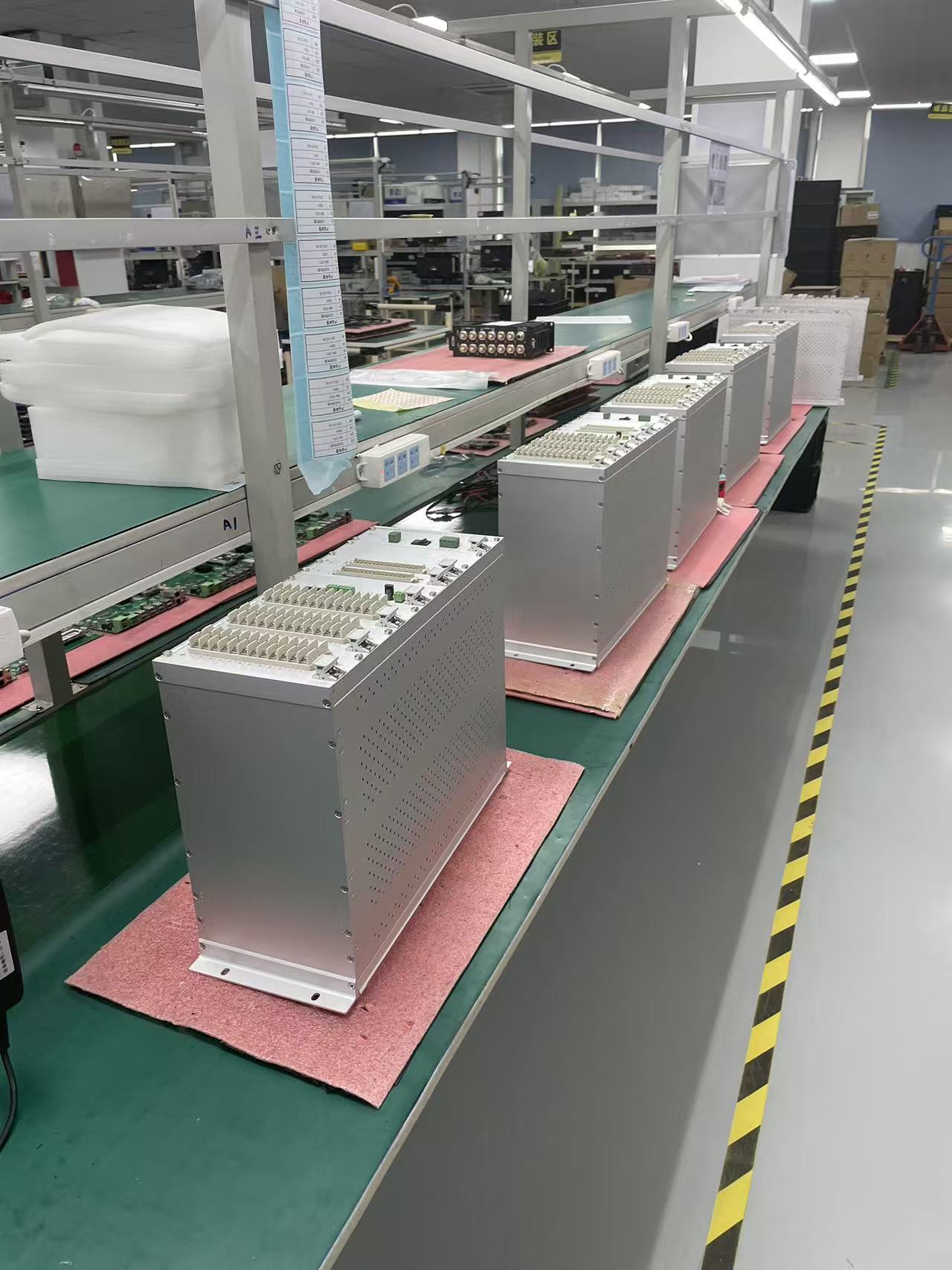
Main Functions
Real-time Acquisition
- Analog Acquisition: Three-phase AC voltage and current acquisition: enables measurement and calculation of voltage, current, active power, reactive power, power factor, and frequency. Up to 24 AC analog quantities can be acquired;
- Status Quantity Acquisition: Acquires signals such as switch status, energy storage, interlocking, and stability control system commands. Tele-signal resolution is no greater than 3 milliseconds. Software debouncing time is settable from 4 to 1000 milliseconds. Up to 120 digital inputs can be acquired;
- DC Power Acquisition: Features up to 16 channels of DC 4~20mA signal acquisition with 3kVDC isolation between channels, suitable for measuring auxiliary control related equipment.
Real-time Control
- Digital Output: Output of control commands. Up to 4 groups of independent start controls are available for DO, with 6 relay outputs per group, totaling 24. All internal logical operations can ultimately output digital signals, and the capacity of the digital output nodes meets control and protection requirements;
Communication Functions
- Communicates with PCS and BMS to acquire data such as active and reactive power for charging/discharging, battery SOC, maximum charge/discharge power, and current operating status;
- Communicates with relay protection, transformer measurement and control, and other devices to acquire relevant data;
- Sends control commands via communication. Fast control commands are sent via GOOSE or other protocols.
Operation Monitoring
- Can monitor electrical quantities such as voltage, current, active power, and reactive power for up to 4 grid-connection points, and monitor information such as the status of an equal number of incoming and outgoing line switches;
- Can record, store, and upload various types of events to the master station, including status changes, remote control operations, and power loss alarms;
- Possesses historical data storage capabilities: including recording load curves for no less than 1 month, no fewer than 256 event records, 256 operation records, and no fewer than 10 device anomaly records;
- Features time synchronization: capable of receiving time synchronization commands from the master station, or various time synchronization commands such as network or pulse signals from local time synchronization devices, maintaining synchronization with the system clock;
- Includes communication monitoring: channel monitoring function for each communication interface of the device.
Relay Protection Functions
- Built-in conventional protection elements such as overcurrent, under/overvoltage, and under/overfrequency, allowing for more complex protection functions through internal logic programming;
- Features PT and CT open-circuit detection functions;
- Includes fault recording (oscillography) function;
- Records various information such as protection self-check, operation, faults, and actions, and uploads it via communication.
Coordination Control Functions
- Primary Frequency Regulation: Based on frequency fluctuations at the energy storage power station's grid-connection point, it autonomously performs millisecond-level rapid and appropriate active power output to support grid frequency;
- Dynamic Reactive Power Voltage Regulation: Based on voltage fluctuations at the energy storage power station's grid-connection point, it autonomously performs millisecond-level rapid and appropriate reactive power output to support grid voltage;
- Precise Load Shedding: Receives precise shedding commands from source-grid-load negative control terminals (hard contact input or communication commands), converts these commands into maximum discharge power or preset power output, thereby supporting the stability control system;
- Peak Shaving and Valley Filling: Charges during off-peak periods and discharges during peak periods. Charging and discharging periods can be arbitrarily set or follow planned curves issued by the dispatch center. Typically, this involves two charge and two discharge cycles per day;
- Receives dispatch commands to implement full-station AGC/AVC functions.