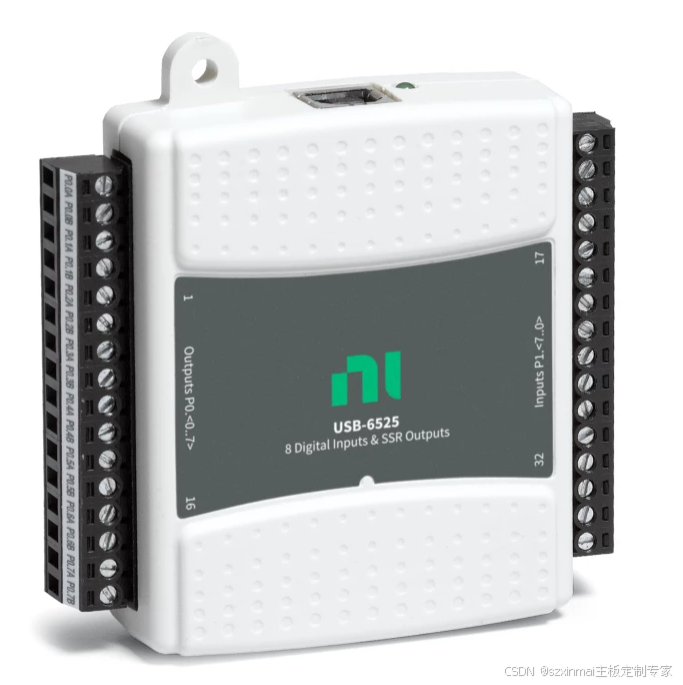
【NI Domestic Alternative】NI USB-6525 16-Channel, 60 V, 8 Solid-State Relays, 8 Inputs, Channel-to-Channel Isolated Digital I/O Device
Overview
The NI USB-6525 is a bus-powered industrial USB digital I/O device designed to bring reliable automation to demanding factory-floor and test-and-measurement environments. This article walks through the device's key specifications, explains how its solid-state relay outputs and isolated digital inputs work together, and discusses what to look for when evaluating domestic alternatives — including the customization services offered by Shenzhen Xinmai (信迈).
Device Specifications at a Glance
The USB-6525 packs a useful combination of outputs and inputs into a single USB-powered package:
| Parameter | Value |
|---|---|
| Total digital channels | 16 |
| Solid-state relay (SSR) outputs | 8 |
| Digital inputs | 8 |
| Max switching voltage | 60 VDC / 30 Vrms |
| Max switching current per channel | 500 mA |
| Isolation | Channel-to-channel isolated inputs |
| Bus power | USB (no external supply required) |
Because the device is entirely bus-powered, it eliminates the need for a dedicated power brick on the bench or in a rack, simplifying cable management in mobile test rigs and field deployments.
Solid-State Relay Outputs
Unlike electromechanical relays, solid-state relays have no moving parts. This gives the USB-6525's outputs several practical advantages:
- Silent switching — no audible click, which matters in noise-sensitive environments.
- Long operational life — SSRs are rated for millions of switching cycles, far exceeding the mechanical endurance of a reed or latching relay.
- Fast switching speed — useful when cycling actuators at higher frequencies than a mechanical relay could reliably handle.
- Reduced contact bounce — eliminates the debounce delay that electromechanical contacts require.
The 60 VDC / 30 Vrms switching voltage and 500 mA per-channel current rating make the outputs directly compatible with a wide range of 24 V DC industrial solenoids, pneumatic valves, small pump coils, and motor starters. For loads that exceed 500 mA, the relay output is typically used to drive an intermediate contactor or solid-state power relay rather than the load directly.
Channel-to-Channel Isolated Digital Inputs
The eight digital inputs are channel-to-channel isolated, meaning each input's ground reference is independent from every other channel's ground reference, as well as from the host PC's USB ground. This is critical in industrial settings where:
- Different field sensors run off separate 24 V loop-powered supplies with floating grounds.
- Ground loops between equipment could corrupt logic-level signals or damage hardware.
- Safety standards require galvanic separation between field wiring and control electronics.
The isolation barrier prevents ground-loop currents from flowing through the input circuitry, which also provides a degree of transient voltage protection — a common failure mode when long cable runs pick up inductive spikes from nearby machinery.
Programmable Power-On States
One often-overlooked feature is the configurable power-on output state. When a PC reboots, crashes, or the USB connection is interrupted, a conventional relay board will default to some indeterminate output state — potentially energizing an actuator unexpectedly. The USB-6525 allows engineers to define the initial relay state in software and store it on-device. On power-up (before any host software connects), the outputs assert the pre-programmed safe state rather than toggling unpredictably. This is a mandatory safety requirement in applications where an unintended output pulse could open a valve, start a conveyor, or actuate a pneumatic cylinder.
Typical Use Cases
Given its specifications, the USB-6525 is well suited for:
- End-of-line functional testers — switching power to DUT rails, simulating digital sensor inputs, and reading back pass/fail signals.
- Small-scale process control — controlling pumps and solenoid valves in a benchtop chemistry or food-processing rig.
- Industrial sensor interfacing — reading PNP/NPN proximity sensors, limit switches, and photoelectric eyes whose supply voltages differ from the host PC ground.
- Lab automation — integrating with NI LabVIEW or LabVIEW NXG via NI-DAQmx drivers, which the USB-6525 natively supports.
Domestic Alternative: Shenzhen Xinmai Customization
For projects where supply-chain localization, cost reduction, or export-control compliance is a requirement, Shenzhen Xinmai (深圳信迈) offers custom board design and manufacturing services that replicate the functional profile of NI USB-6525-class devices. A domestically produced alternative typically targets the same electrical interface (USB bulk transfer, NI-DAQmx-compatible or custom SDK), the same channel count and isolation architecture, and the same SSR output ratings, while using components sourced from domestic or alternative international suppliers.
When evaluating any NI domestic alternative for a production deployment, key checkpoints include:
- Isolation voltage rating — verify the channel-to-channel and channel-to-host isolation voltage meets your safety standard (e.g., IEC 61010-1 CAT II or higher).
- SSR on-resistance and thermal derating — cheaper SSR implementations may have higher on-resistance, increasing heat dissipation at full current load.
- Driver and software compatibility — confirm whether the alternative ships with a LabVIEW driver, a C/C++ SDK, or requires custom integration.
- Programmable power-on state support — not all clones implement this; confirm it is available if safe-state behavior is a system requirement.
- CE / UL / CCC certification — especially important for devices installed inside machinery that must carry a product safety mark.
For teams looking to transition away from NI hardware while preserving their existing test architecture, engaging a vendor like Xinmai early in the design process — before the PCB layout is finalized — allows the isolation topology and connector pinout to be matched to the existing NI wiring harness, minimizing rework on the production line.