PCR Gene Amplification Instrument Solution Based on IMX6ULL+FPGA
PCR (polymerase chain reaction) gene amplification instruments sit at a demanding intersection of precision biology and real-time embedded control. A modern PCR thermal cycler must ramp temperatures with millikelvin accuracy, sustain tight cycle timing across 30–50 amplification cycles, and simultaneously drive a user interface, log data, and communicate results — all within a cost envelope that makes clinical and field deployment practical. This post walks through a hardware architecture that meets those demands by pairing NXP's i.MX 6ULL application processor with an FPGA on a compact, connector-mounted industrial core board.
What PCR Instruments Actually Do
A PCR gene amplification instrument — also called a PCR nucleic acid amplification instrument or polymerase chain reaction nucleic acid amplification instrument — automates the cyclic heating and cooling of a biological sample to exponentially copy a target DNA sequence. Typical applications include:
- Genetic disease screening: detecting whether a sample carries markers associated with hereditary conditions
- Paternity and forensic testing: comparing DNA profiles between individuals
- Gene cloning and research: producing sufficient copies of a sequence for downstream analysis
- Infectious disease diagnosis: identifying pathogen-specific nucleic acid in patient samples (as widely demonstrated during COVID-19 rapid testing deployments)
The thermal cycling profile — typically denaturing at ~95 °C, annealing at 50–65 °C, and extending at ~72 °C — must be executed with high repeatability. Any drift in temperature or timing can cause failed amplification or non-specific products, making the control electronics as critical as the biochemistry.
Why IMX6ULL + FPGA?
The NXP i.MX 6ULL is a single-core ARM Cortex-A7 processor running at up to 900 MHz. It is purpose-built for industrial embedded applications: it integrates a rich peripheral set (USB, Ethernet, multiple UARTs, I²C, SPI, ADC), consumes low standby power, and is available in industrial-temperature variants. Crucially, it runs mainline Linux, which simplifies the development of a graphical user interface, networking stack, data logging, and remote connectivity without the overhead of a full desktop-class SoC.
However, Linux is not a real-time operating system. Precise thermal control — particularly the sub-millisecond PID loop timing required to hit a temperature target quickly without overshoot — benefits from deterministic hardware execution. This is where the FPGA enters the architecture. The FPGA handles:
- Hard real-time PID control of the Peltier or resistive heating elements, isolated from OS scheduling jitter
- High-resolution PWM generation for heater drive circuits
- Synchronous ADC sampling of thermistor or thermocouple feedback at deterministic intervals
- Cycle sequencing and timing, ensuring each denaturing, annealing, and extension step runs to specification regardless of application-layer activity
The i.MX 6ULL communicates with the FPGA over a high-speed parallel bus or SPI/parallel interface, sending set-point commands and receiving status and telemetry. This division of labor — Linux application processor for user-facing logic, FPGA for hard real-time control — is a well-established pattern in medical instrumentation and industrial automation.
Core Board Design
The core board in this solution uses a connectorized (board-to-board connector) design, which is standard practice for industrial embedded modules. This approach offers several advantages over a fully integrated single-board design:
- Replaceability: the core board can be swapped independently of the carrier/baseboard if a higher-performance variant is needed in a future product revision
- Separation of concerns: RF-sensitive and high-speed digital circuits on the core board are physically separated from the noisier power electronics on the carrier
- Reduced NRE cost: a validated core module can be reused across multiple product variants without re-spinning the most complex PCB layers
The solution is described as targeting low-power, low-cost, and compact applications — characteristics well aligned with a benchtop or point-of-care PCR instrument that may run on a regulated DC supply and must fit within a defined instrument footprint. Linux support is provided out of the box, with the option to select cost-optimized core board configurations depending on the feature set required by the specific deployment (e.g., whether HDMI display output, Ethernet, or wireless connectivity is needed).
Solution Topology
The block diagram (shown below) illustrates how the major subsystems interconnect:
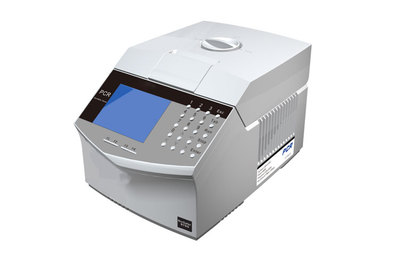
The physical instrument above shows the compact form factor achievable with this architecture — a benchtop PCR cycler with an integrated display and sample block.
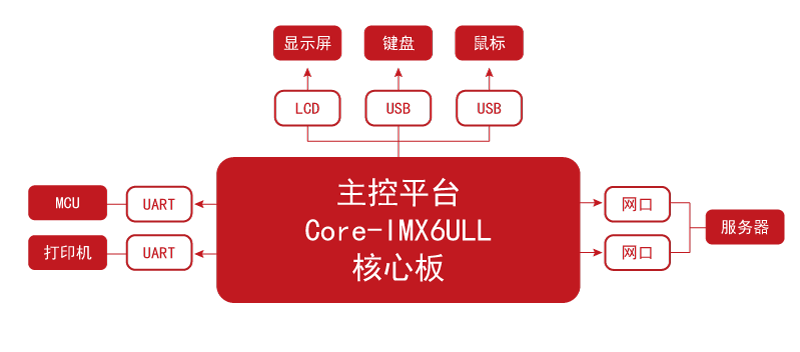
The topology diagram shows the i.MX 6ULL core board as the central processing node, interfacing with the FPGA subsystem for real-time thermal control, display output (HDMI or LVDS panel), storage, and external connectivity — covering both the operator-facing and the precision control planes within a single, cohesive hardware platform.
Design Considerations for Similar Projects
If you are evaluating this architecture for a PCR or similar precision thermal instrument, a few practical considerations apply:
Temperature sensor selection: Thermistors offer high sensitivity in the PCR temperature range but are nonlinear; the FPGA or a dedicated front-end must perform linearization. RTDs and thermocouples require appropriate signal conditioning but may simplify calibration.
Thermal actuator control: Peltier-based designs allow both heating and active cooling (important for fast ramp-down to annealing temperature), but Peltier efficiency is sensitive to drive current and hot-side thermal management. The FPGA's hard real-time PWM control directly determines how well the ramp rate specification is met.
Linux BSP and driver support: NXP provides a well-maintained BSP for i.MX 6ULL, including Yocto and Buildroot layers. For a medical or industrial product, a locked, validated kernel version is typically preferred over tracking upstream, so plan the software configuration management accordingly.
Cost optimization: The i.MX 6ULL's integrated peripherals mean fewer external chips on the carrier board. Selecting the appropriate core board SKU — with or without onboard eMMC, DDR density, or wireless — allows the BOM to be trimmed to exactly what the instrument requires.
This IMX6ULL + FPGA combination offers a practical, proven path to building a PCR instrument that meets both the precision demands of molecular biology and the cost/size constraints of modern medical device development.