FPGA + Actions ARM Solution for VR Video Player with 3D Glasses Display
FPGA + Actions ARM Solution for VR Video Player with 3D Glasses Display
Head-mounted VR video players present a deceptively simple display problem: one video stream must reach two eyes simultaneously, with pixel-perfect synchronization, low latency, and no tearing — all within the tight power and size budget of a wearable device. This post walks through how Sienovo's engineering team solved that challenge using a combined FPGA + Actions (炬力) ARM platform to drive a dual-LCD VR video player capable of real-time 2D/3D switching.
The Core Challenge: One Source, Two Displays
A conventional single-SoC design typically drives one display pipeline. Extending that to two independent LCD panels — each forming one eye of a stereoscopic pair — introduces synchronization demands that software alone cannot reliably meet. Frame timing skew between left-eye and right-eye panels of even a few milliseconds is perceptible as a "ghosting" artifact and contributes directly to motion sickness.
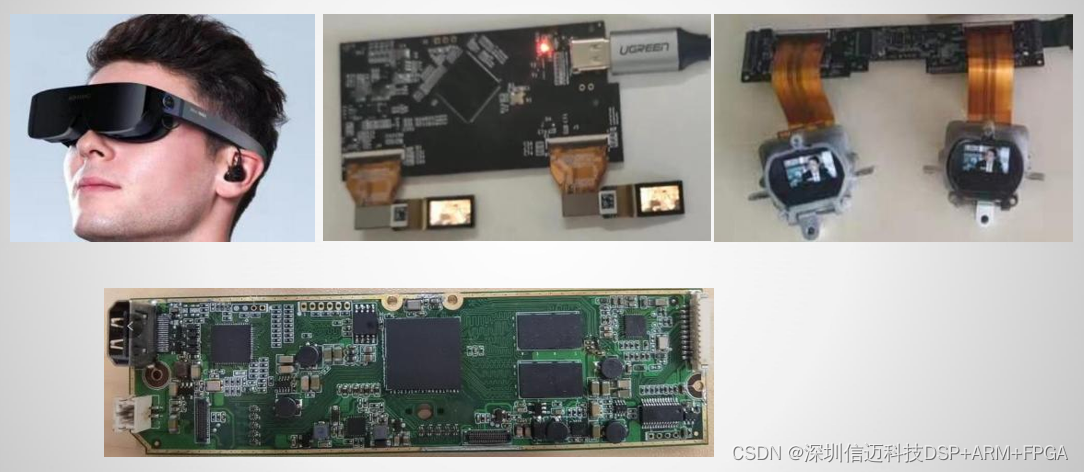
The solution here pairs an Actions ARM application processor (handling media decode, UI, and file system) with an FPGA that takes ownership of the display fabric. The FPGA receives a single video source signal from the ARM SoC and fans it out — or splits it — to drive both LCD panels with hardware-synchronized timing. Because the FPGA controls both display interfaces from a common clock domain, output to left and right panels is guaranteed to be in lockstep, which is essential for a convincing stereoscopic image.
Architecture Overview
Actions ARM SoC (application layer)
- Handles file system access (TF card, USB OTG mass storage)
- Decodes compressed video in multiple formats (H.264, MJPEG, and common container formats)
- Renders the UI overlay for format selection and 2D/3D mode switching
- Outputs a single logical video stream to the FPGA bridge
FPGA (display fabric layer)
- Receives the video stream from the ARM side
- In 2D mode: mirrors the identical frame to both left-eye and right-eye LCD panels
- In 3D mode: splits side-by-side (SBS) or top-bottom (TB) encoded frames — routing the left half to the left-eye panel and the right half to the right-eye panel — while handling any required scaling or line-buffer reordering
- Generates independent VSYNC/HSYNC/DE timing signals for each panel, both phase-locked to the same reference
This clean separation of concerns lets the ARM SoC focus entirely on compute-heavy decode and UI tasks while the FPGA handles the real-time, latency-sensitive display routing — a common and effective pattern in embedded media hardware.
Key Features
1. Multi-Format Video Playback
The Actions ARM platform supports a broad range of common video file formats out of the box, including H.264/AVC in MP4 and MKV containers, as well as MJPEG and AVI. This allows end customers to use standard content without re-encoding for a proprietary format.
2. Real-Time 2D / 3D Effect Switching
A notable design requirement is real-time switching between 2D and 3D playback modes during active video playback — not just at startup. The FPGA's programmable routing logic makes this practical: a mode register is updated by the ARM over a sideband interface (SPI or parallel GPIO), and the FPGA applies the new routing (mirror vs. split) at the next vertical blanking interval, preventing any torn or partially-updated frame from reaching either eye. From the user's perspective, the switch is instantaneous.
3. TF Card and USB Drive File Access
Storage is handled through the Actions SoC's native TF (microSD) and USB interfaces. The firmware presents a familiar file-browser UI, allowing users to navigate directories and select content without proprietary software or a companion app. This is important for consumer-facing VR players where ease of use is a differentiator.
4. Customizable Configuration
The platform is designed for OEM customization. Display parameters (resolution, refresh rate, panel timing), supported format lists, UI skin, and startup behavior can all be adjusted to match a customer's specific panel selection and product requirements — a significant advantage when each VR headset design uses a different LCD module.
Why FPGA + ARM Rather Than an All-in-One SoC?
Purpose-built VR SoCs that integrate a dual-display engine exist, but they constrain the display interface to pre-validated panel configurations. An FPGA bridge gives the design team the freedom to support virtually any LCD panel timing by modifying HDL rather than waiting for a silicon revision. It also provides a path to add future features — such as lens distortion correction in hardware, or hardware-accelerated frame interpolation — without changing the core ARM platform.
For a product line that must support multiple panel variants across different customer SKUs, this flexibility has real commercial value.
Summary
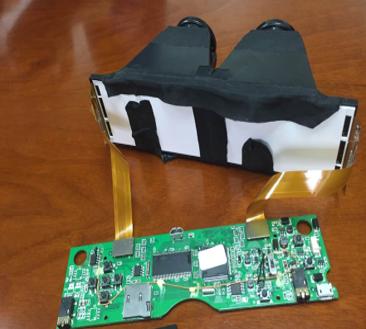
The FPGA + Actions ARM architecture delivers a practical, production-ready solution for VR video headsets: the ARM SoC handles the software-heavy media and storage stack, while the FPGA provides the hardware-guaranteed dual-display synchronization that stereoscopic 3D requires. Real-time 2D/3D switching, broad format support, and OEM-friendly customization make this platform well-suited for consumer VR video players where content flexibility and visual comfort are both critical. If you are designing a similar dual-display wearable and want to explore how this solution can be adapted to your panel and form-factor requirements, contact the Sienovo team for evaluation details.