SMU Source Measurement Unit Platform
A precision Source Measurement Unit (SMU) is one of the most versatile instruments in electronic test and measurement, combining sourcing and measurement capabilities in a single compact package. This post introduces Sienovo's SMU platform — what it does, how it is architected, and where it fits on a modern manufacturing line.
What Is a Source Measurement Unit?
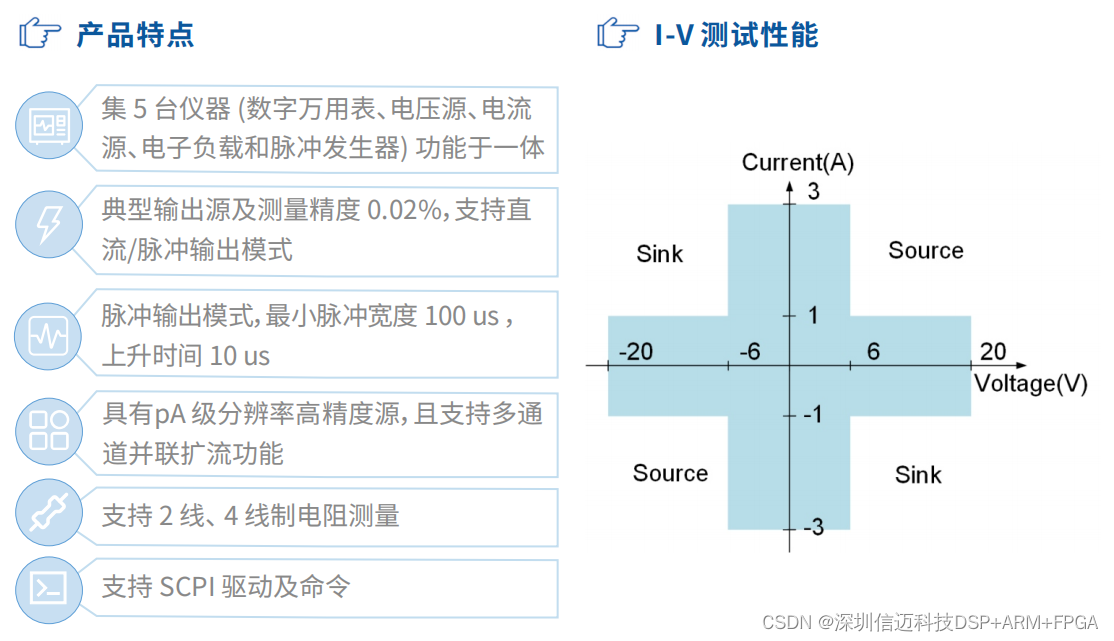
An SMU is an instrument that can simultaneously force (source) an electrical stimulus and measure the resulting response. Unlike a standalone power supply or a standalone multimeter, an SMU operates in all four quadrants of the voltage–current plane:
- Quadrant I — source positive voltage, sink positive current (normal load)
- Quadrant II — source positive voltage, source positive current (active load charging)
- Quadrant III — source negative voltage, sink negative current
- Quadrant IV — source negative voltage, source positive current
This four-quadrant capability means a single instrument can emulate a power supply, an electronic load, or a current source depending on what the device under test (DUT) demands at any given moment — without rewiring the bench.
Integrated Instrument Functions
The Sienovo SMU platform consolidates five traditionally separate instruments into one unit:
| Integrated Function | Typical Standalone Equivalent |
|---|---|
| 6½-digit digital multimeter (DMM) | Bench DMM |
| 5½-digit precision voltage source | Programmable DC supply |
| Precision current source | Current calibrator |
| Electronic load | DC electronic load |
| Pulse generator | Function/pulse generator |
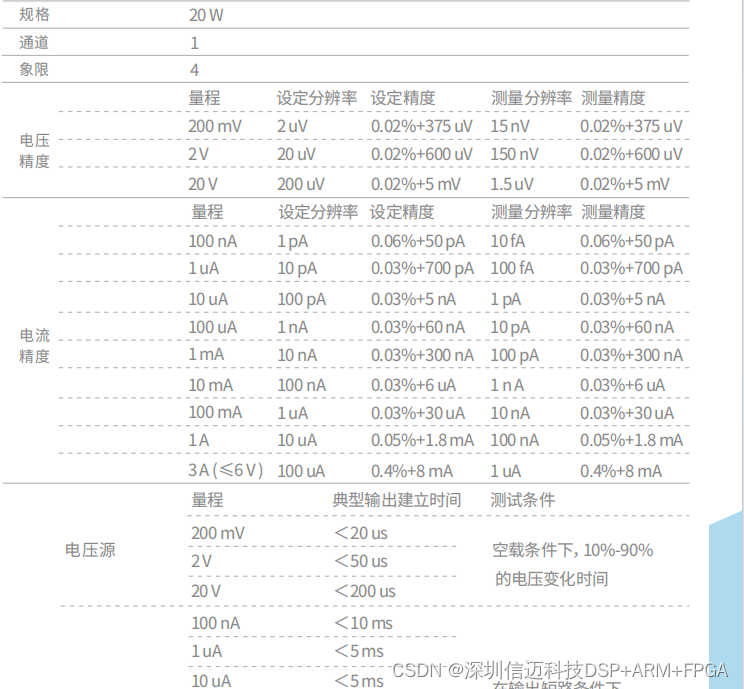
The 6½-digit DMM resolution allows the instrument to resolve signals down to the sub-microvolt and sub-nanoamp range, which is essential when characterizing low-power sensors or leakage currents in semiconductor devices. The 5½-digit voltage source provides tightly regulated output with fine step resolution, important for sweeping bias points on I–V curves.
By collapsing all five functions into a single chassis with a compact footprint, the platform reduces rack space, eliminates inter-instrument cabling (a common source of noise and ground loops), and simplifies software control to a single interface.
Primary Application: IVR Testing
The platform is purpose-built for IVR (Current–Voltage–Resistance) testing of:
- Semiconductors — diode forward voltage, BJT beta curves, MOSFET threshold and on-resistance, IGBT characteristics
- Sensors — resistance-temperature detectors (RTDs), thermistors, Hall-effect sensors, strain gauges
- Modules — power modules, RF front-end modules, MEMS devices
IVR characterization requires sourcing a known voltage or current and accurately measuring the other parameter. Because the SMU does both in one synchronized operation, it avoids the timing skew that occurs when two separate instruments are triggered independently — an important consideration when measuring dynamic or transient device behaviour.
Production Line Integration: ICT and FCT
The platform is specifically designed for automated production-line testing rather than lab bench use. Two test stages benefit most:
In-Circuit Test (ICT) — performed before a board is powered, ICT uses bed-of-nails fixtures to verify component values (resistance, capacitance, inductance) and detect solder defects. The SMU's precision sourcing and measurement capabilities allow it to characterize individual passive and active components in-circuit without removing them.
Functional Circuit Test (FCT) — performed after power-up, FCT validates that the assembled board performs its intended function. The SMU can supply operating bias voltages to specific rails, measure supply current draw (useful for detecting excess leakage or short circuits), and sweep device operating points to confirm parametric limits are met before the unit ships.
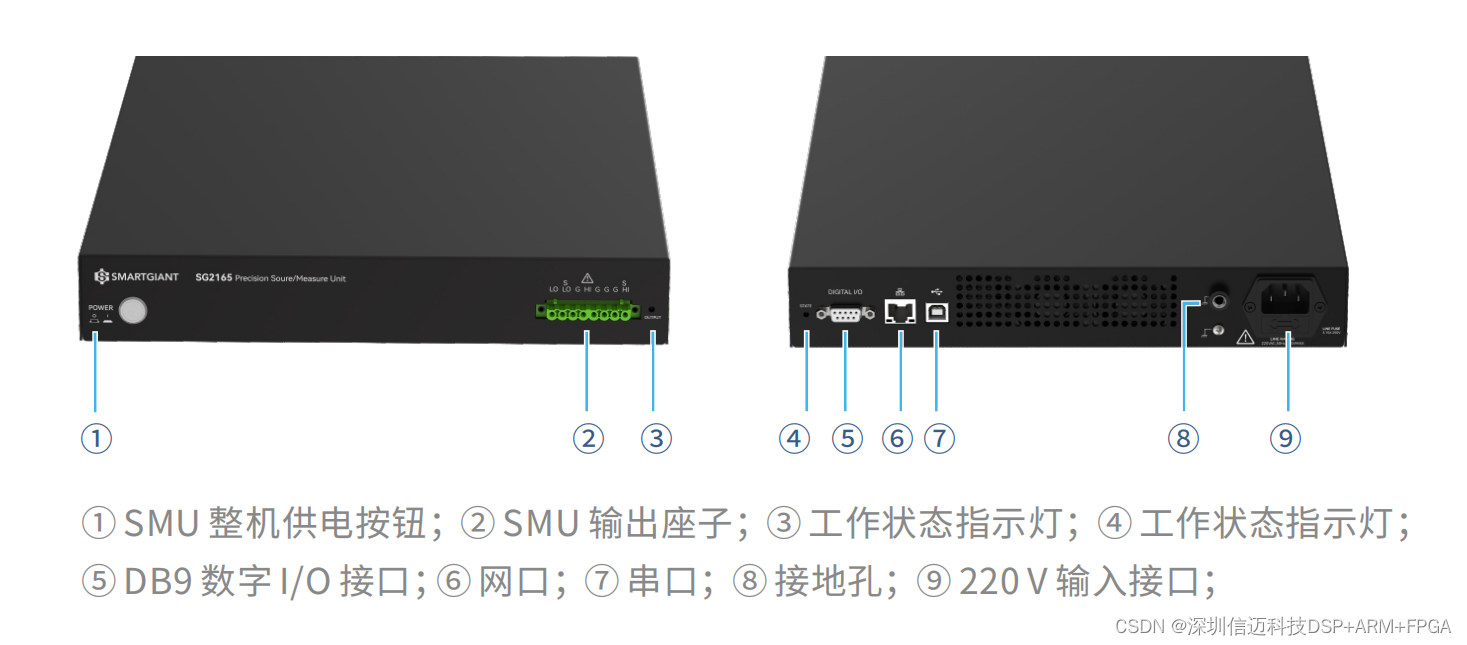
The instrument's standard test interfaces — typically GPIB, USB, LAN, or a digital I/O trigger bus — allow it to be controlled directly by automated test software (LabVIEW, Python with VISA, or proprietary ICT/FCT frameworks) with no manual intervention.
Why Compact Form Factor Matters on the Line
Traditional bench-grade SMUs are large, expensive, and designed for one-at-a-time lab characterization. A production line may require dozens of simultaneous test channels across multiple fixtures. The Sienovo platform's compact size and cost-effective positioning make it practical to deploy at scale — one SMU per DUT slot — without the capital cost of deploying full lab-grade instruments at every position.
The combination of high resolution, multi-function integration, four-quadrant operation, and standard automation interfaces makes the Sienovo SMU platform a practical drop-in solution for manufacturers who need reliable, repeatable parametric testing at production throughput.