AI Edge Computing Box + AI Algorithm Integrated Hardware-Software Solution for Smart Factories
The Case for AI at the Factory Edge
Traditional manufacturing facilities face a familiar cluster of operational challenges: equipment failures that weren't predicted in time, safety incidents that could have been prevented, workers whose attendance and compliance are hard to verify at scale, and production lines where defects slip through until it's too late. These aren't edge cases — they're endemic to the industry. An AI edge computing box paired with pre-integrated AI algorithms offers a practical path to addressing all of them from a single hardware-software platform deployed on the factory floor, without routing sensitive video and sensor data through a remote cloud.
This post walks through the smart factory solution architecture centered on Sienovo's edge AI hardware, covering the specific detection and recognition modules it supports, how they interact in a unified topology, and the measurable operational gains manufacturers can expect.
Why Edge AI for Smart Manufacturing
Cloud-based vision analytics require continuous high-bandwidth uplinks, introduce latency that makes real-time alerting impractical, and raise data-sovereignty concerns for facilities with proprietary processes. An edge computing box running inference locally solves all three: video is processed on-site in milliseconds, no raw footage leaves the facility, and the system continues operating even during WAN outages.
The Sienovo platform bundles the AI algorithms and runtime directly with the edge hardware, so deployment is a matter of connecting cameras, configuring zones of interest, and switching the application on — not standing up a separate inference server or managing a model pipeline.
Quantified Business Impact
Before diving into individual modules, it's worth anchoring the expected return on investment:
- Equipment maintenance cost reduction of 20–40% per year — achieved through predictive maintenance models that detect early-warning signatures in sensor and visual data before a failure event occurs, enabling scheduled intervention instead of emergency repair.
- Production capacity increase of 10–20% — driven by operation-standardization monitoring that flags process deviations in real time, reducing rework, downtime caused by non-conforming work methods, and safety stoppages.
These figures reflect the compounding effect of replacing reactive, manual oversight with continuous automated monitoring across an entire facility.
Solution Topology
The diagram below illustrates how cameras, edge boxes, and the management platform interconnect across a typical factory deployment:
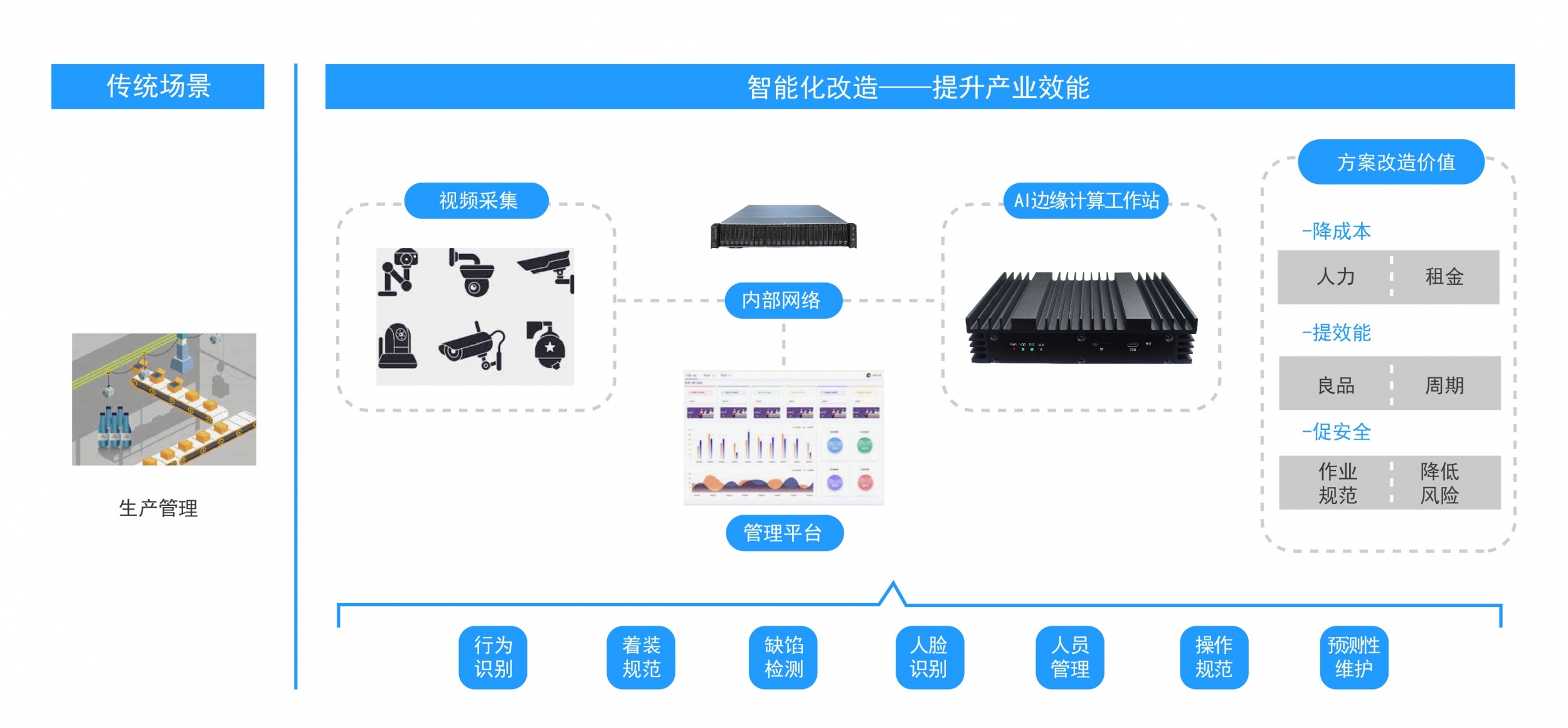
IP cameras distributed across production zones feed RTSP streams into one or more edge AI boxes. Each box runs multiple inference models concurrently, generating structured event data (alerts, attendance logs, defect records) that are forwarded to a centralized management dashboard over the local network. The dashboard aggregates events plant-wide, supports threshold configuration per zone, and can push alerts to operators via SMS, email, or integration with existing MES/ERP systems.
AI Modules Included in the Solution
Attire Compliance Detection
Verifies that personnel entering production areas are wearing required PPE — hard hats, safety vests, gloves, or industry-specific protective clothing. The model runs on each camera frame, triggering an alert when a worker is detected without mandated gear. This removes reliance on manual spot-checks and creates an auditable log of compliance events.
Mask and Shoe Cover Detection
A specialized subset of attire compliance focused on cleanroom or food-safety environments where disposable mask and shoe-cover requirements are strictly enforced at entry points. Camera placement at chokepoints (changing room exits, production floor entrances) lets the edge box serve as an automated compliance gate.
Product Defect Detection
Computer vision models trained on defect classes specific to the customer's product line inspect items on the production line in real time. Defects are flagged and logged with timestamp and camera ID, enabling downstream quality teams to pull defective units before they advance further. Over time, defect logs feed back into model refinement, improving detection accuracy as the model accumulates facility-specific examples.
Face Recognition Attendance Management
Replaces card-swipe or manual attendance systems with camera-based face recognition at entry and exit points. Enrollment is done once; thereafter the system logs arrivals, departures, and zone access automatically. The attendance data integrates with HR or payroll systems, and the same identity pipeline powers on-duty/off-duty detection on the shop floor.
On-duty / Off-duty Detection
Monitors whether assigned personnel are present at their designated stations. When a position is unmanned beyond a configurable time threshold, the system triggers an alert. This is particularly valuable for safety-critical posts — machine operators, hazardous-area monitors — where an unattended station represents a compliance or safety risk.
Production Operation Standardization
Cameras positioned over workstations analyze operator motions and posture against a baseline of correct procedure. Deviations — wrong sequence, missing step, incorrect tool usage — generate real-time alerts to line supervisors. Over a shift this converts subjective "someone should check on that" oversight into objective, timestamped deviation records.
Predictive Equipment Maintenance
Combines visual inspection (vibration-induced jitter in rotating machinery, abnormal heat signatures detectable through compatible thermal cameras) with time-series anomaly detection. The model learns normal equipment signatures during a calibration period, then flags readings that deviate from baseline before they escalate to failure. Maintenance teams receive structured alerts with equipment ID, anomaly type, and confidence score.
Forklift Recognition and Vehicle Intrusion Detection
Detects forklifts and freight trucks operating in or near pedestrian zones. When a vehicle crosses into a restricted area or approaches a pedestrian corridor, the system triggers an immediate alert. This addresses one of the leading causes of serious injury in warehouse and manufacturing environments, where vehicle-pedestrian conflicts are common and often occur faster than manual supervision can respond.
Smoking Detection
Identifies smoking behavior in designated no-smoking areas through visual cues (hand-to-mouth gesture combined with smoke plume detection). Alerts are sent to supervisors in real time, and events are logged for compliance reporting.
Fire and Smoke Detection
Visual fire and smoke detection running at the edge provides an additional layer of early-warning on top of traditional ionization or optical smoke detectors. Camera-based detection is especially useful in large open spaces — warehouses, assembly halls — where point detectors have sparse coverage and response time to a distant detector trip may be slow. The edge box can trigger local alarms directly, independent of network connectivity to any central system.
Deployment Considerations
A typical deployment proceeds in three phases: site survey to identify camera placement for each detection module; edge box installation and network integration; and a model calibration period during which ground-truth labels are collected to tune detection thresholds for the specific environment and lighting conditions. Sienovo's integrated hardware-software approach compresses the calibration phase significantly because the models ship pre-trained on broad manufacturing datasets and require only fine-tuning rather than training from scratch.
For facilities with existing IP camera infrastructure, the edge box integrates via standard RTSP without requiring camera replacement. Multi-box deployments scale linearly — each box handles a defined set of camera streams, and the management dashboard aggregates across all boxes into a single operational view.
Summary
The Sienovo smart factory solution packages eleven distinct AI detection and recognition modules — spanning safety compliance, quality inspection, identity management, equipment health, and intrusion detection — into a unified edge hardware-software platform. By processing all inference locally, it delivers the sub-second response times real-time alerting demands while keeping sensitive operational data on-premises. The documented outcomes — 20–40% reduction in equipment maintenance cost and 10–20% capacity improvement — reflect what manufacturers consistently achieve when continuous automated monitoring replaces the reactive, sampling-based oversight that characterizes traditional production management.