AI Edge Computing Box + AI Algorithm Integrated Hardware-Software Solution for Smart Construction Sites
Construction sites are among the most hazardous work environments in the world, and traditional manual supervision has proven insufficient for managing the full scope of safety risks across large, dynamic job sites. AI-powered edge computing solutions address this gap by deploying real-time computer vision inference directly on-site — eliminating the latency of cloud round-trips and enabling immediate, automated alerts when safety violations occur. This post walks through a hardware-software integrated solution built specifically for smart construction site deployments, covering the detection scenarios it targets, its system topology, and the management platform that ties it all together.
Why Edge AI for Construction Sites
Cloud-based video analytics require video streams to be uploaded continuously, which creates bandwidth pressure and introduces hundreds of milliseconds of latency — unacceptable when detecting a worker without a hard hat near heavy machinery or a fire igniting in a storage area. An edge AI computing box runs inference models locally on an embedded AI accelerator, processing camera streams in real time without dependence on a stable internet connection. This architecture also reduces data privacy exposure, since raw video stays on-site rather than traversing a public network.
Targeted Detection Scenarios
The solution is purpose-built around the most common safety and compliance requirements on construction sites. Each of the following sub-scenarios runs as a dedicated inference module, allowing operators to enable only what is relevant to a given site:
Real-Name Access Management (Face Recognition) — Workers are registered in a personnel database tied to their credentials. The system matches live face captures at entry/exit gates against enrolled profiles, enforcing that only authorized personnel enter restricted zones and maintaining an automatic attendance record.
Hard Hat Detection — A person-detection model combined with a head-region classifier identifies whether workers in camera view are wearing compliant hard hats. Violations trigger instant alerts to site supervisors. This is one of the most universally mandated PPE requirements across jurisdictions.
Reflective Vest Detection — Similar to hard hat detection, this module identifies whether workers in active construction zones are wearing high-visibility reflective vests, a requirement particularly critical in low-light conditions and around moving vehicles.
Perimeter Intrusion Detection — Virtual perimeter lines or zones are drawn over camera feeds in the management platform. Any person or vehicle crossing a designated boundary outside of permitted hours triggers an alarm. This protects both unauthorized civilian entry and controls access to hazardous equipment zones.
Fire and Smoke Detection — A dedicated flame and smoke recognition model continuously monitors feeds from cameras positioned near fuel storage, welding areas, and waste disposal zones. Early detection of ignition or smoke plumes enables rapid response before a fire spreads.
Smoking Recognition — Smoking on active construction sites creates ignition risk near flammable materials. This module detects the characteristic pose and visual signature of a person smoking, flagging the behavior for supervisor review.
Exposed Soil Pile Recognition — Regulations in many regions require bare earthwork stockpiles to be covered or wetted to control dust and runoff. This module detects uncovered soil piles and can trigger compliance alerts when piles exceed a defined area without cover.
Construction Waste Truck (Muck Truck) Recognition — The system identifies waste transport vehicles entering and exiting the site, logging plate numbers and timestamps. This supports regulatory compliance for waste disposal tracking and deters illegal dumping.
System Topology
The solution topology centers on an edge AI computing box connected to the site's camera network. IP cameras across entry points, perimeter fences, active work zones, and storage areas feed H.264/H.265 streams to the box over the local site network. The onboard AI accelerator runs all inference workloads in parallel across streams, with the results pushed to the management platform in real time.

The edge box typically exposes a local API for integration with third-party site management systems and can forward structured event data (violation type, timestamp, camera ID, snapshot) upstream to a cloud dashboard over a low-bandwidth connection — since only metadata and keyframes are sent, not full video streams.
Management Platform
The smart construction site box management platform provides a unified web interface for configuring detection zones, reviewing violation events, managing personnel rosters, and generating compliance reports.
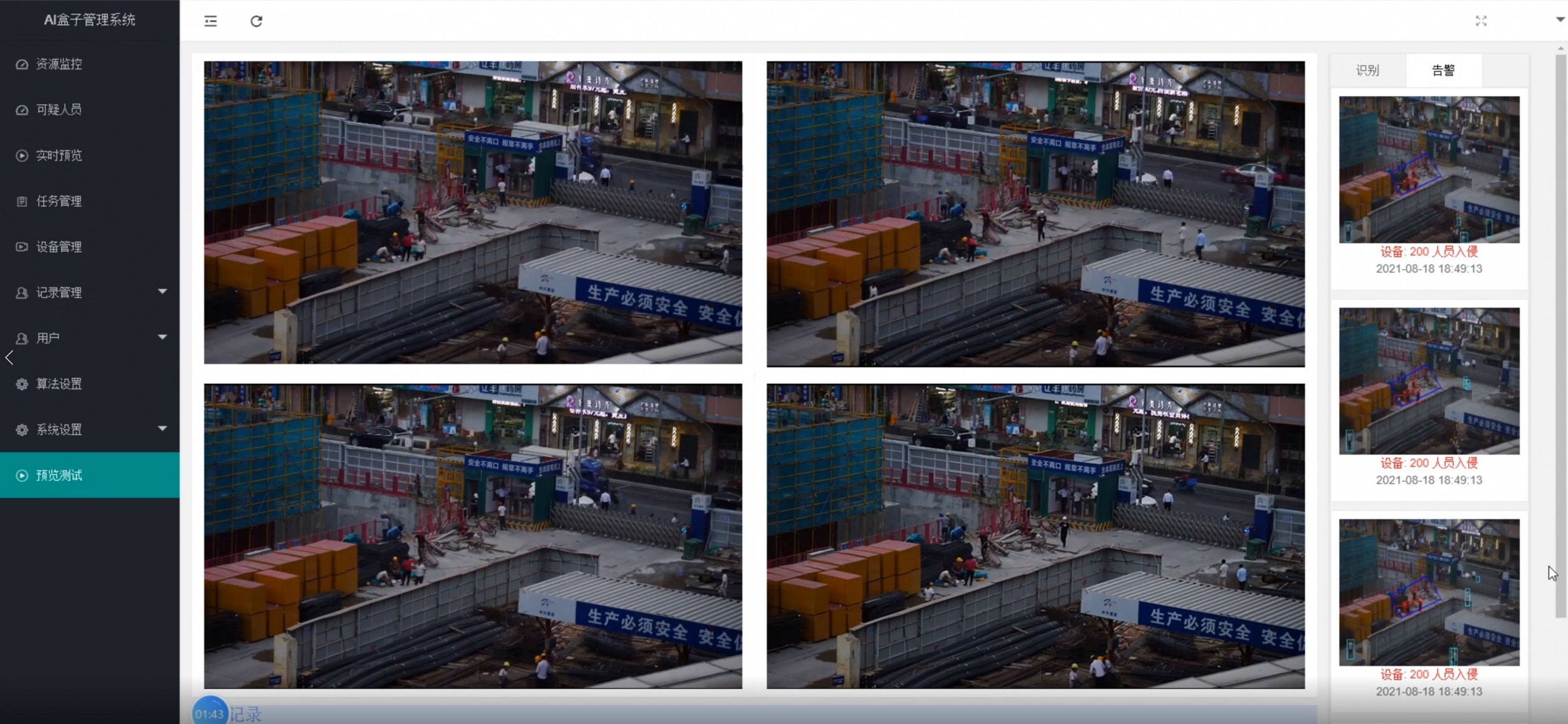
From the platform, operators can:
- Define virtual perimeter zones and alert schedules per camera
- Review time-stamped violation snapshots with the detected category labeled
- Manage worker face enrollment for access control
- Pull attendance and entry/exit logs by individual or by date range
- Configure alert routing — SMS, on-site speaker, or third-party system webhook
Hardware-Software Integration
The key differentiator of a purpose-built solution like this, versus a general-purpose server running the same models, is the tight co-design of the edge hardware and the algorithm package. The AI computing box ships with the detection models pre-optimized for its specific inference accelerator (typically a dedicated NPU or GPU), so operators do not need to manage model quantization, driver compatibility, or SDK configuration. The entire detection pipeline from camera ingestion to alert generation is validated as a unit, reducing deployment complexity on sites where dedicated IT staff are often unavailable.
This integrated hardware-software approach makes AI-powered safety enforcement practical for construction companies of all sizes — from major infrastructure contractors to smaller residential developers — without requiring in-house machine learning expertise.