AI Edge Computing Box + AI Algorithm Integrated Hardware-Software Solution for Smart Power Safety
The power grid is among the most complex and geographically dispersed critical infrastructures in the world. Ensuring safety across generation, transmission, substation, distribution, and retail electricity stages demands real-time monitoring at a scale that human inspectors alone cannot reliably achieve. This post covers how Yingma Technology's edge-AI hardware-software integrated solution addresses that challenge across six concrete power-industry scenarios, using on-device computer vision deployed directly at substations, transmission corridors, and perimeter fences.
Why Edge AI for Power Infrastructure
Power facilities operate in remote locations with unreliable or high-latency network connections. Sending raw video streams to a central cloud for analysis introduces unacceptable latency for safety-critical events such as perimeter intrusion or a worker without a hard hat approaching live equipment. Edge computing boxes that run inference locally eliminate the round-trip and allow millisecond-latency alerts even when WAN connectivity is intermittent. They also reduce bandwidth costs significantly—only structured event metadata and snapshot images need to be transmitted upstream instead of continuous 1080p video.
The three major Chinese power grid enterprises (State Grid, Southern Power Grid, and Inner Mongolia Power Grid) have each embedded AI-powered intelligent inspection and digitalization into their multi-year strategic plans. Yingma Technology's solution is designed to plug directly into those frameworks.
Solution Topology
The architecture follows a three-layer model: edge inference nodes installed at the physical site, a site-level aggregation gateway, and a cloud or data-center management platform. The edge nodes run AI inference on-device, generating structured alarms and annotated snapshots. Those events are forwarded over a private or 4G/5G link to the management platform, which maintains a historical audit trail, generates work orders, and provides a unified dashboard across hundreds of sites.
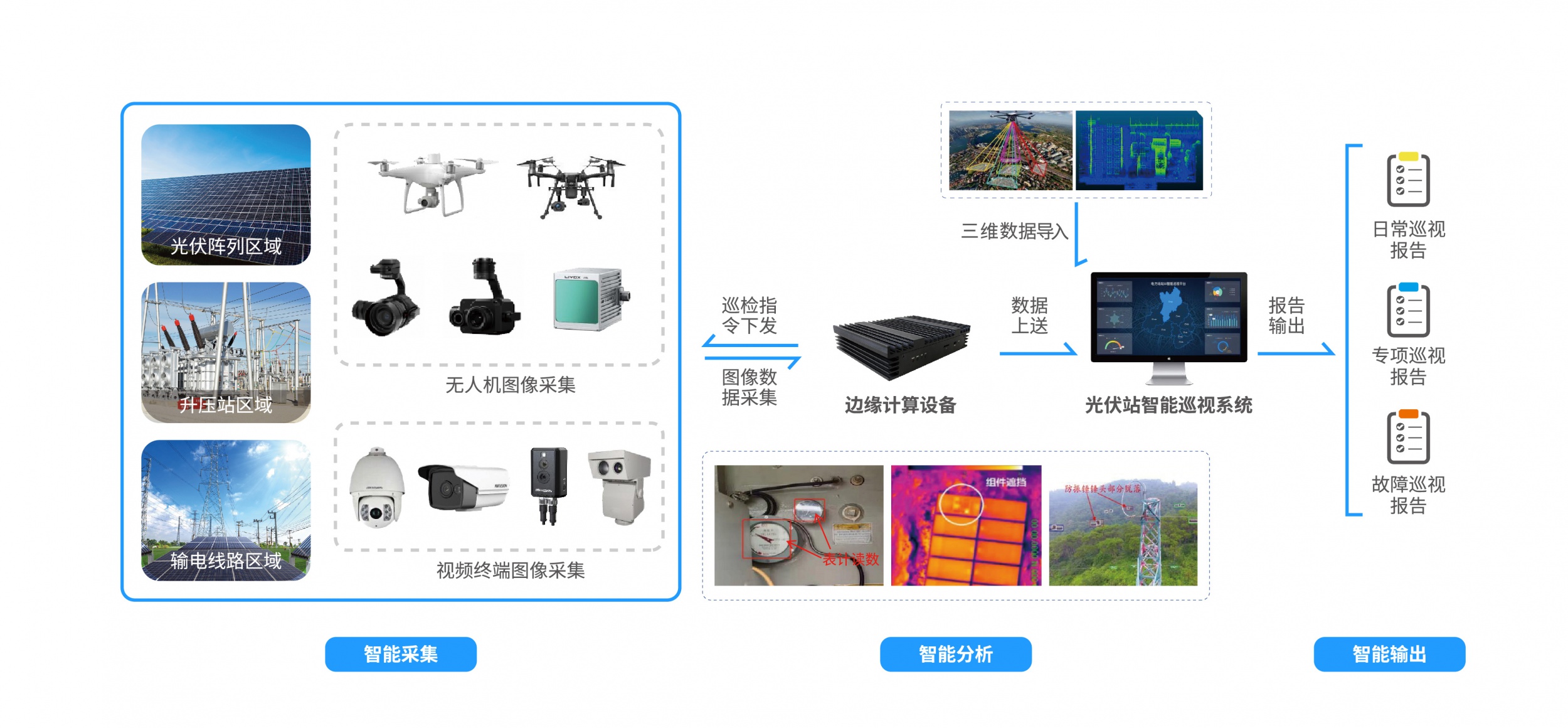
Core Detection Scenarios
Equipment Detection
Industrial equipment on power sites—switchgear, transformers, circuit breakers, insulators—is subject to physical degradation, thermal anomalies, and mechanical faults. Vision-based equipment detection models continuously scan camera feeds for visible defects such as cracked insulators, corroded connectors, or missing protective covers. This shifts maintenance from fixed-interval manual rounds to condition-based alerts, reducing both unnecessary maintenance trips and undetected failures.
Hard Hat and Safety Belt Recognition
Personnel protection equipment (PPE) compliance is a regulatory requirement on all energized work sites. The AI model detects whether workers entering a designated work zone are wearing hard hats and, for elevated work, safety harnesses. A violation triggers an immediate alarm to the site supervisor and logs the event with a timestamped image for compliance documentation. This replaces manual spot-checks with 24/7 automated coverage.
Operation Compliance Monitoring
Beyond PPE, certain high-voltage switching procedures require two-person confirmation, specific tool use, or a defined sequence of physical actions. Computer vision models trained on site-specific workflows can detect whether an operator follows the prescribed procedure—for example, confirming a ground clamp is attached before a switching operation begins. Deviations from procedure can be flagged in real time rather than discovered in a post-incident audit.
Foreign Object Intrusion Detection
Transmission lines and substation yards are attractive nesting and perching sites for birds, and are subject to windblown debris, construction equipment encroachment, and, in some regions, kite or balloon entanglement. Foreign object intrusion detection models identify objects that should not be present within the equipment clearance zone and raise an alert before an arc flash or short circuit can occur.
Perimeter Management
Substation perimeters must be secured against unauthorized human entry at all hours. AI-powered perimeter management combines traditional fence-line camera feeds with deep learning–based person detection to distinguish actual intruders from animals, moving shadows, or swaying vegetation—dramatically reducing the false-positive rate that plagues legacy motion-sensor systems. Alerts include the intruder's location on a site map so security personnel can respond to the correct gate or fence section.
Drone Inspection
For long-distance transmission corridors where deploying inspection vehicles is impractical, drone inspection combined with on-board or edge AI enables automated line patrols. The drone captures high-resolution imagery of tower hardware and conductors; defect recognition models flag items such as damaged spacers, corroded tower bolts, or vegetation encroachment on the right-of-way. Inspection routes can be pre-programmed for fully autonomous operation, with results uploaded to the management platform at the end of each patrol flight.
Bird Nest Detection
Bird nests built on transmission towers and substation structures are a leading cause of flashovers in many regions. Early detection through periodic drone or fixed-camera imagery allows maintenance crews to remove nests during planned outages before they grow large enough to bridge insulator clearances. AI models trained specifically on overhead structure imagery can distinguish nest material from other debris or equipment components with high accuracy.
Hardware-Software Integration
The value of this solution comes from tight integration between the inference hardware and the algorithm software. Yingma Technology ships the AI algorithms pre-loaded and validated on its own edge computing boxes, meaning customers receive a tested, production-ready unit rather than assembling components from separate vendors. The edge box handles video ingestion, real-time inference, alarm generation, and local storage of evidence clips, with no dependency on a cloud API call to produce an alert. This integration also simplifies on-site deployment: commissioning involves mounting the device, connecting it to existing IP cameras, and configuring the management platform endpoint—no model deployment pipeline or GPU driver tuning required on site.
Summary
The smart power solution from Yingma Technology addresses six high-value safety and inspection scenarios—equipment defect detection, PPE compliance, operational procedure verification, foreign object intrusion, perimeter security, drone-based line patrol, and bird nest identification—within a single hardware-software integrated package. By running inference at the edge rather than in the cloud, the solution delivers low-latency alerts in remote and connectivity-constrained environments while reducing bandwidth and data-privacy concerns, in direct alignment with the digitalization mandates of China's major power grid operators.