AI Edge Box + AI Algorithm Integrated Solution for Smart City Management
Smart cities generate enormous volumes of visual data from surveillance cameras installed across streets, parks, waterways, and public spaces. Acting on that data in real time — without shipping every frame to a distant cloud — requires purpose-built AI inference hardware deployed at the edge. Sienovo's AI Edge Box + AI Algorithm integrated solution addresses this need for urban management departments by packaging a ruggedized edge computing platform with a pre-trained vision pipeline that covers more than a dozen distinct urban violation and non-compliance scenarios. The result is a system that can automatically flag incidents as they happen, reduce the burden on human inspectors, and close the feedback loop with the responsible parties far faster than traditional manual patrol workflows.
Why Edge AI for Urban Management
Cloud-based video analytics introduce unavoidable round-trip latency and depend on a stable, high-bandwidth uplink from every camera node. In dense urban deployments — where hundreds or thousands of cameras may be active simultaneously — that upstream bandwidth cost grows quickly, and any network interruption causes a gap in coverage. An edge AI box co-located with a camera cluster performs inference locally, sending only structured event metadata (scene type, GPS-tagged location, timestamp, confidence score, annotated thumbnail) upstream. This dramatically reduces bandwidth consumption, keeps latency under control for near-real-time alerting, and keeps the system operational even during intermittent connectivity.
Edge boxes for outdoor urban deployments must also satisfy strict environmental requirements: wide operating temperature ranges, vibration resistance, dustproof and waterproof enclosures, and reliable power management. Sienovo's platform is designed with these industrial-grade constraints in mind, making it suitable for roadside cabinets, lampposts, and traffic-management hubs.
Solution Architecture
The topology below illustrates how the AI Edge Box sits between the camera layer and the city management backend platform, performing real-time inference and forwarding structured alerts.
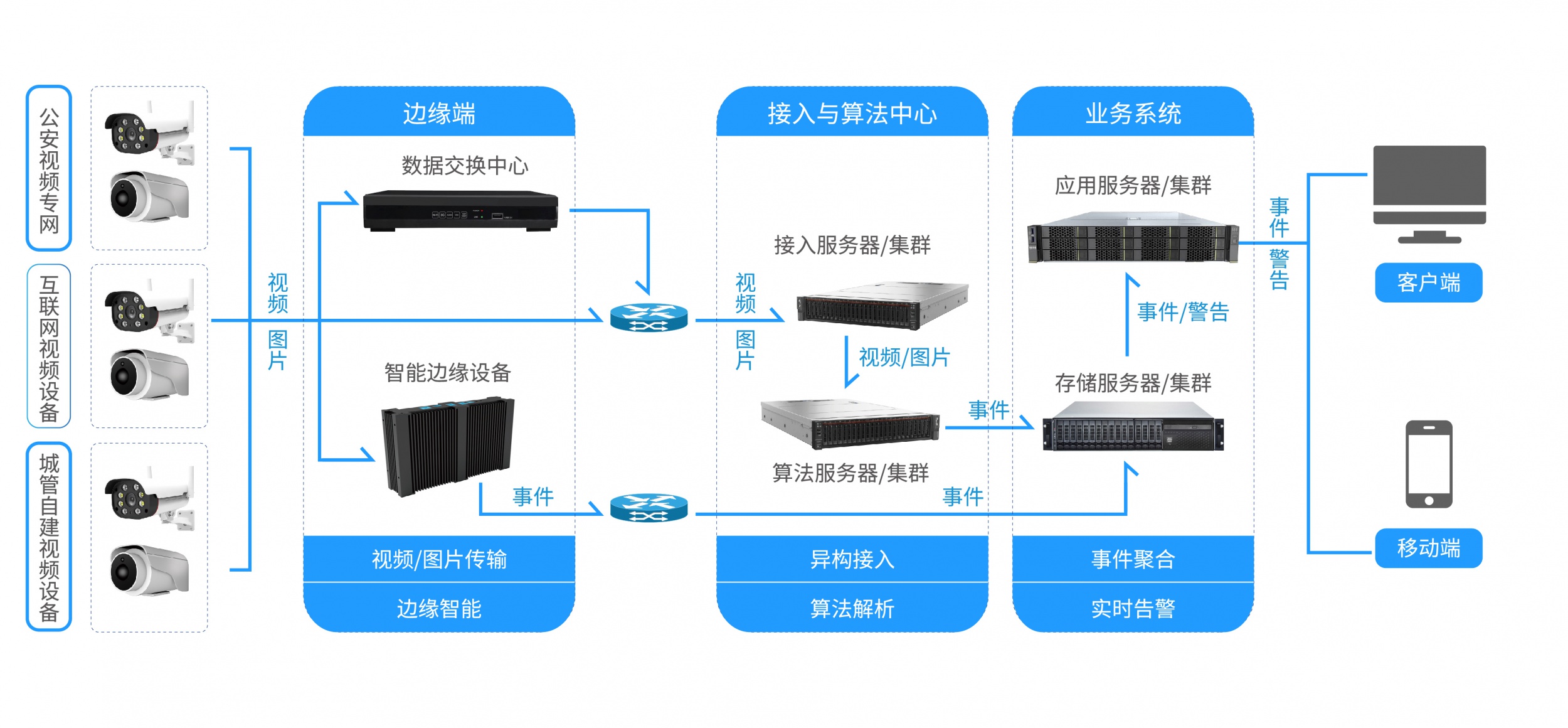
Cameras feed video streams directly into the edge box over local Ethernet or fiber. The on-device AI engine runs multiple detection models concurrently — or sequentially across a scheduling queue, depending on compute budget — and publishes events to the upstream urban management platform via a standardized API. Operators review flagged incidents on a dashboard, issue digital notices to responsible units, and track rectification status. Closed-loop automation means many low-severity violations can trigger automated notifications without human review, enabling the system to scale well beyond what a conventional inspection workforce could cover.
Detected Violation and Anomaly Categories
The solution ships with pre-trained recognition modules for the following scenario types, each targeting a specific pain point in day-to-day urban governance:
Garbage Pile Detection — Identifies illegally dumped waste accumulation on sidewalks, alleys, and open lots before it compounds into a larger sanitation issue.
Billboard Recognition — Detects unauthorized or expired outdoor advertising structures and oversized signage that violates city display regulations.
Banner Detection — Flags illegally hung banners and streamers stretched across roads, fences, or building facades without permit.
Clothesline Detection — Recognizes laundry hung in public-facing areas or on exterior building surfaces where it degrades the streetscape appearance under local ordinances.
Storefront Overstep Detection — Identifies merchants who have extended merchandise displays, seating, or equipment beyond their licensed storefront boundary onto the public sidewalk.
Street Vendor Detection — Locates unlicensed mobile vendors operating in restricted zones, a persistent challenge for maintaining pedestrian flow and fair commercial competition.
Trash Overflow Detection — Monitors public waste bins and flags containers that are full or overflowing so sanitation crews can prioritize collection routes dynamically rather than following a fixed schedule.
Floating Debris Detection in Rivers — Analyzes camera feeds positioned over urban waterways to identify floating garbage, plastic waste, or organic matter that signals a water-quality or drainage event.
Road Surface Damage Detection — Spots potholes, cracking, subsidence, and pavement deterioration so maintenance teams can dispatch repairs before the damage worsens or causes accidents.
Road Waterlogging Detection — Detects standing water accumulation on road surfaces, enabling early warning for traffic management and flood-response coordination during and after rain events.
From Passive Management to Proactive Self-Governance
Beyond the operational efficiency gains, the platform is designed to shift the dynamic of urban management from reactive enforcement toward proactive self-regulation. When responsible units — property managers, business owners, sanitation contractors — receive automated digital notices quickly after a violation is detected, the feedback loop is tight enough that most infractions are rectified before they escalate. Public-facing transparency about where and how violations are being tracked also creates an accountability effect that encourages citizens and businesses to self-monitor, reducing the total volume of incidents over time.
The system supports coverage across urban appearance and environment, street order, publicity and advertising, and municipal facilities — the four core pillars of most city management mandates. By automating routine scene monitoring across all four domains simultaneously, city management bureaus can reallocate human inspectors to complex situations that genuinely require judgment, improving both efficiency and the quality of enforcement outcomes.