Multi-Port Embedded Edge Computing Platform with 11th Gen Intel® Core Processors
Deploying AI inference and data-intensive workloads at the edge demands hardware that balances raw compute power with rugged reliability. Sienovo's multi-port embedded edge computing platform, built around 11th Gen Intel® Core™ processors, is designed to meet exactly that brief — combining modern x86 processing muscle, a dense I/O complement, and a hardened fanless form factor suitable for factory floors, transportation systems, and unmanned field installations.
Processor and Memory
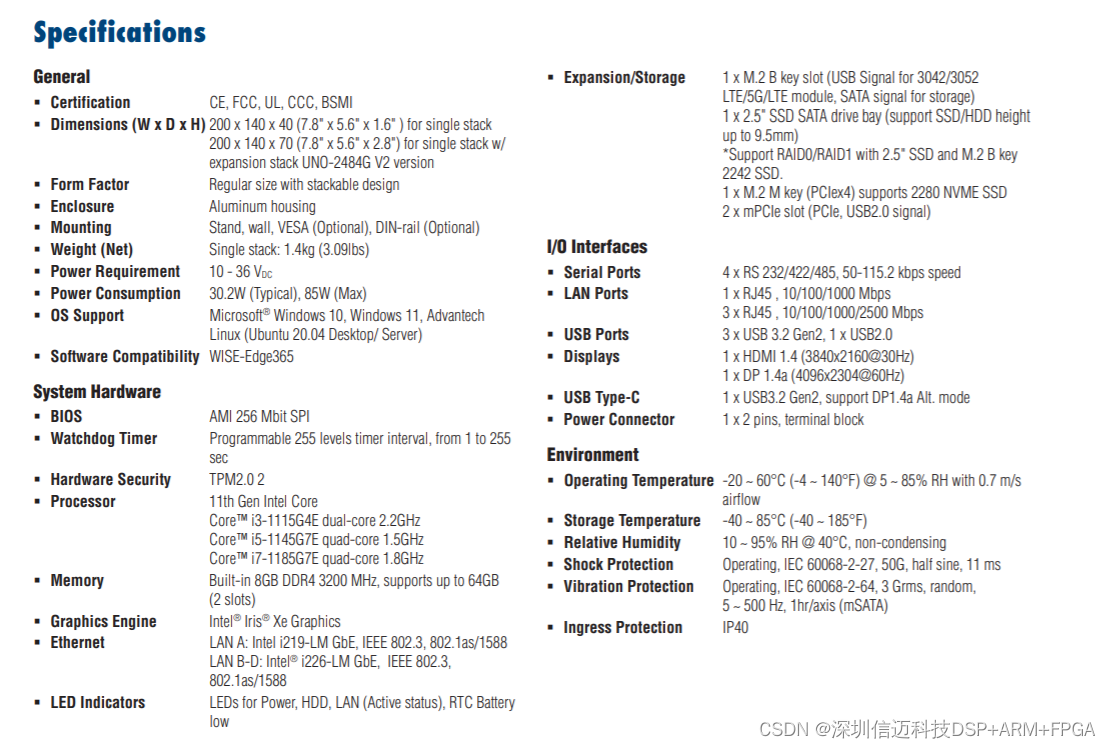
At the heart of the platform sits an 11th Gen Intel® Core™ processor — available in i7, i5, i3, or Celeron® variants — paired with 8 GB of DDR4 memory running at 3200 Mb/s. Intel's 11th Gen (Tiger Lake) lineup introduced the Willow Cove core architecture, which delivered meaningful single-thread IPC gains over the previous Skylake-derived generations. Crucially for edge AI, the integrated Intel® Iris® Xe graphics on Tiger Lake SKUs support hardware-accelerated inference through OpenVINO, enabling object detection, anomaly detection, and other vision workloads without a discrete GPU. Operators can scale performance up or down simply by selecting the appropriate processor tier, keeping the same board layout and peripheral stack.
Connectivity: Built for Industrial Environments
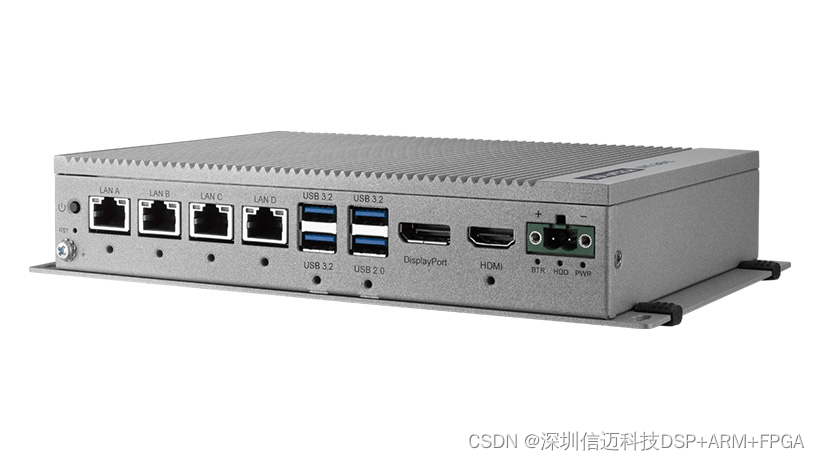
The I/O roster reflects the realities of industrial deployment rather than a typical desktop or embedded single-board computer:
- 4 × Gigabit Ethernet (GbE) — multi-NIC configurations are standard in edge gateways that must simultaneously bridge an OT network (plant-floor equipment) and an IT network (cloud uplink) while keeping traffic isolated. Four ports provide flexibility for VLAN segmentation, link aggregation, or running parallel fieldbus-to-cloud pipelines without a managed switch.
- 3 × USB 3.2 Gen 2 + 1 × USB 2.0 — USB 3.2 Gen 2 tops out at 10 Gb/s, fast enough to stream uncompressed video from industrial cameras or rapidly offload diagnostic data from high-speed sensors. The legacy USB 2.0 port handles lower-bandwidth peripherals like barcode scanners or HID devices without consuming a faster port.
- 1 × HDMI 1.4 + 1 × DisplayPort 1.4a — dual display outputs let operators connect a local HMI panel and an external monitor simultaneously, useful in quality-control stations or central monitoring kiosks.
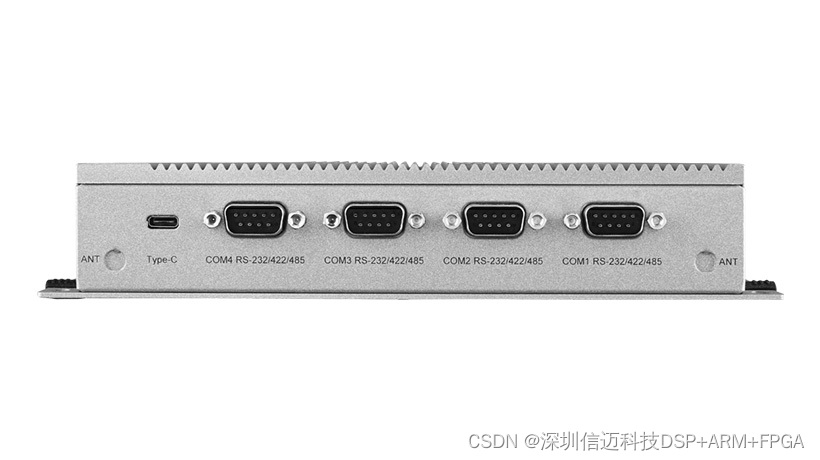
- 4 × RS-232/422/485 — serial interfaces remain the lingua franca of PLCs, motion controllers, barcode readers, and countless legacy instruments. Providing four ports natively eliminates the signal degradation and latency introduced by USB-to-serial adapters.
Modular Expansion via iDoor
One of the platform's most flexible features is the optional second-stack iDoor expansion system. With up to 2 × iDoor slots, integrators can add modules without redesigning the enclosure or adding external boxes. Common iDoor module categories include:
- Wireless connectivity — LTE/5G modems, Wi-Fi 6, or private LoRaWAN gateways for remote sites without wired infrastructure.
- Industrial fieldbus — PROFINET, EtherCAT, CANopen, or Modbus RTU cards that let the platform act as a protocol converter between legacy OT equipment and modern Ethernet-based systems.
- Additional I/O — digital input/output modules for relay control, isolated analog inputs for sensors, or additional serial ports when four RS-232/422/485 channels are insufficient.
This stackable architecture means the base unit can evolve alongside a deployment's requirements — a platform commissioned today as a data concentrator can later gain 5G connectivity or a fieldbus card without hardware replacement.
Fanless, Cable-Free, and Ruggedized
Thermal management through passive cooling (fanless design) is non-negotiable for environments where dust, coolant mist, or vibration would rapidly degrade or clog conventional fans. The enclosure conducts heat away from the SoC through the chassis walls, relying on conduction rather than forced airflow — a well-proven approach in mobile computing and industrial embedded systems.
The zero-cable, lockable I/O design addresses a common failure mode in vibrating environments: connectors that gradually work loose. Lockable connectors on Ethernet, USB, and serial ports physically secure each cable, preventing intermittent disconnections that are notoriously difficult to diagnose in the field. This also reduces maintenance overhead, since technicians do not need to periodically inspect connector seating.
Storage: NVMe for High-Throughput Edge Data
Supporting NVMe storage moves the platform well beyond the throughput ceiling of legacy SATA SSDs (typically ~550 MB/s sequential read). NVMe drives over PCIe can deliver 3–5× higher sequential bandwidth and dramatically lower random I/O latency — critical when logging high-frequency sensor streams, buffering video segments for later upload, or running inference pipelines that read model weights repeatedly from disk. NVMe also simplifies the storage stack by eliminating the AHCI layer, which reduces CPU overhead at the same time.
Customization
Sienovo offers custom configuration options for OEM integrators and solution builders who need tailored SKUs — adjusted memory, specific processor tiers, bespoke I/O labeling, or modified firmware — allowing the platform to ship as a private-label embedded controller rather than a generic off-the-shelf unit.
Summary
This 11th Gen Intel® Core™ edge computing platform occupies a well-defined niche: it provides workstation-class x86 compute (with AI acceleration via Intel Xe graphics and OpenVINO) in a hardened, fanless chassis designed for long-cycle industrial deployments. The combination of multi-GbE networking, native serial I/O, expandable iDoor modules, NVMe storage, and lockable connectors addresses the real integration challenges engineers face when moving AI workloads from the data center out to the production floor or remote field site.